The two adventures included with the STAR FRONTIERS basic game take place on
the large city map. The map shows the downtown area of Port Loren. Areas to the
east, west and south of the map are residential. The spaceport is to the north.
Each square on the map is 5- meters across.
Most large buildings (the Government Building, Pan-Galactic Corporation
headquarters, the Medical Complex, etc.) extend several stories below the ground
as well as two or three stories above the ground. Pedestrian walkways connect
some buildings, and cross above the roads. The monorail is built above the
buildings and walkways.
The cardboard playing pieces must be separated before they can be used. These
counters include characters of all the races. Each player should choose a piece
that resembles his character. There also are counters for vehicles, animals and
strange aliens. Most of these are needed only in the Expanded Game.
STAR FRONTIERS games are played in turns. Each turn is six seconds long, so
there are 10 turns to one minute. Note that game time is not the same as real
time; it might take several minutes to play a sixsecond game turn if a lot is
going on.
During his turn, a character can do any one of the.following things: 1. move
2. fire a weapon 3. move and fire a weapon 4. reload a weapon 5. stand and do
nothing.
Each turn, players must do things in the order listed below.
1. Roll dice to see which side has initiative. A player is not required to move or anack with his character. If the
character moves or attacks, however, it must move or attack at the correct time
during the turn.
At the beginning of each turn, one player from each side must roll 1d10. The
result of this roll is added to the Initiative modifier of the character with
the highest Reaction Speed from that side. Whichever side gets the highest total
has initiative for that turn, which means they get to move and attack first.
If the totals are equal, then neither side has initiative. When this happens,
the side with the highest single reaction speed moves and attacks first,
followed by the other side. However, damage caused by successful attacks does
not take effect until affer both sides have fired that turn (see Combat for more
information).
Players must roll for initiative every turn of every fight.
Characters can move at two different speeds: walkina and running. The
MOVEMENT TABLE shows how many map spaces characters from each race can move in
one turn while walking or running. Moving diagonally is allowed.
2. All characters on the
side with initiative can move.
3. All characters on the side with initiative
can attack.
5. All characters on the side without initiative can move.
6. All characters on the side without initiative can attack.
| Spaces Moved per Turn | ||
| Race | Walking | Running |
| Human | 2 | 6 |
| Dralasite | 1 | 4 |
| Vrusk | 3 | 7 |
| Yazirian | 2 | 6 |
The numbers shown are the maximum distances a character can move at that speed. A Human, for example, could walk 1 or 2 spaces in a turn, or could run 3, 4, 5, or 6 spaces in a turn.
Roads. Crossing a road will slow a character down, because he must dodge traffic. When a character wants to cross a road, he must stop next to it, no matter how ma ny spaces of movement he has left. On the next turn, the character is placed directly across the road, and can move no farther that turn. The character can move normally on the next turn. There is no penalty for running alongside a road.
Pedestrian Walkways. To get onto a pedestrian walkway, a character must enter from one of the ends. A character does not have to stop before crossing a road if he is on a pedestrian walkway. Characters can walk underneath pedestrian walkways without any penalty.
Buildings. A character can enter or leave a building only through a door or from a pedestrian walkway. Characters entering or leaving through a door must stop moving when they reach the door. On the next turn, they can move through the door at their full movement rate. Characters can move about freely inside buildings.
Parking Areas. Characters can move normallythroughparking areas beneath buildings (see Skimmers). Characters must enter and leave parking areas through entrance ramps or elevators in the mall.
Stacking Counters. Only one playing piece can be in a square at a time, unless:
1. The characters are getting on or off the monorail or a skimmer.
2. One of the characters is on a pedestrian walkway and the other is on the ground beneath the walkway.
A character can move through a square that contains another character.
Skimmers are similar to automobiles, but have protected hoverfans instead of
wheels. They float on a cushion of air 30 centimeters (about 1 foot) above the
ground. A skimmer can hold up to five passengers.
Skimmers have a maximum speed of 10 squares per turn, and must stay on the
roads (except when parked). A character can get into a skimmer on the same turn
he moves into the skimmer's square, but the skimmer cannot move that turn. On
the next turn, the skimmer can move up to 3 road squares. It can move its full
10 squares on the following turn.
Skimmers must slow down when they turn or move through an intersection.
(Magnetic field generators built into the roads automatically reduce the speed
of approaching vehicles.) A skimmer can move only 5 squares if it turns or moves
through an intersection during its movement. If a skimmer is in the middle of an
intersection or turning a corner at the start of its move, it can move only 5
squares.
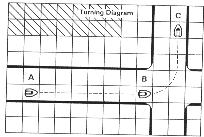
EXAMPLE: A skimmer traveling at a speed of 10 is seven spaces away from a
corner (position A). The skimmer must reduce its speed to seven and stop just
short of the corner (position B). On the next turn it can move five squares and
turn the corner (position C). On the following turn it can move at full speed.
Rental Skimmers. Skimmers can be rented for 10Credits per day. To get
a rental skimmer, a character must move next to the road and signal for one with
his communicator. The skimmer, being driven by a computer, will arrive two turns
later. The charaaer can get into the skimmer on the turn it arrives, but can't
move till the next turn. The character who is driving the skimmer must have his
ID card.
Underground Parking. Most buildings in Port Loren have underground
parking garages for skimmers. Characters must use the entrance ramps to get into
or out of these areas. Skimmers can drive through these areas at a speed of 5
squares per turn or less. Characters can walk or run through these areas at
normal speeds.
Characters are in combat whenever at least one of them is attacking another
in any way. Guns and grenades are the most common weapons. Two of a character's
abilities are important in combat: Dexterity and Stamina. A character's
Dexterity score determines his chance to hit a target. A character's Stamina
score is the number of points of damage the character can take before passing
out.
A character must be able to see his target in order to shoot or throw a
grenade at it. A character can see his target if a straight line from the center
of his square to the center of the target's square is not blocked by a building.
A building does not block a character's line of sight if the character is in a
position where he can lean around the corner to shoot. Monorails, walkways,
trees and other small obstacles do not block the line of sight. The Sighting
Diagram shows several examples of clear and blocked lines of sight.
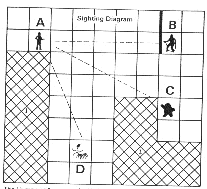
The Human at A can see the Yazirian behind the low wall at 8. If the Yazirian
crouches behind the low wall, he will be completely hidden from the Human. The
Human can not see the Dralasite at C because it is hidden by the corner of
building 2. If the Dralasite was leaning around the corner, the Human could see
it. The Vrusk at D is blocked from the Human'sviewbythe corner of building 1. If
the Human leans around the corner, he can see the Vrusk.
Whenever a character fires a weapon at another character or any other target,
follow this step-by-step procedure.
1. Count the number of squares in the most direct path from the attacker to
the target. Count the square the target is in, but not the square the attacker
is in.
2. Check the WEAPONS TABLE for the weapon the attacker is using. The distance
in squares from the attacker to the target determines whether the target is at
Point Blank, Short, Medium, Long or Extreme range. A target that is beyond
Extreme range cannot be hit.
3. Subtract the Range Modifier for this range from the firing character's
Dexterity score. The Range Modifiers are shown in parentheses beneath the
ranges.
4. If the firing character was running or riding in a skimmer, subtract 10
from the result from step 3.
5. If the target has cover (see Cover), subtract 10 from the result from step
4. This final number is the character's "chance to hit."
6. Roll percentile dice. If the number rolled is less than or equal to the
character's chance to hit from step 5, the character hits the target. If the
number rolled is higher than the character's chance to hit, the character misses
the target. (If the character missed with a grenade, it will go off in another
square; see Grenade Bounces.)
7. If the target was hit, the character who fired checkstheWEAPONS TABLE to
see how much damage his weapon causes. The character rolls the indicated number
of dice and the target subtracts the result from his Stamina.
EXAMPLE: Eusyl is shooting a gyrojet pistol at a target eight squares away.
This is medium range (-20). Eusyl's Dexterity score is 40. Subtracting 20
because of the range gives Eusyl a 20% chance to hit. Dave Schick rolls
percentile dice and the result is 13. This is less than Eusyl's chance to hit,
so she hit the target. Dave rolls 2dlO for damage, and the result is 12. The
target character must subtract 12 points from its Stamina.
1. Find Dexterity.
2. Determine the range to target.
3. Subtract range modifier from Dexterity.
4. Subtract 10 if running or riding in skimmer.
5. Roll d100, if less than or equal to CHANCE TO HIT then you hit. (If
threw grenade and missed check Grenade Bounces.)
6. Roll damage.
When a character throws a doze grenade, hischanceto hit the target is
determined normally. If the percentile dice roll is less than or equal to the
character's chance to hit the grenade goes offwhere the character wanted it to.
If the dice roll is higher than the character's chance to hit. the grenade
bounces into a different square before going off.
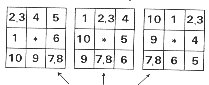
The direction the grenade bounces is determined by rolling 1 d10 and checking
the diagram below. The grenade bounces in the direction shown by the number that
was rolled on the die. The diagrams show grenades coming from several different
directions. If the grenade did not come exactly from one of these directions,
use whichever diagram is closest to the situation.
Grenade Bounce Diagrams The distance the grenade bounces depends on howler it was thrown. The table
below shows how far grenades will bounce if they are thrown from different
ranges:
* Numbers in parentheses are range modifiers,
subtracted from the firing character's Dexterity.
Weapon
Damage
Range (5-meter squares)
Point Blank (0)*
Short (-10)*
Medium (-20)*
Long (-40)*
Extreme (-80)*
Gyrojet Pistol
2d10
---
1
2-10
11-20
21-30
Laser Pistol
1d10
1
2-4
5-10
11-20
21-40
Laser Rifle
1d10
1-2
3-8
9-20
21-40
41-80
Needler Pistol
2d10
1
2-3
4-6
7-12
13-20
Doze Grenade
special**
---
1
2-3
4-5
6-10
** See Damage: Doze
Grenades.

Direction of Throw
* is target
square
| If the Target Was At | Then The Grenade Will Bounce |
| Short Range | 1 square |
| Medium Range | 2 squares |
| Long Range | 3 squares |
| Extreme Range | 4 squares |
A grenade will stop if it hits a wall or other obstacle.
EXAMPLE: Eusyl is throwing a doze grenade from long range. The grenade misses its intended square. Dave Schick rolls 1 d10 and gets a 5. The grenade bounces 3 squares directly to the right of the target square. and then goes off. If anyone was in that square, theywould be knocked out by the gas.
The effect of a doze grenade is described under Damage.
Automatic Hits
A roll of 01 to 05 always is a hit, regardless of mod)fiers, if the target is
visible and in range. For example, if a characterwith a Dexterity score of 35
shoots at a target at Extreme range, his chance to hit is -45%. However, if the
character rolls 01 to 05 on percentile dice, he hits the target anyway.
Cover
Cover is any solid object that can protect someone from gunfire. A character
who is partially hidden by a wall, a rock, a skimmer, etc., has cover. A
character has cover if he is in any of the following situations:
1. The character is in a space containing a monorail pylon, a statue, trees,
low walls, large rocks or a parking area entrance ramp.
2. The character is inside a building. This applieswhetherthe character is
fighting opponents who are also inside the building or is standing next to a
door or window and shooting at targets outside.
3. The character is standing near the corner of a building, in a position
that lets him lean around the corner to shoot at a target.
4. The character is standing on a pedestrian walkway.
5. The character is riding in a skimmer.
Vehicles
A character who is riding in a skimmer can fire a weapon, but has a -10
modifier for moving (the same as if the character were running). A character who
is driving a skimmer cannot shoot a gun.
All characters who are riding or driving skimmers have cover.
A character riding in a monorail car cannot shoot at anyone outside the car,
or be shot at by anyone outside the car.
Damage
When a shot hits its target, the firing character must roll dice to see how
badly the target is injured. The WEAPONS TABLE lists how many dice of damage
each weapon causes.
Damage caused by weapons is subtracted from the target character's Stamina.
When a character's Stamina is reduced to O or less, the character is
unconscious. An unconscious character cannot move or fire for the rest of the
game. The character will die unless given a Staydose injection (see First Aid
Pack).
EXAMPLE: Eusyl's Stamina score is 35. She is shot with a laser pistol, and
takes 8 points of damage. Her Stamina is reduced to 27. After four more turns,
Eusyl's Stamina has been reduced to 9 by two more wounds. On the next turn,
Eusyl is shot with a needler and takes 12 points of damage. This reduces her
Stamina to -3, so Eusyl passes out from her wounds.
Doze Grenades. Doze Grenades release a small cloud of fast-acting
knockout gas. Any being in the same square as a doze grenade when it goes off
will be knocked unconscious for one hour. A Stimdose will wake up the character,
but will not restore 10 Stamina points. The gas affects only the square it is
in, and lasts only until the end of the turn it is thrown.
Ammunition
All guns in the Basic Game use zither an ammunition clip or a powerpack.
These fit into the handle of the weapon. Only laser pistols
The number of shots in each powerpack or clip is shown on the following
table:
Players must keep track of how many shots their characters have fired. When
their weapon is out of ammunition, characters cannot fire until they reload.
Reloading. A character can reload a weapon with a fresh clip in one
turn if the character does not run (and the character has a fresh clip). A
weapon cannot be fired on the turn it is reloaded.
Weapon
No. of Shots
Gyrojet pistol
10
Laser pistol
20
Laser rifle
10
Needler pistol
10