 Setting up a new U-shape machine layout in a workshop allows a change-over from a 5 machine-3 operator system to a 5 machine - 2 operator system.
Kaizen
According to Mr. Masaaki Imai, the first Japanese to introduce Kaizen to the world, the essence of Kaizen is simple and straightforward: Kaizen means improvement. Moreover, Kaizen means ongoing improvement involving everyone - including managers and workers. The Kaizen philosophy assumes that our way of life requires to be constantly improved.
The Japanese word Kaizen means improvement. The Japanese way is to encourage small improvements day after day, continuously. It is a soft and gradual method as opposed to the western habit of scrapping and starting off afresh. Kaizen involves continuous improvement in working life, personal life, home life, and social life as a whole. As related to the workplace, Kaizen means continuing improvement involving managers and workers, customers and suppliers alike. Quality relates to anything that can be improved. Thus, through Kaizen processes such as TQC, TQM, Hoshin, and Strategic Planning, products are made more competitive.
There are two elements that constitute Kaizen. They are improvement/change for the better, and that these are ongoing/continuous. A lack of any one of these elements would not constitute Kaizen. For instance, the expression of "business as usual" contains the element of continuity without improvement; while on the other hand the expression of "break through" contains the element of change or improvement, but without continuity. Kaizen should contain both elements.
Kaizen is controlled. It is not acceptable to let anybody change designs, layouts or standards for some pretended "improvement". Improvement groups most often control Kaizen and everybody, regardless of rank or position, is encouraged to make suggestions through a suggestion submission system. An action committee reviews the suggestions. Suggestions likely to be turned into applications are usually rewarded according to the global gain. Improvement ideas can be in response to a problem exposed by the Kaizen committee, or even spontaneous in nature.
Setting up a new U-shape machine layout in a workshop allows a change-over from a 5 machine-3 operator system to a 5 machine - 2 operator system. Packing electronics components into custom-made 4000-part boxes instead of conventional 2000-part boxes, reduces machine stop frequency in packaging. Using gravity (free energy) to dispose of finished parts or waste saves movements; a hole in worktable lets finished parts fall into a crate below, through a pipe. Addition of a positioning jig on a bending machine allows the bending of two chassis as against only one initially.Kaizen is not a method in itself, as other analysis and creativity techniques are still required to be used. The Kaizen concept involves an array of improvement activities such as : Single Minute Exchange of Dies (SMED), Total Productive Maintenance (TPM), Zero Defects, Fool Proofing (Poka-Yoke), Just In Time (JIT), etc., all of which lead to improvement - which is what Kaizen is all about.
The improvement incentive system must be formal to avoid uncontrolled enthusiastic initiatives to modify designs, processes, and standards. Even as the system rewards good ideas, the reasons for rejecting other ideas must be clearly explained. Failure to do this may cause a drop in motivation levels and create ill feelings among those whose ideas were rejected. Industrial Engineering staff, whose jobs inherently involve constant improvement, must find their place in this system.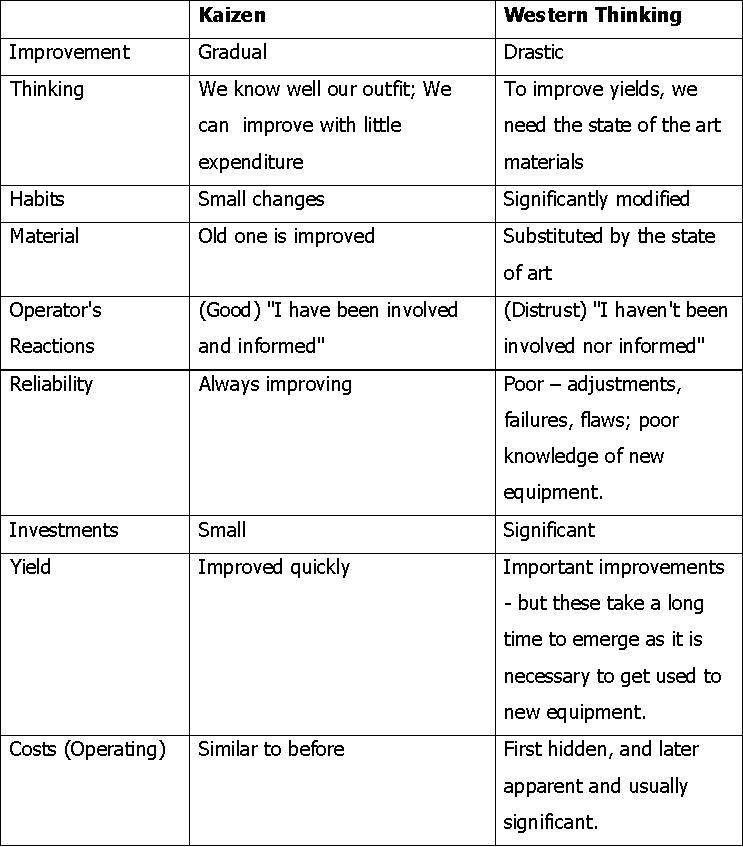
Kaizen, as is clear from the definition, is a common word and very natural to individual, continuous improvement in personal life, home life, social life and working life. Everybody deserves to and should be willing to improve for the better continually. "If a man has not been seen for three days, his friends should take a good look at him to see what changes have befallen him" quoted from an old Japanese saying, describes how natural Kaizen is. However, when Kaizen is adapted in an organisation with management perspectives, it is easier to talk about it than to implement it.
Transplanting Kaizen in an Organization
Transplanting the concepts of Kaizen into organisations and management is not easy. It is very natural that people will propose some kind of change in their work place when they become dissatisfied with the present condition. They are generally inclined to make or propose improvements starting from their own work place. Some of the improvements could be carried out directly. Perhaps, the boss would not even notice these. However, when approval is required, there could be several kinds of responses from the boss. A good response is one that encourages subordinates to carry out their ideas. The boss may then appreciate or reward the ideas. Involvement and positive response by the boss develops trust with subordinates and stimulates other improvements. Cumulatively, this will create a kind of 'momentum' for continuing improvement. Top management commitment is essential, to realise the objectives of Kaizen.
Three functions should be executed simultaneously within any organisation : Innovation, Kaizen and Maintenance. By Maintenance, we refer to maintaining the current status - set procedures and standards are implemented. People in the lower levels of the organisation mostly maintain standards. By Innovation, we refer to breakthrough activities initiated by top management such as buying new machines, new equipment, developing new markets, directing R&D, changing strategy etc. However, an important function of top management should be developing a culture within the organisation to support continuous improvements. Big and bold steps should require top management authority for implementation. In the middle, Kaizen activities are created - these are small steps, but contribute to continuing improvement. Kaizen should be done by the lower and middle management and workers, but once again it is emphasised that encouragement and direction from the top is vital. Top management's top responsibility is to cultivate a Kaizen working climate or culture in the organisation.

