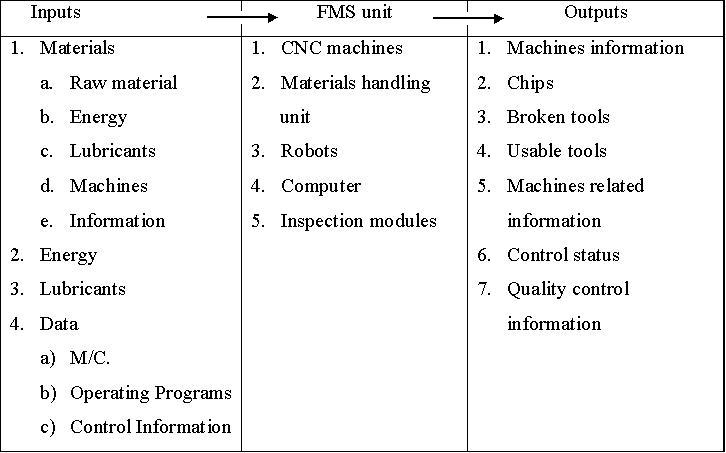
Elements of an FMS
Basically, an FMS is made up of hardware and software elements. Hardware elements are visible and tangible such as CNC machines tools, pallet queuing carrousels (part parking lots), material handling equipment (robots or automatic guided vehicles), central chip removal and coolant systems, tooling systems, coordinate measuring machines (CMMs), part cleaning stations, and computer hardware equipment. Software elements are invisible and intangible such as NC programs, traffic management software, tooling information, CMM program work-order files and sophisticated FMS software.
A true FMS can handle a wide variety of dissimilar parts, producing them one at a time, in any order, as needed. It needs the flexibility to adapt to varying volume requirements and changing part mixes, to accept new parts, and to accommodate design and engineering modifications. FMS also requires the flexibility to cope with unforeseen and unpredictable disturbances such as machine downtimes problems or last minute schedule changes; and the ability to grow with the times through system expansion and configuration, improvements, and alterations.
Flexible manufacturing systems provide increased flexibility, higher productivity, improved quality products, and greater machine utilization. To meet such demands, robots are increasingly employed as part of flexible manufacturing systems. A full FMS installation is one in which a process is put under total computer control to produce a variety of products with the system's defined capability and with a predetermined schedule.


