
Afghanistan

Official nameRepublic of Afghanistan
Area 250,000
Population25,838,000
Capital Kabul
Major Cities Kabul, Herat, Mazar-i-Sharif, Qandahar, Jalalabad
Ethnic GroupsPushtun, Tajik, Uzbek, Hazara, Baluchi, Brahui, Aimaq, Turkmen
Official Language/sPushtu & Dari
Major languagesPushtu, Dari, Baluchi, Turkish languages
Major ReligionsSunni Hanafi Islam, Shia Imami Islam, Shia Ismailism, Hinduism, Sikhism
EconomyGrains, opium, tannery
GDP/capita$813
Currency Afghani
Year of Independence

Afghanistan in Brief

This landlocked nation in south central Asia is at the crossroads of Turkic and Persian cultural realms. The dominant ethnic groups are Pushtuns who are of Persian stock and are also found in large numbers across the border in Pakistan. Other major Persian groups include Tajiks, Aimaqs and Baluchis. The Hazaras of central Afghanistan are of Mongoloid stock and are largely Imami Shias, unlike other tribes who are Sunni Muslims. Uzbeks, Turkmen and Kirghiz peoples to the north of Afghanistan are of Turkic stock. High mountain ranges dominate much of the landscape interupted by broad valley plains and deserts to the south.
The majority of people derive their living from agriculutral pursuits, be it for subsistence or commercial. A significant number are nomadic herders who shift between fields of pasture depending on seasons. To what extent the latest war has had an impact on the Afghan peasant or nomad is still to be determined. Decades of war and instability has resulted in refugee movements across borders into Iran or Pakistan, or internal displacement. With the climate of stability in place following the departure of the Taliban, refugees are returning to their homes in larger numbers.

Current Leadership and Politics


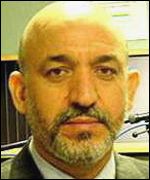
Hamid Karzai

History prior to 1920

Afghan Monarchy

King Zahir Shah reigned as ruler for several decades, during the 1950s and up till the early 1970s. This was an era of relative calm and peace. In 1972 the King took an ill-fated journey to Italy for an eye operation. A coup was launched in his absence by his brother who overthrew the established monarchy. He was to remain in exile for nearly 30 years.

Communist Revolution

Habibullah Amin was installed as the pro-Soviet puppet ruler who was later replaced by Najibullah in 1979 following his assassination.

Soviet Occupation 1979-1989

The Parcham faction regained full power following the arrival of Soviet forces sweeping down from the north. Organised resistance toward the foreign invaders was frequent and ferocious especially in the countryside. This heavy resistance also resulted in severe repression by the invading army which resulted in many deaths and displacement of many people. The Many refugees fled to either Pakistan or Iran, where guerilla forces often accompanied them.
There, in their new host country, the Mujahideen organised themselves into combat units battling Soviet forces in Afghanistan. In the north-west Pakistani city of Peshawar, where many refugees were residing, 7 Sunni Mujahideen factions formed a strategic alliance for the purpose of liberating Afghanistan from pro-Communist and Soviet influence. With funds from US and Saudi Arabia along with logistic training from Pakistan's secret service, the ISI, the Mujahideen were given a powerful shot in the arm. Among the main guerilla commanders were Ahmad Shah Masood who lead his mostly Tajik force in the Panjshir valley of northern Afghanistan and Gulbuddin Hekmatyar the more radical fundamentalist who lead his largely Pushtun militia the Hizb-e-Islami. In later years, following the departure of Soviet troops from Afghanistan, the ISI favoured Gulbuddin's party.

Mujahideen Factional War 1989-1996

The ongoing Mujahideen assault on the Soviet army and their allies had a put a heavy toll on both sides by the end of the 1980s. Finally in 1989, Gorbachev the then USSR leader ordered the pulling out of Soviet troops from the country, leaving the pro-communist regime of Najibullah more vulnerable to advancing Mujahideen forces. Upon the capture of Kabul by the victorious Mujahideen, factional fighting broke out between the already shaky alliance. Thus began the phase of intra-Mujahideen warfare, which took place largely in Kabul and other urban domains. This was in contrast to the occupation era, when fighting was restricted to the countryside.
Severe rivalry was taking place between Gulbuddin's Hizb-e-Islami and Burhanuddin Rabbanis' Jamiat-i-Islami, who were backed by Ahmad Shah Masood. There was also military challenge from Uzbek warlord, Rashid Dostam who controlled the northern town of Mazar-i-Sharif, the pro-Iranian Shia Mujahideen Hizb-e-Wahdat, Herat's strongman Ismail Khan, and other Pushtun factions. To complicate things further, foreign Islamic militants were also operating in much of Afghanistan, using it as a launching pad for militant action overseas. Among them were the Arab 'Afghans', Kashmiris, Uighurs, Uzbeks, Pakistanis, Philipinos and Africans. These foreigners came to assist in the anti-Soviet resistance of the previous decade.

Taliban Rule 1996-2001

In 1996, a Pakistani convoy carrying commercial goods, was rescued from bandits by a religious militiamen formerly linked to the Harakat Inqilab-i-Islami. These madrassa educated zealots were part of a new militant order known as the Taliban, who operated out of Deobandi Sunni religious schools from Pakistan's western provinces. With aid from the Pakistani ISI and Pakistani Deobandi militants, the Taliban rapidly gained control over much of southern Afghanistan, with little resistance. To their credit law and order was established where ever they took over, which won them support from the general populace who were eager to see an end to war.
But the Taliban imposed a harsh version of Tribal Islamic law when in control, such as severe restriction on women, compulsory beards for men, enforcement of prayer and the banning of all forms of entertainment, including TV, music and singing. Minority Shias and Sufis were also prevented from practicing their religious activities. All the while, the Taliban regime was host to an array of foreign Jihadi militants whose agenda was to overthrow governments they view as pro-west. Usama bin Ladins' al-Qaaida was one such organisation, which coordinated the activities of various Islamist militants worldwide.
By 1997 the Taliban had absorbed more than 90% of Afghanistan under their rule, with the remaining north-east still under the control of Ahmad Shah Masood. Despite that, the Taliban under the guidance of Mulla Omar, were recognised by only 3 countries - Pakistan, Saudi Arabia and the United Arab Emirates. This had to do with of the world shunning the Taliban's repressive policies, especially towards women and minorities. More pressure was applied to the Taliban by the US following the US embassy bombings in East Africa(1998), which was blamed on al-Qaaida. The Taliban resisted US attempts to extradite Usama bin Ladin, who had by now established strong links to the Taliban leadership. The Clinton administration at that time could not do much than lauch missiles into several militant camps in southern Afghanistan. The Taliban refused to budge, and continued playing host to al-Qaaida.
The terrorist attacks in New York and Washington on September 11 2001 changed all that. An ultimatum was handed down to the Taliban to deliver Usama bin Ladin to American authorities or face military attack. Once again the Taliban proved to be defiant, with the result that a full scale assault by US and Western air strikes ensued, aided by Northern Alliance forces on the ground, starting October 7 the same year. Within weeks the Taliban and al-Qaaida

Towards the end of Taliban Rule

Before the ouster of the Taliban from Kabul in November 2001, there were several major Mujahideen groups vying for power. They were divided by linguistic and sectarian factors. However under the charismatic leadership of Ahmad Shah Masood, many of these factions formed the Northern Alliance to oppose the Taliban and its foreign militia llies. Following the assasination of Ahmad Shah Masood, and more importantly after the attacks in US on September 11 2001, the Northern Alliance were fast being galvanised to grab more territory from the Taliban. Aided with outside military assistance(Russia, India and USA), the Northern Alliance gradually swept The Taliban away from power in Kabul and eventually occupied two-thirds of the nation. The remaining southern(Pushtun majority) areas came under the influence of the Southern Alliance or the anti-Taliban Pushtun militias. Read more...

US presence and Future Outlook

The Loya jirga was held.
Hosted by www.Geocities.ws

1