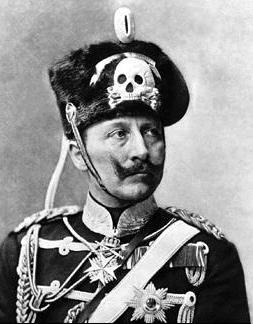

Someone once said that the Kaiser always spoke of God as if the Almighty were waiting in the next room to see him. That may have been a sarcastic remark, but Wilhelm II certainly was a devout Christian and was sincere that he owed his position to God and that his crown was a responsibility for which he answered to God alone. This does not, contrary to what some may think, mean that the Kaiser was an iron-fisted absolutist. The German Reich was a constitutional monarchy even though it seems authoritarian compared with those of the same name today. The royals had considerable power but there was a divided government with the Reichstag, the Bundesrat and the Kaiser at the top, the member states had considerable autonomy and there was democracy. Wilhelm II complained often enough about political headaches but he never for a moment doubted the monarchial principle and unlike many others he was determined to defend it. He once wrote to his cousin Tsar Nicholas II of Russia, trying to improve Russo-German relations, saying that it was essential for the German and Russian emperors (and one would assume the Austrian emperor as well as the three most powerful monarchs in relation to their governments) work together to build a monarchial bastion against the threat of spreading republicanism. Prior to World War I this was really a visionary statement given that Europe was dominated by monarchies at that time. However, Wilhelm II knew all too well that republicanism was a disease that had to be quarantined and that monarchs had to be vigilant against any inroads made by the enemies of monarchy. This was a big reason for his bewilderment at the alliance of such old and venerable monarchies as Britain and Russia with republican France.
Over and over again the Kaiser made his views known and would certainly have agreed with the words of one of deputies who said that the German Kaiser should always be in a position to order any lieutenant to take ten men and close down the Reichstag. Yet, the Kaiser was not an autocrat and he even clashed with the formidable Prince Bismarck over defending the rights of German workers. When confronted by the duplicity of his former Italian ally during World War I the Kaiser was convinced that the King of Italy would be called to account by the Almighty. He imagined God reminding the King of Italy that it was He and not the Italian ministers to whom the King owed his crown and to whom he was accountable. This mentality was at least something of a weakness when it came to the outbreak of World War I as the Kaiser seemed to take a more old fashioned view of royalty than was realistic at the time. When King George V told his brother, Prince Heinrich, that he did not want to get involved with any wars on the continent the Kaiser refused to take the British into account in the lead-up to the war saying simply that he had the word of a king and that was good enough for him. The truth, of course, was that the King of Great Britain did not have final say on the actions of the sitting government and the conflict spread. It seemed unthinkable to the Kaiser, who was always so obsessed with the brotherhood of monarchs and the family ties of Queen Victoria that his royal cousins George and Nicholas would go to war against him in support of republican France.
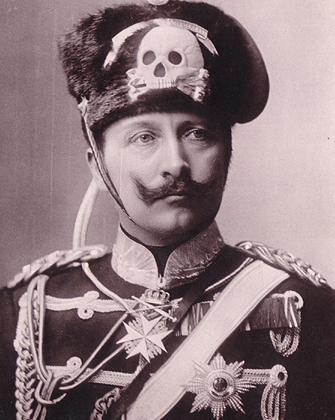
A similar case can be made for the Middle East. Part of the territories carved out of the defeated Ottoman Empire became republics (those under French mandate) but even Iraq, under British mandate, eventually became a republic and it should not be that surprising given the circumstances that existed at the time. It is a well known fact that in the past century the British themselves had defended the weakening Ottoman Empire simply because they knew that what would replace it would be far worse than anything the Turks had ever done. They knew the region would fall into chaos if the Ottoman Empire ever fell and that is why they kept it on life support up until World War I when the Turks committed the deadly sin of allying with the Germans. There is no denying that if the Central Powers had been victorious in World War I there would be many more monarchies in the world today; first among them of course being the monarchies of Germany, Austria-Hungary and Turkey. Of course it would have been better if the war had never happened, but few were willing to listen to Kaiser Wilhelm II when he was trying to warn his brother monarchs about the very real danger of republican movements. For that matter, he also predicted the rise of China and was ignored but that's another story. The Kaiser saw Europe in the old light, he saw a family of monarchs reigning over the nations who needed to support each other against any hint of revolution. This would have made him right at home in the post-Napoleonic world, but in the early 20th Century very few were willing or able to listen to him. The fact that the Kaiser held monarchy so sacrosanct is also evident in the German bombing campaign of London by the zeppelins. Aside from churches, monuments and residential areas, the Kaiser gave strict orders that no palaces were to be bombed -all quite a different policy than what was done by the Germans in World War II.
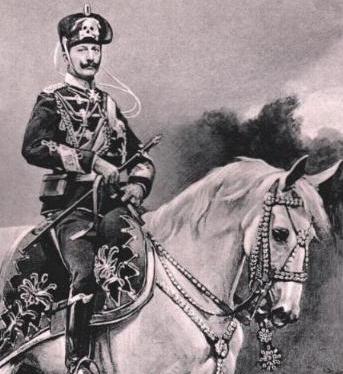
Kaiser Wilhelm II was a monarch who believed in monarchy and felt strongly that monarchy was a better system for organizing human endeavour as opposed to republics. The Kaiser felt that an important part of this, from the time he came to the throne until the time he died in exile, was that a monarch is a check on the wild and sometimes irrational whims of what was popular and could ensure stability, strength, tradition and the 'big picture' of world events. He was a monarch tailor made for monarchists.
"As sovereigns who are responsible to God for the welfare of the Nations entrusted to our care, it is our duty therefore to closely study the genesis and development of "public opinion" before we allow it to influence our actions."
-Kaiser Wilhelm II