 |
|
|
|
|
|
|
|
|
|
|
|
Kaiser Wilhelm II in World War I |
|
|
|
 |
|
|
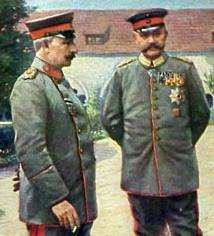
| The German Kaiser, Wilhelm II, though he was called the "Supreme Warlord" actually played a very limited role in the execution of the First World War. The idea that he was personally responsible for starting the war is so absurd that any belief in the idea can only be the result of willful ignorance. He was no more responsible than the Austrian Kaiser, Franz Joseph, was for getting all of the nations Into the war. Germany was supporting her Austrian ally, and in fact the Kaiser tried to call back his forces from invading Belgium, which even the Germans admitted was an illegal act. First, the Kaiser was told by his military chief of staff, Graf von Moltke, that to leave Belgium unmolested and divert all troops to the eastern front was simply impossible. In fact, the military head of the German railway system later wrote that such a movement was possible, but nonetheless the Kaiser believed his commander and dropped the issue. However, again, at the last minute when he had the slightest glimmer of hope that war in the west could be avoided, Wilhelm II immediately tried to halt his troops before they crossed into Belgium and that time Moltke simply refused to obey. |
|
| During the war itself, the Kaiser left most of the planning to those who were trained to do it. Although he had been given the traditional training of a Prussian officer, Wilhelm II did not possess the characteristics needed of a military commander. Before the war he had commanded half of the troops in the regular German army field maneuvers, but finally quit when he discovered that his generals had been purposely letting him win year after year. Besides which, the era when a monarch could effectively lead his troops into battle was largely over as the armies were too numerous and the battlefields too vast. On the Allied side, monarchs in command of their own troops met with very different fates. The gallant King of the Belgians, Albert I, became quite famous for his actions at the head of his small army, but the Tsar of Russia, Nicholas II, though a very brave and intelligent man, met with absolute disaster when he decided to take command of the Russian armies himself and ultimately only hastened the collapse of the Romanov dynasty. |
|
| Wilhelm was painfully aware though that it was the ideal for the Prussian warrior-king to lead his troops into battle and he was always somewhat sarcastic in his comments about being left out of the war for the most part and rather envious of the more hands-on role his son, Crown Prince Wilhelm III, was able to have at the front in command of an army. However, that is not to say that the Kaiser did nothing during the conflict. He was the supreme commander, all orders required his signature, he presided over the major councils and had to approve the various strategies which his commanders put forward. As the supreme commander, one of the duties he had to perform more than once was to settle disputes between his top commanders on the eastern and western fronts, each of which naturally felt emphasis should be on their own area of operations. After the defeat at the First Battle of the Marne, Moltke was replaced by General Erich von Falkenhayn who was often at odds with Generals Hindenburg and Ludendorff in command of the forces opposing the Russians. |
|
|
|
 |
|
|
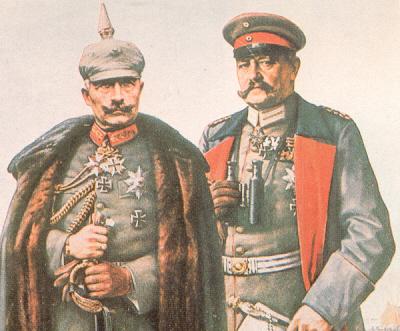
| After the battle of Verdun, Falkenhayn was replaced by Field Marshal Hindenburg and the Kaiser began to recede more into the background as Hindenburg became the great German hero of the war and his deputy General Ludendorff became more and more like a de facto dictator. Simply by threatening to resign the pair were able to gain approval of almost any plan they liked. Wilhelm II, however, accomplished some subtle things which might not often make the history books, but which prove that the Allied propagandist view of him was totally false. For example, when German troops pushed the Russians out of Poland, the Kaiser ordered supplies rushed to the aid of the Jewish population of Warsaw which had been left to starve. In a similar vein, when the German zeppelins began their first bombing flights over London Wilhelm II, who was half British on his mother's side, ordered them to avoid civilian areas and take special care that no churches, palaces or national landmarks were damaged. He also did what most other monarchs did during the war such as visit hospitals, review his troops, give encouraging speeches, meet with his allies and decorate his heroes. |
|
| At the front, and at home though, the Kaiser was increasingly marginalized and no one was more aware of this than he was. In 1918 when General Ludendorff, using troops brought from the east where Russia had recently been knocked out, launched his massive attack code-named Operation Michel, the ensuing battle became known as the 'Kaiserschlacht' or "Kaiser's offensive". Wilhelm II asked why this should be so when he had nothing to do with it, and when he was told that as supreme commander it was he who had given the order, the Kaiser replied that he had given the order for every offensive during the war, so it made relatively little sense that this one should be given his name. Although the offensive was a spectacular feat of arms, it ultimately ground to a halt and from that time on the Germans would be pushed steadily back to the Hindenburg Line. Along with setbacks at the front, anarchy began to break out at home, aided considerably by the starvation conditions caused by the British naval blockade. |
|
| Ironically, it was Wilhelm's pride and joy, the Imperial German Navy, where actual revolt first broke out, with only the elite U-Boat fleet remaining loyal. As mobs stormed through the palace in Berlin, the Kaiser, who was at the front, considered for a time going out to the trenches to seek his death in battle. On another occasion, he seemed determined to abdicate as German Kaiser, but not as King of Prussia and on another day considered accepting whatever peace terms the Allies would offer and then leading his troops back to Germany to crush the leftist rebellion and restore his rule. Finally though, told by Hindenburg that the army was no longer loyal, and with the Allies demanding his removal before any peace terms would be discussed, Wilhelm II abdicated his throne and went into exile in the Netherlands. Those present at the signing of the abdication recalled that the Kaiser had thrust the papers in their direction saying, "you have no warlord now". The role of the Kaiser in World War I and in the history of Germany had come to an end. |
|
|
|
 |
|