 |
 |
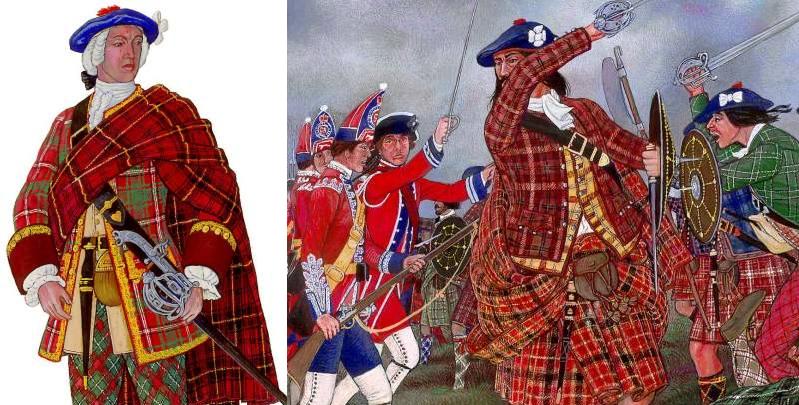
| Charles was extremely dejected by the withdrawl, seeing that the opportunity to take London would never come again, and at each step of the retreat north he pleaded with Murray and the chieftains to stand and fight. Finally, back in Scotland, the Jacobites made a stand at Falkirk in January of 1746. General Henry Hawley (who may have been one of George II's illegitimate children) of course had the Jacobites outnumbered, but once again the Jacobites were victorious. Repulsing a cavalry charge, the rest of the Hanoverian troops fled the field, Hawley among them after losing some 350 casualties and 300 more taken prisoner compared to only a little over 100 men killed or wounded on the Stuart side. Once again, Prince Charles urged his commanders to follow up this victory by counter-attacking south again and striking toward London while the enemy was still stunned by the loss, and once again, he was ignored and the retreat north continued. Hounded by superior forces under the brutal Duke of Cumberland, the Jacobites retreated all the way to the northernmost extremes of Scotland where, overcome by hunger, privation and the elements, they finally decided to turn and fight at Culloden Moor.Outnumbered, in a poor condition and on unfavorable ground the fight could only have one outcome for the Jacobites. They charged bravely and were butchered bravely, the army all but wiped out, the Jacobite Uprising of 1745 ended for all intents and purposes then and there. Wounded men were executed by the Hanoverians, and the severe crackdown that followed in Scotland earned the Duke of Cumberland his lasting nickname, "Cumberland the Butcher". Prince Charles did manage to escape however, and deprived the Hanoverians the joy of hanging him. Despite having a bounty of 30,000 pounds on his head, no one betrayed Bonnie Prince Charlie and with the help of Flora McDonald he escaped to France. Flora would later becoming a leading loyalist in the American War for Independence where many of the defeated Jacobites relocated. Charles' life in exile was not to be a happy one. He had spent his entire life planning and preparing for the restoration of the Stuarts, and with that hope dashed he seemed to have lost all sense of purpose. In 1766 his father died and he was proclaimed by his die-hard Jacobite supporters King Charles III, however after the death of his father Pope Clement XIII no longer recognized the Stuart claim. Even many of James' most devoted adherents believed that the Jacobite cause had been lost and they would have to come to terms with the House of Hanover. In 1772 Charles married Princess Louise of Stolberg-Gedern and the two lived in Rome and later Florence. The marriage was not a happy one though. Louise claimed that Charles abused her and it is known that she was having an affair with an Italian poet. She left Charles in 1780. Prior to his marriage, Charles had had an illegitimate daughter by Clementina Walkinshaw who he legitimized and gave titles to in the Scottish peerage. He drank heavily and lived a gloomy life in Rome with his daughter for the rest of his life. Charles Edward Stuart died in Rome on January 31, 1788 and was buried in Frascati Cathedral, the see of his brother Henry Cardinal York. Upon his death the Jacobite remnant recognized the cardinal as King Henry IX but for all intents and purposes the rivalry was ended by Cardinal York and the Hanoverian King George III. In 1807 the body of Charles was moved to a crypt in St Peter's Basilica in the Vatican, where he lies today alongside his brother Henry and his father James III. With the passing of the Stuarts, and especially following the death of King George III in Britain, the United Kingdom broke ties to her past as traditional, Catholic and constitutional monarchy. Without the Stuarts it would be the radical liberals who ruled, the Protestants and the Parliament would slowly gain an absolute hold on power, reducing the monarchy to symbolic status only. |