�What shall we do today?� If this question pops into your mind, and you realize you�ve already visited every store in Estes, driven all the roads in Rocky Mountain National Park and hiked all the trails you�re willing to hike, perhaps it�s time to visit a little known town called Glen Haven, just seven miles from Estes Park.
The road to Glen Haven (also known as McGregor Road) is easy to find. It�s located slightly west of the Stanley Hotel, and is clearly marked �Glen Haven� and �Devils Gulch.� While driving this road keep your eyes open for raptors and other birds, as hawks and eagles favor Lumpy Ridge for nesting. Bluebirds also nest along Devils Gulch Road, and elk and deer graze the open meadows. There are many spots where you can pull off the road to view wildlife safely.
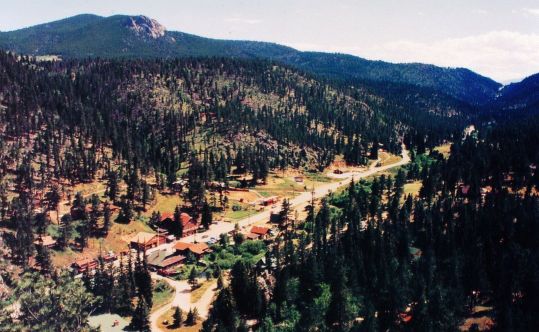
After five miles you�ll reach the top of Devils Gulch. Be ready to downshift gears as this section of road, commonly known as the �switchbacks,� drops 800 feet quickly. Before dropping down into the canyon, pull off the road and take a look behind you at the view, as the best view of Longs Peak can be seen from here. Once you�re at the bottom of the curves it�s another mile to downtown Glen Haven.
What to do: Glen Haven is unique. It still has the appearance of an old west town, and a person can whittle away a few pleasant hours, despite the town�s size being small. There are several stores to browse, offering hand-crafted pottery, jewelry, glass, local history books, Indian art, antiques and more. Buy a sandwich, a drink or one of the General Store�s famous cinnamon rolls, or relax in one of the three picnic areas along the North Fork of the Big Thompson River just a mile or two down the canyon. Big horn sheep visit the canyon often so please drive carefully around the curves as the rams sometimes graze along the side of the road. Rivers in the glen yield trout; rainbows, browns, brookies, and maybe a cutthroat or two. Fishing licenses and bait are available at the General Store.
If you love to hike there are several trails from the glen. There are two trailheads for Crosier Mountain; by the stables in downtown Glen Haven or by the Retreat entrance two miles down the canyon. Trailheads for Deserted Village and Lost Lake are found at the end of Dunraven Glade (turn at the Retreat sign). Information on trails from Glen Haven can be found at the Forest Service Visitor Center in Estes Park, or in local businesses. If you�d rather travel on horseback, horse rentals are also available at the stables. Call 586-2669.
Hungry and weary at the end of the day? The Inn of Glen Haven offers fine dining and beautiful rooms decorated in �Olde English� style; reservations recommended.
Once you have visited Glen Haven you could return to Estes the same way you came, or continue downhill another eight, beautiful miles, to Drake. From there you can loop back to Estes Park or continue on to Loveland.
Glen Haven�s 100th Anniversary: The month of July offers several additional attractions to Glen Haven. The Volunteer Fire Dept., will hold its annual pancake breakfast fundraiser and craft show, but this year several other activities will be organized in celebration of the one-hundreth anniversary of Glen Haven, which was actually last year, but is being celebrated this year as �Glen Haven 101�. Check local newspapers for dates and times.
GLEN HAVEN HISTORY 101
While standing in the beautiful Estes Valley, take a moment and let your eyes scan northeast to the end of the unusual rocky ridge-line known as Lumpy Ridge. Perhaps as you gaze at this mysterious spot, an unusual shaped cloud will drift up from the hidden gulch, and for a moment, you might think it is smoke, or possibly, devils escaping upwards. It is thought that this is how travelers, hunters and trappers of old gave it the name Devils Canyon, as the clouds appeared to be smoke or devils rising from the pits of hell.
In 1877 Devils Canyon appeared in Hayden�s Atlas showing no obvious trail leading down the gulch. It was, however, around 1874 when the first settlers took solace in the beauty of the valley at the bottom of the gulch. A few cabins were built by trappers and hunters, and a cattle ranch was built by P. J. Pauley, who later became owner of what is now McGraw Ranch, owned by the National Park system. These new homes were built only short distances from the many summer Indian trails, used for centuries by the Arapaho, Cheyenne and Ute Indians, for hunting and summer foraging camps. Before 1895 these cabins were isolated and accessible by only one trail that led to a secret valley with wildflowers too numerous to count, thick with pine trees and swamped with predators and other wildlife: bears, mountain lions, bobcats, elk, deer, wolf and coyotes.
In 1896 the first signs of more permanent settlements started to lay ground when a saw mill was set up along the North Fork of the Thompson river by Ira Knapp and his father and brothers, first on Miller Fork and later across the road from the stables now in town. A road was built in order to get the lumber to Loveland. It traveled through Cold Canyon down to Miller�s Fork and on to join what is now Hwy. 34 at Drake. In 1897 the Knapps laid claim to the land that is now known as Glen Haven. A lot of this road was built much higher up than it is now, and was moved closer to the river by Larimer County over the years.
In 1899 the road leading up Devils Gulch (as the canyon later became known) to the Estes Valley was a very long and steep haul only suitable for horses or a spring wagon and team. The road had logs laid across it width-ways to prevent wash outs. Called a corduroy road, a trip up it would have been bumpy indeed. In the early 1900s George Dennis built a summer hotel at the bottom of Devils Gulch. Dennis improved the road up the gulch by widening it slightly and adding some hairpin turns to relieve the steepness. This section of road is still there, though it has since been widened and paved to handle modern-day traffic. A few years ago guardrails were added as an extra safety precaution.
Since 1896 the area had been commonly known as �Knappville,� but in 1903 Ira Knapp and the Reverend W. H. Shureman decided to change the name of the town to �Glen Haven,� and at the same time founded the Presbyterian Assembly Association. His intention -- to make the area a summer resort for Presbyterians.
In 1903 the association had 19 stockholders; and 30 at the end of 1904. The main function of the association at this time was to sell lots to new stockholders and maintain the roads and bridges up Fox Creek and North Fork. The association had little effect on the original residents at this time.
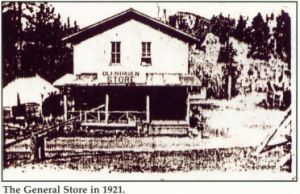
In 1921 the Glen Haven store was built by the association and was run by several different people over the years.
In 1923 the Presbyterian Assembly Association was reincorporated as �The Glen Haven Resort,� in the hopes of encouraging prospective land owners to become members, without requiring them to be a Presbyterian.
Over the next few years the General Store added on several rooms including a dining room and kitchen, and the outward appearance was improved. Sunday services were held at the store and a piano was secured for use at these services. Around town more buildings went up, a Post Office was maintained and roads, bridges and forest were improved upon.
By now the wildness that the Indians and rugged outdoors men such as �Mountain Jim� probably hunted in, and loved, had been �tamed.� Bounties were offered for the killing of snakes, and most of the mountain lions that had roamed the area freely had been killed. Unwanted pests such as the pine beetle were under control, and brawling behavior from the two-legged beasts was strongly discouraged.
The town continued to grow and soon offered two restaurants: The Glencrofter Country Store and Wild Bill�s Cook Shack. Additionally there was Calico Kate�s Gift Shop, the Glen Haven Lodge (now the Inn of Glen Haven), Buckskin Bo�s Livery Stables, a Town Hall and many new homes. The Cheley Trails End camps for boys and girls were also established. The Post Office was moved around town several times and the Glencrofter store burned to the ground. Two gas stations appeared and disappeared, the names of the stores changed, amazing characters came and went. However, most of the buildings still remain and continue to offer visitors a leisurely, uncrowded way to pass a few hours.
The stores may have changed, but Glen Haven still offers a touch of the old west, for those wishing to escape the constant rush of modern day life.
By Roxy - [email protected]
2004