Completely
paralyzed from the neck down after an accident, Tomihiro Hoshino turned
to painting and poetry to express his appreciation of the beauty around
him. His works, which are housed in the Tomihiro
Museum in Gunma, have that clarity and freshness that celebrates life
and the innate beauty of living things.
According
to this profile,
“Hoshino modestly asks that we not regard his work as the product of a
handicapped man or allow emotions of sympathy or admiration to stand in
the way of our natural appreciation.”
I remember
I was once asked offhandedly by a member of Friendship Asia what
I would think of Rondalla On Wheels’ music if I had not known them before
and could therefore be a disinterested judge. I can’t answer this question
with authority as I can’t be a disinterested listener. But sometimes, while
listening to their performance, I close my eyes and I easily forget that
the music was being performed by handicapped people.
Which is good
because Rondalla On Wheels, as they themselves are quick to point out,
is about ability—good, vibrant music, full of energy and vigor—not
disability.
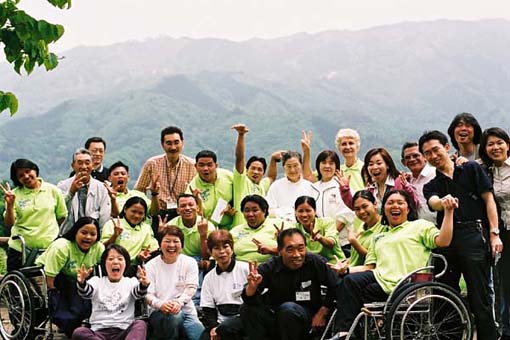
Rondalla On Wheels’ music stands on its own; listeners need not know or
do anything else to appreciate it, which is really how it should be. But
if listeners learn that the performers are handicapped people, that fact
should enhance and not detract their appreciation of the music.
Tomihiro Hoshino
himself saw the Rondalla On Wheels perform and expressed his heart-felt
appreciation for their music, a compliment the Rondalla On Wheels are surely
pround of.