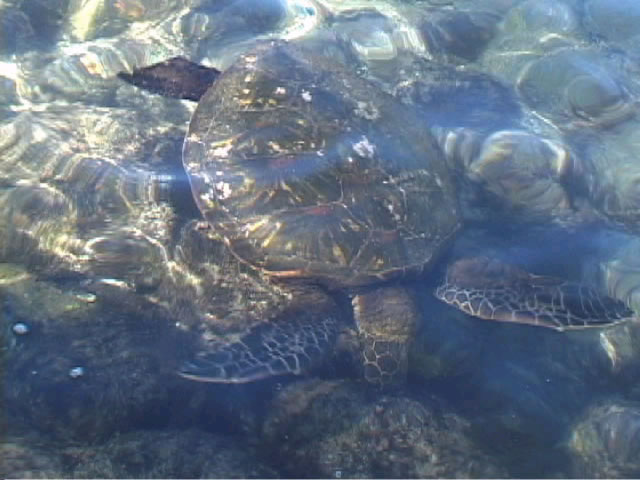
The following facts were obtained and paraphrazed from a PDF file entitled Sea Turtles, which was written by the U.S. Fish and Wildlife Services in 1998.
The Loggerhead Sea Turtle gets its name from its large head. Most Loggerhead Turtles weigh anywhere from 150 to 400 pounds, and are 2.5 to 3.5 feet long. It usually eats mollusks, crustaceans, and shellfish. A sea Turtle shell consists of the Carapace (top part of the shell) and a Plastron (lower part of the shell). The Loggerhead's Carapace is a reddish-brown color, while its Plastron can range from a brownish to yellowish color.
The Loggerhead Sea Turtles lay eggs in intervals, about every 2-3 years. Its nesting season is from May to September in United states. Each female Loggerhead will lay 4 to 7 clutches per nesting season with 100 to 126 eggs in each clutch. Eggs take about 60 days to hatch. There are two main locations where Loggerhead Sea Turtles nest. The first is on Masirah Island, Oman in the Middle East, while the second nesting location is in the United States on the southeastern coast.
Green Sea Turtles weigh anywhere from 300 to 400 pounds, and are over 3 feet long. Adult Green Sea Turtles are herbivores, which means they are plant eaters. It eats mostly seagrasses and algae. Its shell is shaped like a heart. The Green Sea Turtle's Carapace is smooth and its color ranges from light to dark brown, while its Plastron can range from a white to light yellow.
Green Sea Turtles lay eggs in intervals, about every 2-3 years. Its nesting season in the United States is from June to October. Each Green Sea Turtle female lays 3 to 5 clutches per nesting season with an average of 115 eggs per clutch. Eggs take about 60 days to hatch. The largest nesting site in the Western Hemisphere of Green Sea Turtles is in Costa Rica. There are other nesting sites located on the Pacific coast of Mexico and Florida.
Leatherback Sea Turtles weigh anywhere from 650 to 1,300 pounds, and are 4 to 8 feet in length. The Leatherback Sea Turtle has a scissor-like jaw and eats mostly jellyfish. It also eats other food such as sea urchins, squid, custaceans, fish, algae, and floating seaweed. The Leatherback Sea Turtle is the only species to lack a hard shell, instead its shell is long with a layer of rubbery skin that is thin, but tough. Its Carapace is black with white spots, while the Plastron can range from a white to a black color.
Leatherback Sea Turtles lay eggs in intervals, about every 2-3 years. Its nesting season in the United States is from March to July. Each female Leatherback lays 6 to 9 clutches per nesting season. Each clutch has about 80 fertilized eggs that take about 65 days to hatch, plus there are 30 unfertilized eggs that do not hatch. There are nesting locations throughout the Caribbean, the northern coast of South America, the Pacific coast of Central America, and the east coast of Florida.
The Flatback Sea Turtle can weigh as much as 200 pounds, and is around 3 feet long. It eats sea cucumbers, jellyfish, mollusks, prawns, and seaweed. The Flatback Sea Turtle has a gray-green shell that is oval shaped. Its shell is flatter than other species of Sea Turtles.
Flatback Sea Turtles lay up to 4 clutches per nesting season every 2-3 years. There is an average of 50 eggs per clutch. The Flatback Sea Turtle is the only Sea Turtle not on the U.S. Fish and Wildlife Services Endangered Species List. However, the Flatback does not nest in the United States. It only nests on the northern coast of Australia and off the Gulf of Papua, New Guinea.
The Hawksbill Sea Turtle weighs anywhere from 100 to 200 pounds, and can be as long as 3 feet in lenght. It has a beak-like jaw and eats mostly sponges along with anemones, squid, and shrimp. The Hawksbill Sea Turtle's Carapace is brown with other colors of yellow, orange, and reddish-brown, while the Plastron is yellow with black spots.
Hawksbill Sea Turtles lay eggs in intervals, about every 2-3 years. Each female Hawksbill lays 2 to 4 clutches per nesting season. There are around 160 eggs in each clutch, which take about 60 days to hatch. The Hawksbill nests in the Caribbean, but are not longer found anywhere in large numbers.
The Kemp's Ridley Sea Turtle weighs anywhere form 80 to 100 pounds, and is usually 2 to 2.5 feet in length. It eats crabs, clams, mussels, and shrimp. The Kemp's Ridley has an oval shaped shell. Its Carapace is olive green, while its Plastron is a yellowish color.
Kemp's Ridley Sea Turtles lay eggs every year with a nesting season ranging from April to June. Each female Kemp's Ridley lays about 2 clutches each year with around 105 eggs in each clutch. It take about 55 days for the eggs to hatch. The only major breeding site for the Kemp's Ridley Sea Turtle is in Rancho Nuevo, Mexico. The Kemp's Ridley is the most endangered and rarest of all Sea Turtle species.
The Olive Ridley Sea Turtle weighs anywhere form 80 to 110 pounds, and is usually 2 to 2.5 feet in lenght. It eats crustaceans, Mollusks, and Tunicates. The Olive Ridley's shell is heart shaped and its overall color is olive green.
Olive Ridley Sea Turtles lay over 110 eggs per clutch and it takes around 52 to 58 days for eggs to hatch. The Olive Ridley nests on the Pacific coast of Costa Rica and Mexico.
Link back to the Sea Turtle Home Page.
Link back to my Home Page.
The photographs on this page can be found at naturescapes, which was developed by Annette Lamb and Larry Johnson. See their Sea Turtle Photographs.


No errors found with WDG Web Design Group Batch Validator, This is the response received for this page:
Document Checked
URL: file:///C:\WebPage_L571\turtle3.html
Character encoding: UTF-8
Level of HTML: XHTML 1.0 Transitional
Congratulations, no errors!
