
The universe is like a safe to which there is a combination, but the combination is locked up in the safe.
- Peter de Vries
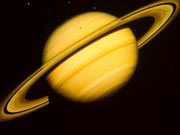
Saturn throughout History
Saturn Basics
The Satellites of Saturn
Saturn's Rings
Saturn Link
People have enjoyed Saturn since prehistoric times.
       orbit:  1,429,400,000 km (9.54 AU) from Sun
       diameter:  120,536 km (equatorial)
       mass:  5.68e26 kg
Saturn is the second largest planet and the sixth planet from the Sun. It is the least dense of the planets with a specific gravity less than water. It is made of 75% hydrogen and 25% helium with traced of water, methane, ammonia, and rock. Saturn contains a rocky core with a layer or liquid metallic hydrogen and a layer of molecular hydrogen. The interior is very hot.
Thirty-one satellites have been found orbiting Saturn. The most recent moon was discovered in 2003. Some of the moons have relationships and rotate together. Titan is by far the largest moon at a radius of 2575 kilometers.
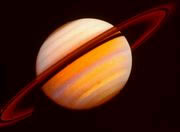
The rings of Saturn are fascinating the humans. The origin of the rings is not known. Although Uranus, Jupiter, and Neptune have very faint rings, none compare to the magnificent rings of Saturn. The rings are composed of tiny particles (ice and rock) having their own independent orbit. Two prominent rings and one faint ring can be seen from Earth. However many other rings exist. Although the rings are very impressive, they are actually thin at less than one kilometer thick.
Here is a link to Saturn Page 2.

