

Most of the following material has been extracted from "The History of Ice Cream", written by the International Association of Ice Cream Manufacturers (IAICM), Washington DC, 1978. As you will note below, however, much of the early history of ice cream remains unproven folklore.
Once upon a time, hundreds of years ago, Charles I of England hosted a sumptous state banquet for many of his friends and family. The meal, consisting of many delicacies of the day, had been simply superb but the "coup de grace" was yet to come. After much preparation, the King's french chef had concocted an apparently new dish. It was cold and resembled fresh- fallen snow but was much creamier and sweeter than any other after- dinner dessert. The guests were delighted, as was Charles, who summoned the cook and asked him not to divulge the recipe for his frozen cream. The King wanted the delicacy to be served only at the Royal table and offered the cook 500 pounds a year to keep it that way. Sometime later, however, poor Charles fell into disfavour with his people and was beheaded in 1649. But by that time, the secret of the frozen cream remained a secret no more. The cook, named DeMirco, had not kept his promise.A newly published book, by Caroline Liddell and Robin Weir, Ices: The Definitive Guide, publ. by Hodder and Stoughton, 1993, ISBN 0-340-58335-5, suggests that the historical basis of these tales is skeptical.
What follows is from the opening of the first chapter of their book:
Most books are full of myths about the history of ice cream. According to popular accounts, Marco Polo (1254-1324) saw ice creams being made during his trip to China, and on his return, introduced them to Italy. The myth continues with the Italian chefs of the you Catherine de'Medici taking this magical dish to France when she went there in 1533 to marry the Duc d'Orleans, with Charles I rewarding his own ice-cream maker with a lifetime pension on condition that he did not divulge his secret recipe to anyone, thereby keeping ice cream as a royal perogative.They go on to refute the claims about Marco Polo, Catherine de'Medici, and Charles I (in particular, while the IAICM reference credits DeMirco as the Charles I chef, apparently while other various sources credit 10 different men, there are no records of such a pension being paid to any of Charles I's cooks).
They do go on in their book to discuss history for which there is a record, with (I think) the earliest written record being something made in China.
In 1774, a caterer named Phillip Lenzi announced in a New York newspaper that he had just arrived from London and would be offering for sale various confections, including ice cream. Dolley Madison, wife of U.S. President James Madison, served ice cream at her husband's Inaugural Ball in 1813.*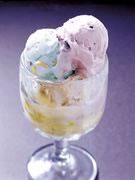
An unsubstantiated (by me) story passed on to me regarding Dolley's discovery of ice cream goes like this:
Betty Jackson, a black woman from Chadds Ford, Pennsylvania, established a tea room on French Street in Wilmington, Delaware, where she sold cakes, fruit, and desserts to wealthy people for their parties. Her son, Jeremiah Shadd, was a butcher, well-known for his ability to cure meat. His wife, known as Aunt Sallie Shadd, achieved legendary status among Wilmington's free black population as the inventor of ice cream. The story was that the butcher Jeremiah purchased Sallie's freedom. Like other members of her family, she went into the catering business and created a new dessert sensation made from frozen cream, sugar, and fruit. Dolly Madison, the wife of President James Madison, heard about the new dessert, came to Wilmington to try it, and afterward made ice cream a feature of dinners at the White House.Related Links
For a biography of Dolley Madison:
At the Montpelier, VA site, see: Dolly Madison.
At the White House site, see: Dolly Madison.
What causes a brain freeze from eating Ice Cream? Find out.
Here is a interesting site about Ice Cream. It has some great recipes.

