Dicefest
© 2005 Jon David Faeth & Jim Faeth
Introduction
Dicefest is a strategic, abstract board game for two, three or four players who must manipulate their dice and get them to the other side of the board to win. Players will need to think and plan ahead to gain ground. Knowing how to maneuver the dice efficiently while blocking your opponents� moves are important elements to winning.
Requirements
To play Dicefest you will need:
- 2, 3, or 4 players
- 1 game board
- 3 six-sided dice per player
- 36 counters
The Board
The game board is quite simple. It can be put together using a Chess/Checkers board, or you can follow this link and print it yourself.
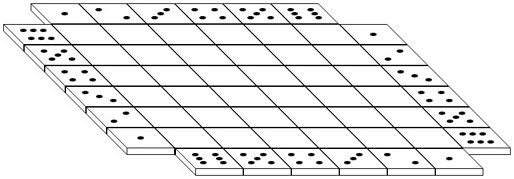
The inside of the board is a 6x6 square grid. The outer spaces on each side of the 6x6 grid are numbered (left to right) 6, 5, 4, 3, 2, 1.
If you decide to use a Chess/Checkers board, you can label the numbered spaces and the four corner spaces are not used at all.
The Dice
A player's set of dice should be identical to each other. This means the color of the dice (each player should use a different color), and also the arrangement of each die's numbers. Every die in the game should have the same arrangement of numbers. These patterns have a subtle, but important, affect on gameplay.
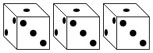 These dice will work for this game. When you look at them from this angle they have the same numbers on the same sides. This means they have the same arrangement.
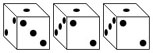 These dice have different arrangements. The first die matches the three in the above example, but the other two do not follow the same pattern.
Dicefest can be played with dice that have different arrangements, but this would have an adverse affect on the fairness of each player's movements.
Setting Up
Once you have all of your pieces assembled lay out the board, then place a counter in each unnumbered space on the inner 6x6 grid.
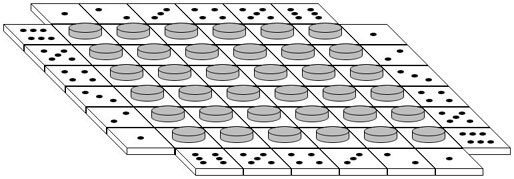
Each player rolls their dice. This is the first and only time the dice are rolled. If a player rolls the same number on any two or three of their dice, they must reroll their duplicates, and must continue rerolling until they have three different results. Once dice-rolling is finished, players place their dice on the board in their starting positions.
Each player chooses which side of the board they'll start from, then they place their dice on that side. Each die goes on the space that shares its number. Also, every die begins with its highest number on the sides (meaning neither the top nor bottom) facing to its owner's left. Most dice will start with 6 facing to the left. A die showing 1 or 6 will have the 5 facing left instead.
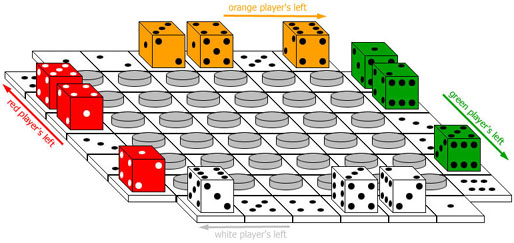
Set up is now complete. The oldest player chooses a player (him/herself or someone else) to take the first turn.
Game Play
The first player takes the first turn. Each player acts in turn, going clockwise around the table, for the rest of the game. Players will move their dice, collecting counters from the board as they go. Counters are then used to change the positioning of the dice to make them able to move more efficiently.
The game ends when a player has all of their dice on the opposite side of the board from where they started, and they have no counters left in their collection. This player wins the game.
Each Turn
On their turn a player may either move or rotate one of their dice.
When a player moves a die they may move it in any direction left, right, forward, or back. The die is moved exactly as many spaces as the number facing in the direction it is being moved. It may go to any space (numbered or blank) that does not have another die in it. Also, a die may "jump" over another die that lies between itself and its destination. If the acting player moves their die to a space with a counter, they take that counter from the board, and add it to their collection.
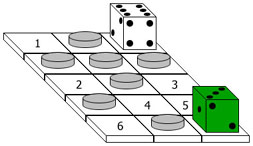
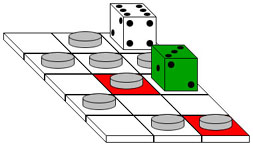 It's the green player's turn, and he wants to move this die. If he moves it to our left, it moves one space (the 1 is facing in that direction). If he moves it downward, it moves exactly two spaces.
Outside of this example, he would also be able to move this die six spaces right or five spaces upward. On most dice the numbers on opposite faces from each other add up to seven. So 5 is opposite 2, 3 is opposite 4, and 6 is opposite 1.
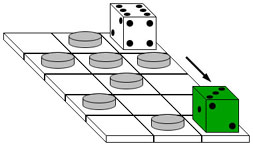 The green player decides to move his die two spaces down. First, he picks up the counter from that space to add it to his collection. Then he moves his die to that space (without rotating it).
If any move would put a die off of the board, or at the same space as another die, that's an illegal move.
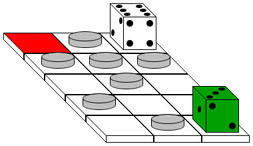 The white player moves after the green player. She has only one move in this example. She may move two spaces to the left (which she doesn't want to do), but cannot move four spaces down, since that would put her die in the same space as the green player's die. This is an illegal move, and she'll have to do something else this turn.
When rotating a die a player may turn it 90 degress on an X, Y, or Z-axis. To do so the acting player must spend counters from his/her collection. This is done by taking a number of counters equal to the number on the top face of the die that will be rotated, and placing them in unnumbered spaces on the board that have neither another counter nor a die in them. If there are not enough empty, unnumbered spaces, or the acting player does not have enough counters, the rotation may not be done.
 Instead of moving the white player decides that she wants to rotate her die. The top number of this die is 6, so she will have to place six counters on the board from her collection. There are exactly six empty spaces in the example that she may place those counters in.
If the white player has fewer than six counters in her collection, or there were less than six empty spaces, she would be unable to rotate her die.
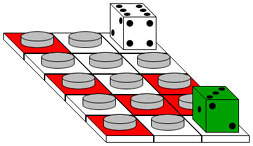 The white player does have at least six counters in her collection. She takes her counters, and places them in the empty unnumbered spaces.
Now she has to decide which way she will rotate her die. She can rotate it 90 degrees on any X, Y or Z-axis. She could turn it clockwise, counter-clockwise, or vertically (putting a new number on top of the die).
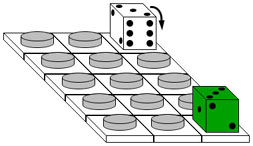 The white player rotates her die so that the previous top number is now on the side. Assuming there is enough space below the example, her die could now jump over the green player's die on her next turn.
If she decides to rotate this die in a later turn, it will only cost her three counters. Dice with low numbers on top tend to be very mobile, while higher numbers let a player get rid of more counters at once.
In the rare case that a player has no moves that they can make, that player must pass their turn. The only time a player may pass is when they are forced to. Otherwise, a move must be made.
When a die is on the opposite side from where it started, and it's in a numbered space that matches its top number, that die becomes "locked". A locked die cannot be moved or rotated by its owner. Locking dice is necessary to win the game.
Ending the Game
When a player has locked all three of their dice, and they have no counters in their collection, they win the game. A player can lock all of their dice even if they have counters left, but they do not win. If all but one player manage to lock their dice without winning, the last player with free dice wins.