Glenmore
Park Natural Therapy
More information
about,..."Iridology"
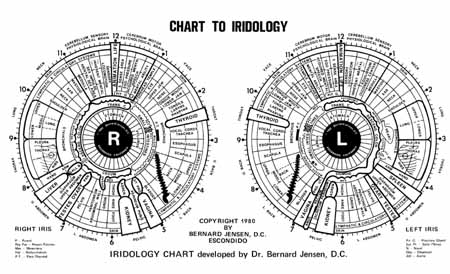
Iridology
has its roots in ancient times
dating back about 1,000 B.C.. Stone slabs were found depicting a
relationship
between the iris and other parts of the body. Hippocrates, the father
of
Western medicine, also makes reference to the iris as a means for
assessing
the body's parts. In the seventeenth and eighteenth centuries, various
books were published on the subject of using parts of the eye as a tool
for gathering general information about the overall state of the
physical
body. It was not until the late eighteenth century, however, that
Iridology
really started to take hold in the assessment of physical conditions as
an aid in the treatment of illness.
What is Iridology ?
Iridology is the process of assessing the
condition of the body's tissues through a comprehensive study of the
iris
and the sclera of the eye. By reading the topography of the iris, a
trained
practitioner can specifically locate various weaknesses and toxicities
in the body, as well as the severity of any particular condition. The
study
of Iridology is a powerful tool for assessing underlying tendencies
which
may be a factor in the cause of disease. Where Allopathic medicine
primarily
deals with symptomology, such as prescribing Aspirin for fever for
instance,
an Iridologist uses symptomology to help guide him/her to the
underlying
cause of illness. Disease is a label given to a specific collection of
symptoms, and as Iridology is not concerned with labels per se, the
Iridologist
will rather examine internal patterns which hold the key to their
original
source. Although Allopathic medicine does use the eye to assess several
medical conditions, traditional Western practice has yet to give
Iridology
any real credibility.
Iridology works through the central
nervous
system. The brain, being the central processing unit of the body,
allows
the whole body to communicate with all of its parts. The optic nerve,
as
an extension of the brain, carries the energetic impulses from the body
to the fibres in the iris, where the condition of the body's tissues is
reflected. This is very similar to Reflexology and Pulse Diagnosis,
although
the iris reveals far greater detail about the body's functioning than
most
other assessment systems. Once a practitioner knows what indicators to
look for, assessing and locating inherent systemic weaknesses becomes a
straight forward process. In Eastern Medicine, there are various ways
in
which a trained practitioner can read the condition of the body's
systems
through similar physical interpretations, such as Facial and Tongue
assessment.
What is seen ?
That which can be seen in the iris includes
hereditary and acquired conditions, the level or severity of an
illness,
emotional retention, as well as all of the body's systems and the
condition
of its tissues. Iridology is not a diagnostic tool, in so far as an
Iridologist
cannot actually see specific 'diseases' in the iris or sclera. If, for
instance, an individual has stones causing an irritation in the
kidneys,
then what will show in the iris is irritation in the tissues relating
to
the kidney region. Even if there is no irritation in the tissues of the
kidney from the stones, there may be indications of weakness in the
tissues
of the kidneys as revealed in the iris.
All conditions found in the iris of the
eye
are mutable, regardless of whether or not the indicators are hereditary
or acquired. The human body can always be cleansed and rebuilt,
regardless
of age. The key to retraining the system is to offer support in a
gentle,
natural way to those areas of the body which have inherent weaknesses
or
which have become toxic over time. In any case, there are always
positive
choices to be made in the treatment of an individual's condition.
More on Iridiology
Iridology is the art and science of evaluating
a person through the observation of their eyes. Specifically, the
colored
portion, the iris and to some extent, the conjunctiva, or white of the
eye, are used. This information enhances the understanding strengths
and
challenges within a body. The genetic makeup is demonstrated here, as
is
the level of tissue inflammation and toxicity.
The eyes have often been referred to as
windows
to the soul. Starting in the early 1800's, specific changes in the iris
were documented by doctors that were related to certain conditions.
Hundreds
of areas and signs have been defined. Although iris analysis is not
common
in the United States, it is popular in Europe. It is taught in medical
schools and used by many medical doctors.
Personality traits can also be seen
within
your eyes. This concept has been developed only over the past twenty
years.
More recently the concept of "Time Risk" has been introduced. This
defines
time periods when the body was more vulnerable to stresses with a more
damaging effect on the body. There is no other place that connections
between
the mind and the body are more evident.
The eye is like a language. Our
understanding
is only limited by our ability to interpret the symbols and signs.
Recent
European and Russian studies have been demonstrating the many
interconnections
and various interactions between the eyes and the body-mind.
How Does Iridology Work?
The iris has a very special makeup. Some
of the nerves leading to the front part of the eye are connected via
the
brain to cells throughout the body. These ocular cells are very unique
because they have characteristics of both nerve and muscle cells. They
are in contact with and react to changes within the body. This two-way
communication link is believed to influence how the body reacts or
heals.
Light affects an organ system through these nerves and the organ can
also
modify the appearance of the iris. By observing the change in
appearance,
the status of a tissue can be determined.
Each individual's genetic makeup is
unique.
The characteristics that we have inherited influence the way that our
bodies
grow. During the early stages of our development, the environment will
modify who and what we become. The iris is influenced by this and will
vary in appearance based on the body's constitution as it is formed.
Iridologists
can then determine the relative strengths of the individual. Some areas
of the body are not as resistant to stress. They may function
abnormally
and break down. The reaction of these different body tissues is evident
as inflammation or degeneration. When this happens the body manifests
symptoms
that we call disease.
This is not practicing of medicine or
optometry.
Iridology does not name diseases. It does not show past operations,
variations
of normal cells, pregnancy, cancer or a specific pathology by name. It
is not a psychic analysis but rather an empirical study that does have
the ability to view the interplay of the various parts of the body. A
person's
mental or personality characteristics may also be evident.
How Can Iridology Help You ?
The iris reveals where we are strongly or
weakly built. It illustrates how well our body handles stressors. Some
are very sensitive to stress while others seem to resist stress better
and have quicker recovery. The quality of the neural force in different
areas as well as the overall condition of the nervous system can be
evaluated.
Most of the other systems are also shown, including the endocrine,
circulatory,
lymphatic, reproductive, gastrointestinal, respiratory, skin, etc. The
inherent strength, toxicity and degree of function can be seen. Even
before
symptoms are present, iridology can enhances one's understanding of
those
areas that need attention. Whether one has a disease or just a risk
factor,
the iris is a valuable guide.
The evaluation involves a careful study
of
your eyes using an instrument called a Biomicroscope or Slit Lamp. This
allows for a detailed observation of the individual fibers and signs. A
special camera is also used to take photographs of your eyes for
reference
and for research. Questions and discussion will refine the analysis to
provide you the most accurate information. The sessions will often
exceed
an hour in length and may be taped. Although the microscope is bright
there
is nothing about the process that is invasive or painful.
After your iris analysis, your
understanding
of those processes that may have created health problems should be
enhanced.
Areas that are at risk can be identified. Nutritional and life-style
changes
that are supportive of these areas can be implemented to protect
against
stress.
For more information
regarding Iridology or how
Glenmore Park
Natural Therapy may be able to assist
you, email us today.

