 |
 |
 |
 |
 |
| Cities |
 |
|
 |
|
 |
|
| ROSIEZZite |
 |
 |
 |
|
|
|
|
|
|
|
| Sri-Lanka |
| "Once you discover, you must explore.." |
| Polonnaruwa |
| Anuradhapura |
| Sigiriya |
|
 |
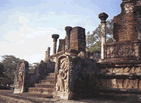
| The glory of mediaeval Sri Lanka is seen at Polonnaruwa, the mediaeval Capital of the Island about 216 km, south east of |
| Anuradhapura. Polonnaruwa, used by the Sri Lankan kings as a "country residence" from the 7th century, became the Island's |
| capital in the 11th century AD. Within the ramparts of the Royal Citadel are the ruins of the king's palace, the Council Chamber and the Royal Bath. The Sea of Parakrama is a giant man made irrigation reservoir. |
| About 205 km north of Colombo is Anuradhapura, the first capital of Sri Lanka, established in the 4th century BC that remained the Royal Capital for over ten centuries. Several magnificient dagobas, buildings, monasteries, ponds, irrigation tanks spanning one thousand five hundred years bear testimony to a glorious and technically advanced civilization. Ruvanveli, Jetavana, and |
| Abhyagiri are huge dagobas that stand majestically having withstood the battering of elements for over 15 centuries. |
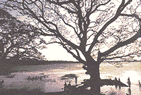 |
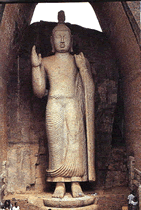
| Foremost among the numerous historical monuments in Anuradhapura is the Sacred Bo Tree, grown from a branch of the Bodhi tree under which the Buddha attained enlightenment. Among the extensive ruins covering the city of Anuradhapura are Buddha images, temples, palaces, bathing ponds, monasterins, hospitals, alms halls, and beautiful stone carvings and irrigation tanks. |
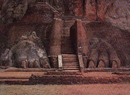
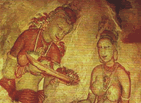
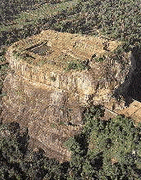
| Sigiriya, a city, palace and garden complex catering a 200 meter high rock is a glowing tribute to the vision of king Kashyapa who created this "Palace in the Sky" in the 5th century AD. On the summit of the Sigiriya rock (meaning the "Lion Rock") that is over 1.5 hectares in extent, are the remains of a large palace, the earliest surviving royal |
| palace in Sri Lanka, with several chambers and a bathing pond. In a shelterd pocket of the giant rock are the celebrated paintings of 5th century AD, a few that is remaining from around 500 paintings that once covered the rock surface. |
| Meticulously planned water gardens at the foot of the rock are the earliest such gardens found in Asia. The boulder gardens are a fine example of landscaping while conserving the environment. The Mirror Wall, which had been exposed |
| centuries still carry some of the original sheen that has given it the name. |
| to elements for over 15 |