NATURAL DESIGN
For centuries, many scientists have followed a basic assumption in their search for truth: that every set of complex questions has a simple, unifying answer. This has inspired scientists to create theories of simplicity and unity, and it has challenged them to seek new simplicities and unities when old theories became bulky and strained.
For a well-known example, let's look at the history of astronomy. Ptolemy proposed that the sun and planets revolved around the earth, and in the next few centuries this was the common belief -- and scientific "fact." However, as observations became more refined, his original diagrams had to be altered to fit the evidence. It took enormous mathematical effort to uphold the theory, because planets often did not behave in ways that made sense in a universe with the earth at its center. Kepler tried a new and simple approach: putting the sun at the center. Sure enough, the calculations worked very easily under this theory. Now it was just a matter of convincing the people -- and the Church!
The search for simple, natural design has fueled scientists' curiosity for all of recorded history. As the example above shows, sometimes the "find" is erroneous. But sometimes the pieces really do fit together with precision and elegance. The Greeks came upon a mathematical truth that became the basis of their science, art, architecture, and music, and to this day the truth still holds. That truth is a simple ratio -- 1.618, which they named phi.
Before explaining how phi could be so useful to so many fields, it would be wise to explore this number a bit. First, find the inverse or prime of this number by dividing it into the number one (in other words, work out the decimal for 1/1.618). Does the answer .618 look familiar? Just in case you don't think this is impressive, try doing this with any other number. You will find that no inverse comes close to looking like its original number. There is definitely something special about phi.
Now, take a standard-size credit card and measure its sides (preferably in metric units). Divide the length by the width and you will meet our friend again. Why? This is because modern graphic artists have learned something from the Greeks: the phi proportion gives the most pleasing visual effects known to man. (And if your credit card is pleasing to the eye, it's just one more incentive to take it out -- and use it!) The Greeks called this proportion the Golden Mean, and they used it in building their temples and other structures.
But why is the Golden Mean so pleasing? Why does it make the Parthenon, the Mona Lisa, and the United Nations building beautiful works of art? The answer lies inside our own bodies. Measure the face of a friend, from the bottom of the chin to the hairline. Measure from the bottom of the chin to the bridge of the nose (the point between the eyes). Divide those numbers. Does the answer look familiar? Now measure from the hairline to the tip of the nose. Divide that number by the whole-face measurement. Again, you should get the Golden Mean. Regardless of the size of the person, the proportion holds true. In fact, our entire bodies are full of the Golden Mean.
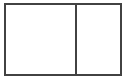
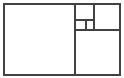
Your credit card can also be called a Golden Rectangle. If you construct such a rectangle, then draw another Golden Rectangle inside it, using the width as the length, and kept doing this until it was too small to measure, you get something like this:
If you connect the corners of the rectangles, you get a spiral:
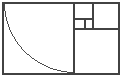
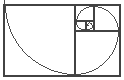
Is this a natural shape? Absolutely! Note pictures of spiral galaxies. Then check the arrangements of pinecones, whelk and nautilus shells, and sunflowers. The Golden Rectangles can also be taken apart to form five-sided stars. (For a graphic demonstration of this and other wonders, watch Disney's "Donald in Mathmagic Land" .) You can find evidence of such natural pentagrams in sand dollars and many flowers.
[See Links page for more examples and illustrations.]
It should be apparent by now that there is a natural design at work in the universe. Randomness is just an illusion when the design reveals itself. And just in case there is any question about how far the design goes, consider this: the phi proportion has even been found in the double-helix "ladder" arrangement of the DNA molecule, a structure that encodes hereditary traits through its chemistry and geometric design. So from the macro to the micro, the design is in place, and we humans are gloriously caught in the middle of it.
But how does all this relate to human function and human development? To start answering that question, let's turn again to the science of mathematics.
Natural Progression
A Renaissance mathematician named Fibonacci discovered a unique sequence of numbers. He started with 0 and 1 (a natural starting point) and added them to get the next number. Now he had 0, 1, 1. Then he began to add the last two numbers of the sequence to produce the next. This is what appeared:
0, 1, 1, 2, 3, 5, 8, 13, 21, 34, 55, 89, 144, ...
It turns out that these numbers appear in natural design, such as in the number of concentric spirals in a pinecone or sunflower, and the number of seeds in each spiral. And if this were not enough evidence that they relate to the Golden Mean, consider this: as you move up the sequence, the relationship of any two consecutive numbers gets closer to phi. For instance, divide 34 by 21; then try 55 by 34; then 89 by 55. You will get closer and closer approximations of 1.618. So with the Fibonacci sequence, we can describe the Golden Mean not only as a natural proportion, but also as a natural progression. In fact, as you look at how the numbers quickly get larger, you can almost imagine them taking on a spiral shape of their own:
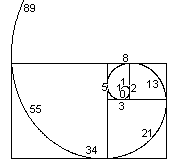
(As a convenience, the Fibonacci numbers will be presented as linear and equidistant for the remainder of this book. However, do not forget how the numbers actually depict natural design in progression.)
Now bear with this a bit more, and you'll see how this all relates to human development. When viewing the Fibonacci sequence, imagine that each number represents the beginning of a new cycle or set. This would mean that each previous number represents the end or completion of a cycle or set:
|
End of old cycle |
|
|
|
|
|
4 |
7 |
12 |
20 |
33 |
54 |
88 |
|
Start of new cycle |
0 |
1 |
1 |
2 |
3 |
5 |
8 |
13 |
21 |
34 |
55 |
89 |
Music provides some good examples of this idea. An octave, by its very name, is made of eight notes. However, the first and last notes are really the same, only in different registers. In fact, the sequence we call an octave is complete with seven notes; the eighth note is actually the beginning of a new octave or cycle. (See how that compares with the illustration above.) A chromatic octave, using the white and black keys on a piano, is considered to have 13 notes. However, the first and last are the same, so here the cycle is complete with 12 and restarts with 13. Again, this matches the illustration. Finally, count the number of keys on a piano. Whether conscious of it or not, piano builders traditionally complete the cycle just where natural design and progression would predict.
Using the Fibonacci sequence, a natural progression of human development begins to reveal itself. Look again at the number lines above. Imagine these numbers as ages in a person's life. Notice the numbers on the bottom row that represent beginnings of cycles and ages. Then notice the numbers on the top that represent ending or completions. Do you see some familiar patterns? The ages that have traditionally marked early childhood, adolescence, and adulthood seem to jump out at you, don't they? The numbers that mark the milestones of human life are the same numbers that express the perfect proportion found in all nature.
So how might this natural sequence or rhythm define natural development at the various stages of human existence? That is, how can the Golden Mean and phi and Fibonacci numbers help parents, educators, counselors, and caretakers discover and foster what is natural and healthy at each stage of life? The rest of this book will be devoted to addressing these questions. And to start the journey, we'll look at a couple of major themes in the human drama: The Purpose of Life and The Way Things Work.
Next Page Table of Contents