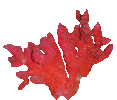
The chemistry of coral is involved in the forming of its skeleton, the limestone (calcium carbonate) skeleton. The tiny coral polyps secrete a limey substance that hardens into the coral structure. This substance is calcium carbonate ( CaCO3) with a small amount of specialized proteins also present in the coral skeleton.
There are two forms of calcium carbonate; aragonite and calcite. Their crystal shape differs though their chemical formula is the same. Aragonite is the denser form and is found in the hard or scleractinian corals. Whether the aragonite or calcite form is produced depends on the "seed crystals" growth pattern and the proteins secreted by the polyps.
The aragonite form is found in mollusc abalone shells. These shells have a "mother-of-pearl" layer in which calcium carbonate was supposedly produced in part, by specialised proteins found in the shells. The proteins were seperated, isolated and identified by polyacrylaminde gel electrophoresis, electro-elution, and amino acid analysis. The proteins of shells are generally acidic though a basic protein has also been found. It is thought to bind the insoluble matrix to acidic proteins in such a way that promotes the " mother-of-pearl" formation. |