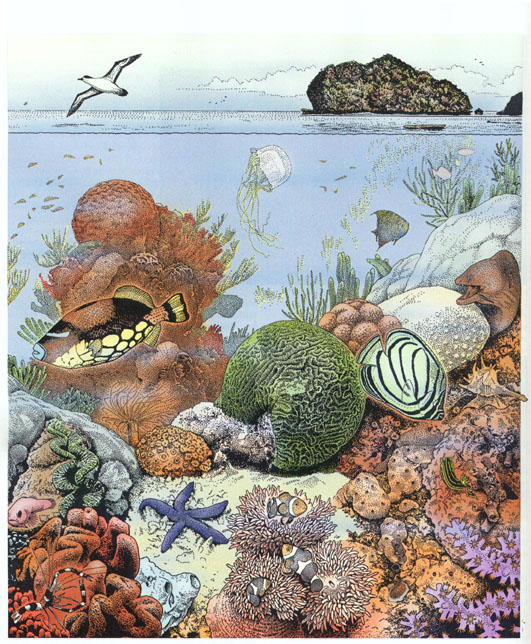
Coral is from the phylum Cnidaria, which aslo includes jellyfish and sea anemones. They are radially symmetric, diploblastic animals and coral is of the basic polyp form, meaning that it is a sessile animal that attaches the base of it's body to a surface, with it's mouth and tentacles facing upwards. The coral can make a skeleton of limestone (calcium carbonate) around its soft body to protect itself, and while each coral animal is small, they live together in large colonies all linked together as if they were one. These animals working together, are master builders, producing giant structures such as the Great Barrier Reef. Coral colonies vary in size; some only form small colonies, wereas others may form colonies several feet high. Star coral
(Montastrea annularis) colonies reach an average height of 3-4 meters. One of the largest corals, Fungia ( mushroom coral) extends 25 cm in diamter where as others average 1-3 mm in diameter. Almost all types of coral polyps and some other cnidarians contain algae (zooxanthellae) inside their epidermal cells. The algae and the polyp have a mutualistic relationship, the algae take in ammonia given off as a waste product by the polyp and return amino acids. The coral also recieves substances such as clucose and glycerol from the photosynthetic activities of the algae, which explains why coral reefs usually form near the surface of the water. |