 |
 |
|
 |
|
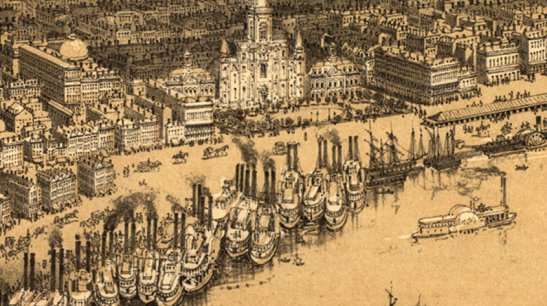 |
| New Orleans Port Side |
| In 1699 the first plans for New Orleans were born. French-Canadian Pierre le Moyen, Sieur d'Iberville left France to found a colony in the Gulf of Mexico. Sieur d'Iberville set up fur trading orginally on the north gulf coast, then moved the estabilishment to Dauphin Island. Once again, he moved the fort and created an inland colony near Loouisiana. Sieur d'Iberville was in charge of all France's responsibilities in the southern portion of the Louisianna territory. When Iberville died in1706 the land under his jurisdiction was given to his brother, Jean Baptist de Moyen Sieur de Beinville. Beinville had great plans for the development of the French colonies and in 1717 he submitted plans for a new settlement for the Company of the West. In 1718 France agreed with Bienville's plans, and authorized him to establish settlement, according to his plans, 100 miles up the Mississippi River. Four years later the capital of the Louisiana territory was transferred to the new settlement known as New Orleans.The new colony was called "New Orleans"; in honor of the Duke d' Orlean, who had something to do with the funding of the new colony. The Duke favored John Law, the founder of Company of the West, the construction of New Orleans inclusive. The new growing, colony needed a government, so a democratic council was formed. New Orleans was under the rule of a law making body known as the Superior council which was formed in 1712. The Superior council was well liked by the people because it was a small representative democracy. During the 1720's Bienville was replaced as mayor by Sieur de Pierre. The colony did not experience much growth during this period of time without Bienville so he was appointed governor in 1730 and left the colony permanently in 1742. Spain took over the government of New Orleans in 1766. The Spanish sent the new governor, Antonio de Ulloa, to reign over their newest asset. Although the colony was completely populated by the French, there was not an immediate oppositiion to the Spanish government. The French had treated the colonist poorly. The little property that the colony manintained was dependent on France and the French Markets. The only thing Governor Ulloa wished to do was replace France with Spain and the French markets with the Spanish Markets. The colonist were indifferent to a distant change such as this. The first group to reach New Orleans had been the French . The French in America were called Creole , it comes from the Spanish word "criollo"; meaning white of French descent. As far as most of New Orleans was concerned, "Creole"; meant white American born people. The Creole are generally high in social status. The Creole are accredited with keeping the "France" in New Orleans. They kept their traditions and beliefs in the new world. Bastille Day was celebrated widely by the Creole, they rose the tricolor French flag, and celebrated as they would have in France. Over all the Americans dislike the Creole, they look down upon them for many reasons, one of these being their devout Catholicism. A group often confused with the Creole were the Cajun. "In reality the , the difference between Creole and Cajun is not quite so simple. In the strict definition a Creole would have been either white or black. Being the full blooded descendent of a French or Spanish settler or a slave of any other nationality or race with one of the aforementioned settler types. The word Creole means literally in Spanish, 'child born in the colonies', as opposed to a child born in Europe or any other Nation around the world. Cajuns on the other hand were decendants of French Canadians who lived in Novia Scotia since 1604....'; The Acadians were given the name "Cajuns'; by the New Orleanians. These new settlers arrived against their will in 1740 The Acadians in Canada in a place called l'Acadia meaning literally "the Heaven on Earth'; , because the land was so extremely fertiel and they were so extremely happy there. The Cajuns were kicked off their land, put on boats and sent down the Mississippi to Louisiana. They settle on farms outside of New Orleans. The slowly estabilished themselves as excellent farmers and were able to catch fine prices for their crops. The Germans also immigrated to New Orleans. There were three major immigarions to Louisianna, the first of which was in the late 1740's due to many European Revolutions. The Germans liked the French area of Louisiana because there was farm land of the same quality they were accustomed and the same religion was practiced amongst their people. They settled on farm land far north of New Orleans. They found the land highly unpleasant and farming almost impossible, and they became discouraged. Many returned to New Orleans planning to board the next ship bound for Europe to live as they had before. The New Orleanians convinced them to settle in the area again, this time just north of the city on the banks of the Mississippi River. There new home was soon known as le Cote Allemand, or the German Coast. Another European group to move to New Orleans were the Irish. Ireland at the time was under British control. The Irish were being oppressed because of their religion in their home country and they needed a sage place to go. New Orleans was extremely popular amongst Irish colonials because it was a Catholic settlement with absolutely no British ties. The Irish in New Orleans were poor, it was hard to find jobs, and they were struck with an outbreak of yellow fever. People in New Orleans were quick to criticize that the Irish brought the desease with them. Although many Irish became sick and died from the epidemic they became relied upon immensely in the work force, a big change from their earlier proverty stricken lives. During a brief period from 1708 to 1710 it became illegal to import slaves from other countries, so the value of a purchased laborer sky rocketed. Farmers did not want their expensive human property to perform the extenuating jobs, so the Irish were hired to fill the recently vacated physically taxing positions. Yet another group of Europeans that immigrated to America were the Italians. The Italians fit extremely well into the economic system of New Orleans and were essentually just another group of people joining the work force. The Italians arrive in the mid 1740's to the early 1750's, and cause no major problems in the community, until they attempted to maintain their heritages just as the other ethinic groups were attempting to do. The Italians were Catholic, as were the rest of the city, but their celebration of a different patron Saint caused a few problems. When the Italians first began the commemoration of their faith the festival conflicted with other religious plans and a group of Italians were lynched for this reason in 1747. Italy was outraged so Louisiana, in an attempt to deter an international incident, paid a monetary compensation to Italy which solved any international problems that might have resulted. A group of non-Europeans in New Orleans were the Africans who started arriving in the early 1700's. A few actually immigrated on their own accord simply wanting to settle in New Orleans, however most were brought here against their will as slaves. Though slaves from all nationalities had been here since the beginning of the settlement. New Orleans is the safest , fairest place for slaves to live with even the laxest of laws imposed on slaves. Slavery was not revered by the entire population as quoted by du Lac Perrin "(Slavery) the greatest of all necessary evils, as well as those who endure it, as well as those that are obliged to employ its victims." The slaves in New Orleans were given many freedoms. Some slaves were able to eventually purchase their freedom, though most that did were well past the three quarter mark of middle aged. Some slaves were even bought and used under the idea of indentured servant slaves, thus having a contract of servitude which meant they would be freed once the time frame stated was served. People who ended up in this situation usually did so in one of the following ways, signing an indenture to secure passage to America, court or authority imposed indenture due to debt, or performing some illegal act and getting caught. Slaves were given Sundays, holidays, and other religious feasts off or were compensated for working on those days. On their commitment free days, slaves could work for themselves, some that saved wisely could buy their freedom eventually, though it was not something that commonly happened. Also, to insure the well being of slaves, only those who were capable of properly feeding, clothing and houseing them were allowed to buy them, those that are unable to cover the costs of these duties can not legally secure a slave. Though many did on the black market, and those slaves were usually not treated very well at all. The local government increased restrictive slave laws. The slave trade became increasingly viscious in New Orleans, until ulitimately in the early 1750's to date New Orleans became the slave emporium of the country. Slave auctions and sales are almost daily occurences. Slave retail is now a lucrative industry, windows showcased auctions and slaves line the auction house streets. In a city with so many ethinic groups and varying cultures, each to which religion is extremely important, their differences have had to be addressed. The religion of the colonist greatly effects the aura of New Orleans. Each one dutifully following traditions and celebrations that are now all a part of New Orleans culture. The religions here integrate, conflict, yet still manage to compliment each other in unique and interesting ways. Originally the most widely followed religion in New Orleans was Catholic. When the fur traders first arrived in America, they were not considered very religious, in fact they were almost regarded as faithless, but they had been raised in the Catholic faith. Once families began to form in the colony Catholicism prevailed as the Religion of choice. Settlers from Ireland and Italy had great celebrations for the patron Saints they worshipped, Saint Patrick and Saint Joseph perspectively. Saint Patricks day is celebrated on March 17th. There are parades, festivals, balls and community picnics. The Irish are proud of their holiday and bost it proudly amongst the community. The Italian settlers celebrate Saint Josephs day . They have magnificent vigils, masq. balls, and build extravagent alters to Saing Joseph. They had promised if they reached America safely they would annually build an alter in praise of him. The celebrations became competitions through the years and the festivals became larger until they were eventually called carnivals. The period of celebration before lent. The Catholic Religion has many ceremonies and traditions that are practiced within the churches. An extremely important religious festival in New Orleans is the Carnival. The Carnival has been celebrated since the founding of the settlement. Originally called by the French "Carnelevament", meaning litterally "putting up the meat" , the festival was shortened to "Carnival"; by the settlers. Integrated into the theme of the Carnival is the celebration of Mardi Gras (Fat Tuesday) which marks the end of the Carnival season. Carnival season lasts from January 9th through February 5th. Which is Mardi Gras next year so do plan ahead for your costumes, and party dates should your character desire to throw a masquerade. Carnival is celebrated loudly by the entire population of New Orleans. Mardi Gras is a time masked balls, parades, yard parties and picnics. People come from all over for the celebrations some times as far away and New York Territory. A side from Christian religions a few immigrants follow the religion of Voodoo. Voodoo is extremely propular and supported by superstitions and folklore that is fiercely believed in, in this area of the world. The belief is that possession of spirits is possible, and if the spirit possesses you, you have reached the height of religion. Followers of Voodoo do not believe in reincarnation, but they do follow the belief of worship of ones ancestors. The experiences their predecessors had and the information they received can be possessed by anyone who worships them. The religion was introduced by the immigrants from San Domingo. Voodoo priests and priestesses are said to have great powers through the ceremonies, rituals, and concoctions they put together. It is also said that they are not people to back in a corner lest they turn those powers against you and/or those you care about. There are many types of people in our world here, so do come and role play here if you dare to take the chance on becoming in slaved, indentured, or involved in some of the local superstitions or folk lore that is in actuallity reality. Or perhaps you would prefer to get involved in marketing slaves, handling indentured servants from abroad, or the import and exportation of contraband, maybe dealing with the pirates that frequent our ports or actually call New Orleans their port of call. You might be the wealthy black sheep of your family who is looking for a place of refuge, the wayward rich girl who got herself knocked up and is hideing from her family, a rogue , rake, or gambler who enjoys the finer pleasantries of life, or just someone seeking a place to call home. Either way all are welcome to come and join in the fun and add their own twists to any of the lines of role play going on here, or start a new line of their own. We hope to see you soon, Madame Rose |
 |
| This information has been altered from the original text it was taken from. A simple College Essay on the history of New Orleans was used to come up with the history and time line for this room as well as information about the history of America found on line. Dates and historical facts have been altered for the soul purpose of creating a role play room we think most can feel comfortable in and have fun role playing. It is a fictional place merely remotely based on historical facts and a true geographical location created for the purpose of offering a versatile realm to role play in that has an air of reality.The true history of the area allows for the population to be from all around the world, New Orleans even back then was known as a smelt pot because it so quickly became the home and harbor for so many immigrants from such a wide range of nationalities. For the purpose of role play the time frame has been altered to better suite our needs. Below you will find a brief history for this fictional realm to help you become better oriented with it. Hope you enjoy and find it interesting. Madame Rose |
 |
|
|
|
 |
 |
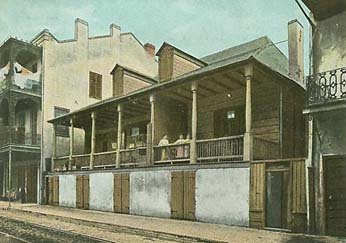 |
| Madame John's Legacy - Brothel in French Quarters |
 |
|
| BACK |
| NEXT |
|
| HOME |