Thomas Andrews
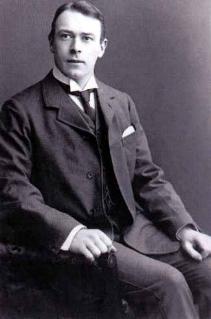
In 1884, Thomas Andrews, like his father before him, was entered into the Royal Belfast Academical Institution at the seemingly-tender age of 11, but left in 1889 when he was 16 to begin working for Harland and Wolff as a premium apprentice.
This meant that his parents paid Harland and Wolff anything up to �100 when he started his apprenticeship, and in return, Andrews would be guaranteed a position at the shipyard at the end of his apprenticeship.
Despite the fact that the owner of the shipyard, Lord Pirrie, was Andrews� uncle, he certainly didn�t seem to enjoy any favouritism; Andrews worked hard during his apprenticeship, and in time, this would be duly recognised by the shipbuilders in the near-future.
In 1901, Andrews was made manager of the construction works at Harland and Wolff, and in the same year he was also made a member of the highly-esteemed Institution of Naval Architects, not bad going for a 28 year-old. Around this time he was heavily-involved with the construction with the White Star Line�s �Big Four�, the quartet of Celtic, Cedric, Baltic and Adriatic.
In 1907, Harland and Wolff rewarded Thomas Andrews� hard work and sheer enthusiasm for shipbuilding by making him Managing Director.
Andrews had previously travelled on 3 other ships� maiden voyages, the last of the Big Four, Adriatic, in 1907, Oceanic, and of course, Olympic. Now, as 1912 loomed, he would be making the trip to New York again, aboard the largest vessel in the world... Titanic.
As for Andrews himself, he seemed to have no thoughts whatsoever of self-preservation, instead preferring to ensure the safety, indeed the very survival of other passengers. Around 2.10a.m., a steward making his way upto the boat deck, John Stewart, saw Thomas Andrews staring at Norman Wilkinson�s painting
�The Approach To Plymouth Harbour�, which hung proudly above the mantlepiece in the First Class Smoking Room.
Stewart asked, �Aren�t you even going to try for it Mr. Andrews?�
Andrews never replied, and his eyes remained fixed on the painting, his redundant lifejacket lay nearby on a table.
No one would ever see Thomas Andrews again, his body was never recovered.
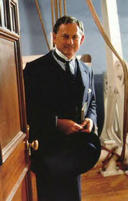
"T. Andrews" in The Movie Titanic
<<