

|


|
Hearing
Loss A recent survey on my system has revealed that the vast majority of visitors here engage in touring activities with their bikes (based on the sample that responded.) I thought it would be appropriate, therefore, to post an article on a threat that is largely restricted to those of us that ride our bikes over long distances and over the years. That threat is to the loss of your ability to hear. As you read further you will find that it has already happened to you, it will get worse, and that your helmet is an inadequate defense against it. It turns out that wind noise does the most damage to your hearing. It is constant, loud, and very difficult to get away from. At highway speeds you will find that wind noise is well over 100 db, even when wearing a helmet! Wearing a helmet cuts the noise by only about 3 db, and then only if it is at least a 3/4 shell and properly fitted. (An improperly fitted helmet actually INCREASES wind noise!!!) ONE HOURS of exposure to 110 db will damage your hearing. At 115 db it takes only 15 MINUTES. The damage is relentless, irreversible, and cumulative. Following is a chart demonstrating wind noise at 30 MPH and 60 MPH within various brands of helmets as published in a 1991 issue of Motorcycle Magazine. 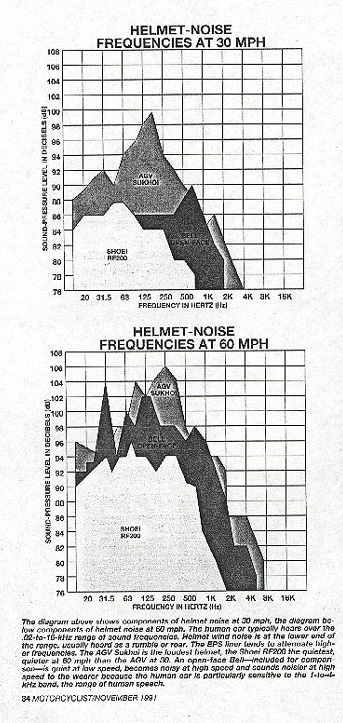 What
can be done about this? How can we protect our hearing from wind
noise? What
can be done about this? How can we protect our hearing from wind
noise?Well, first, you can make sure that you wear a helmet, that it is at least a 3/4 shell, and that it fits properly. A properly fitted helmet has a lining that presses against the skin on your cheeks as well as across your forehead. Not only does your helmet not shift around on your head when it fits properly, but it cuts wind noise from reaching your ears. Second, you can wear earplugs. There are some problems associated with doing this, not withstanding the fact that in some states it is illegal to do so. (You can legally drive a motorcycle if you are deaf, but not wear earplugs - fancy that.) Aside from the law, many people simply cannot stand (or get used to) wearing them. And, if they are improperly inserted, provide very little noise reduction benefit and will hurt in no time at all. Earplugs are cheap. You can buy good quality earplugs by the dozens and their cost will be less than $1 a pair when you do so. (I cannot imagine buying one pair and reusing them day after day - what a foolish way to save a penny.) If earplugs are not for you, then try small pieces of cotton. They are more comfortable, though not nearly as effective, and I'll guarantee you don't reuse them just to save a penny or two. Wearing earplugs of any kind, it seems to me, is counter-productive at speeds below about 40 MPH. But if you ride our highways for any distance at all you will CERTAINLY be better off having worn them (and, by the way, you will actually be able to hear better with them in your ear than not at those speeds.) Just because your hearing is already a 'little' damaged from wind noise you should not think it can't get worse. Riding a motorcycle at highway speeds is a GUARANTEED way to damage your hearing - and potentially profoundly. The majority of our hearing needs involves frequencies below 16 KHz. These sounds are what we use when we talk (and listen.) These also happen to be the frequencies most affected by wind noise hearing damage. Or, if you prefer to ignore this bit of advice, practice saying 'Huh?' But don't get used to doing that - expecting this minor inconvenience to work forever. Your hearing will get worse. For perspective, a noisy restaurant produces about 80 db of noise. A subway produces about 90 db of noise. A rock band generates about 110 db, a car horn is about 115 db, a gunshot is about 140 db. Osha says that hearing loss can begin at 90 db. Max safe exposure at 110 db is 1 hour, and only 15 minutes to sounds in excess of 115 db. Return |