ABSTRACT
Techniques used in Corrosion Monitoring
Corrosion monitoring is one of the basic functions required for safe and efficient industrial operations. This paper presents an overview of the various corrosion measurement technologies that are available for monitoring industrial process systems.
Some of the many techniques available that are presented in the paper are:-
1) Corrosion Coupons - Coupons can be weighed to determine the extent of mass loss corrosion. In some cases, valuable information on the nature and distribution of corrosion can also be assessed.
2) Electric Resistance (ER) technique - ER probes utilize the change in resistance produced by the change in cross sectional area resulting from corrosion.
3) Linear Polarization Resistance (LPR) technique - LPR probes utilize the relationship of Potential vs. Current on a corroding electrode to determine a value of LPR.
4) Electrochemical Impedance Spectroscopy (EIS) - In EIS AC impedance of the metal-electrolyte interface is measured to predict corrosion rates and characterize systems.
5) Electrochemical Noise (EN) - It is a monitoring technique which directly measures naturally occurring electrochemical potential and current disturbances due to ongoing corrosion activities.
The paper also highlights the limitations and advantages of the techniques mentioned above.
Ronak Vakil
Yugin Gupta
T.E.Chemical
Students of D.J.Sanghvi College of Engineering
Introduction
Corrosion is a natural process, which can attack any metal or alloy under the right conditions. Corrosion is defined as the destruction or deterioration of a material because of reaction with its environment.
The cost of corrosion is tremendous. Since metals are so widely used in today’s world corrosion is al around us and can affect us in many ways. The corrosion of steel rebar in reinforced concrete can proceed out of sight and can suddenly result in failure of a section of highway, damage to buildings etc. Perhaps the most dangerous of all is corrosion in the process industries. Corrosion related failures in the process industries all too often result in catastrophic failures of piping and equipment which can cause explosion fires and release toxic materials to the environment.
Consider some of the direct and indirect effects of corrosion to the chemical process industry:
While the economic costs are frightening, we must consider them to be of secondary importance to the potential loss of life and damage to the environment.
It is essential, therefore, for operators of industrial process plants to have a program for controlling and measuring corrosion. On-line monitoring and control of process operating parameters and direct on-line monitoring of corrosion rates are essential to an effective program. Corrosion monitoring is one of the basic functions required for the safe and efficient industrial operations.
There are many purposes for corrosion monitoring in industrial systems. These purposes generally include one or more of the following:
There are various technologies that are available for monitoring industrial process systems. They range form non-direct to direct/intrusive techniques and include everything from simple corrosion coupons to electrochemical methods. These systems should be selected to meet the specific needs of particular plant requirements to minimize downtime and equipment failures.
The purpose of this paper is to introduce several of the more common techniques utilized for monitoring corrosion in industrial process operations and to define their advantages and limitations.
Corrosion Mechanisms
Corrosion is an electrochemical process in which metal atoms are oxidized to form positive ions (cations) while other chemical species are reduced. This results in a flow of electrons from one site to another on the metal surface. Consider the corrosion of iron in hydrochloric acid as depicted in the figure below
The overall reaction is described by equation no. (1)
Fe + 2HCl -> FeCl2 + H2 (1)
This reaction can be considered to be the sum of two reactions:
Fe -> Fe++ + 2e- (oxidation) (2)
2H+ + 2e- -> H2 (reduction) (3)
A site where oxidation occurs is defined as an Anode and where reduction occurs as a Cathode. The anodic and cathodic areas together form a Corrosion Cell and the reactions at each site are a Half-Cell. The hydrochloric acid in this reaction acts as an electrolyte. There must be an electrolyte for corrosion to occur. The current which flows in the corrosion cell per unit area is referred to as the Corrosion Current Density(icorr). Since icorr is a measure if current flow per unit time, it is directly related to units Metal Loss per unit time, which is how the corrosion rate is expressed (mils per year of metal thickness reduction ) so icorr is a good measure of corrosion rate in the cell.
Each half-cell reaction has a characteristic potential when compared to a standard reference electrode. While there are several measurement techniques available, we will use Redox Potential which is the potential of the half-cell reaction when it is at equilibrium in a solution of its own ions compared to the potential of a standard hydrogen reference electrode.
To be in equilibrium means that an equal number of ions are being reduced as are being produced by oxidation at any given time. Considering the iron half-cell of the figure above, this means that reactions (2) and (4) as shown are proceeding at the same rate.
Fe++ + 2e- -> Fe (reduction)(4)
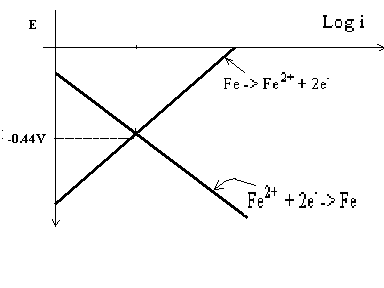
It can be demonstrated that each of these reactions has a potential-current relationship which can be drawn as a straight line on a semi-log graph, as shown in the following figure.
shown above the point where these reactions cross is the point of equilibrium and is, by definition, the redox potential of the half-cell.
The more negative the redox potential, the more reactive is the metal.
A graph similar to the previous one can be drawn for each cathodic reaction, and at equilibrium the oxidation and reduction reactions are proceeding at the same rate.
Superimposing the graph of of the earlier one and the potential curves for the hydrogen half-cell gives us a polarization diagram for the complete corrosion cell of Fe-H2, as shown below:
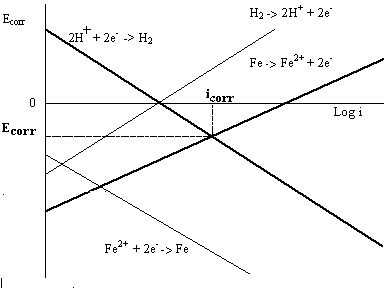
Polarization Curves for Iron-HCl Corrosion
Polarization is defined as the change in the potential of an
electrode from the open circuit potential (i.e. at zero current flow) to the
potential resulting from a current flow. The redox potential of any half-cell
is the same as their open circuits potential, since there is no net current
flow in the half-cell. However, we know that once the iron and hydrogen half-cells
are connected electrically, a corrosion current flows in the cell. Since the
two half-cells are now connected through metal with negligible electrical resistance,
the two half-cells must now be at the same potential for all practical purposes. The point where the curves cross is defined as the Corrosion
Potential, or Ecorr, of the cell. Each half-cell has been polarized
due to the flow of current in the cell, icorr . It may also be seen
from the graph that the reverse reactions in each half-cell (iron reduction
and hydrogen oxidation) proceed at much lower than equilibrium rates and are
usually negligible (note the logarithmic scale on current) but they do not disappear!
The Tafel Slope, used in electrochemical measurement techniques, is the slope
of the straight line for the anodic or cathodic reaction. Note that the redox potential of the anodic iron reaction is
more negative than that of the cathodic hydrogen reaction. In all cases, if
the metal has a more negative redox potential than the cathodic reaction, it
tends to be corroded. We would not, therefore, expect copper with a redox potential
of +0.34 volts to be corroded in a de-aerated HCl solution since the redox potential
of the metal half-cell is more positive than the only possible cathodic reaction,
hydrogen reduction. If the HCl solution is free of dissolved oxygen, our prediction
holds true –no corrosion occurs. Returning once again to the iron-HCl corrosion cell in the
first figure, we might expect for corrosion to eat a hole through the metal
at the anode, leaving the cathodic areas untouched. This does not happen, however.
In an oxygen-free HCl solution Uniform Corrosion (sometimes referred to as General
Corrosion) actually occurs with the iron being corroded away in a more or less
uniform manner over the entire surface. To understand why this happens we must
look at the effect of the cathodic reaction on the concentration of hydrogen
cations. As the reaction proceeds, hydrogen cations are consumed to form hydrogen
gas. This causes a reduction in hydrogen cation concentration at the cathode
compared with the anode, where no depletion of hydrogen cation occurs. But it
can be shown that an area with a greater concentration of hydrogen cations tends
to be cathodic to a site with a lesser concentration. Thus, the anode and cathode
are constantly reversing as a direct result of the effect the reaction has on
hydrogen cation concentration. These changes occur continually and on a microscopic
level so the whole surface appears to be corroding at once. Now that we have a basic understanding of the electrochemical
nature of corrosion and the behavior of metals in corrosive fluids, lets examine
a Galvanic Corrosion Cell. We are all familiar with the corrosion of ferrous
metals (e.g. steel) when in contact with copper-based materials (e.g. brass).
Why does the iron corrode leaving the copper alone? We know that the redox potential
of copper is +0.34 and of iron -0.44, a difference of 0.78 volts with iron by
far the most negative. Since the more negative area is anodic, the steel corrodes,
and the brass is protected. Oxygen in a solution dramatically increases the rate of corrosion
due to its effect on cathodic reactions and can also be an important contributing
factor in some of the more dangerous forms of corrosion, Pitting and Crevice
Corrosion, especially in more active metals. Crevice corrosion occurs in crevices
found at gaskets, lap joints, bolts, rivets or under deposits of scaling materials,
corrosion products or dirt. Pitting is similar to crevice corrosion except that
the initial pit usually results from failure of a passivating film at one point
or from some other similar surface imperfection. Unlike crevice corrosion, therefore,
its location cannot be predicted. The oxygen concentration in a crevice or pit
is lower than on the rest of the surface because the fluid in the crevice or
pit is stagnant while the majority of the surface is exposed to fluid flow which
tends to replenish the dissolved oxygen supply. Unlike uniform corrosion, however, the cathodic and anodic
sites do not change location in such Oxygen Concentration Cells, so the pit
or crevice remains anodic and corrosion proceeds much more quickly at that site.
In many processes, therefore, particularly high-pressure water systems (e.g.
oil field waterflood and boiler feedwater systems), equipment and/or chemicals
are added to remove dissolved oxygen. Other types of Concentration Cells (e.g.
metal ion) can have similar effects. Another important concept is Passivation. In some metals, initial
corrosion produces a thin coating on the surface which protects the underlying
metal from further corrosion. This is why aluminum is suitable for use outdoors;
an aluminum oxide film makes the metal passive to further corrosion. Stainless
steels derive their resistance to corrosion from an oxide of chromium, the primary
alloying component in stainless steels. Erosion Corrosion occurs when high velocity fluid flow and/or
flow of abrasive materials prevents formation of protective films, allowing
fresh material to be continually exposed to the corrosive environment. Fretting
and cavitation are each special forms of erosion corrosion. Exfoliation is characterized by the flaky, blistered appearance
of the surface and is common in aluminum alloys. Selective Leaching involves the removal of one element in an
alloy; dezincification (the removal of zinc from brass alloys) is the most common
example. Inter-granular Corrosion is a localized attack at the grain
boundaries, which proceeds much as pitting corrosion, but along grain lines
primarily due to small differences in metallurgical properties. Stress Corrosion Cracking (SCC) can occur when a metal is both
stressed and exposed to relatively mild corrosive conditions, causing the metal
to fail at applied stresses well below predicted mechanical failure levels.
The most notable example is the cracking of austenitic stainless steels (e.g.
type 316) when exposed to environments containing the chloride ion. SCC is an
anodic process which can be reduced or eliminated through CP. Hydrogen-Induced Cracking (HIC) is similar to SCC, and occurs
under stresses which would not ordinarily lead to failure but which are made
worse by corrosion processes. HIC is, however, a cathodic process in which the
presence of atomic hydrogen (H+) is important. HIC occurs most often
in environments containing poisons which inhibit the formation of hydrogen gas
from atomic hydrogen at the cathode. Hydrogen sulphide (H2S) is the
most noteworthy of these poisons. Being a cathodic process, HIC is actually
made worse by cathodic protection systems. Microbiologically Influenced Corrosion (MIC) is the result
of the growth of bacteria and other biological organisms in a system, causing
or worsening corrosive conditions. Generally, the types of corrosion encountered
are similar to other forms of localized corrosion as discussed previously.
Techniques of Corrosion Monitoring
In this paper, measurement of corrosion refers to any technique which can be used to determine the effects of corrosion :
A comprehensive corrosion control program should include several techniques since no single technique is capable of providing the information necessary in a timely manner. An overview of measurement techniques is presented below .
Radiography (X-Ray) permits two dimensional views of the piping or equipment walls and is suitable for detecting major flaws or severe corrosive attack. Radiography is not suitable for detecting small changes in residual wall thickness due to accuracy limitations.
Ultrasonic Measurement techniques are similar to Radiography in that specialized equipment are required and techniques are almost exclusively used for inspection than online monitoring. Depending on the intensity of scan information from simple depth measurements, to 3 dimensional views of the surface can be obtained. These are less used in process industries because of cost, speed of coverage, and very large quantity of data produced.
Visual Inspection is almost not practicable for online corrosion monitoring. However, visual inspection should be carried out to verify the results of on-line corrosion monitoring programs and choose new sites for monitoring.
Destructive analysis should be performed whenever possible. For exaple when a pipeline is being replaced for another. Such sections should be inspected for any unusual corrosive activity.
Chemical Analysis involves the monitoring of the products passing through a pipe or equipment which is being corroded. These products should be monitored for unusual levels of corrosion products.
Corrosion Coupons
Coupons are the oldest and the simplest device used in monitoring of corrosion. Coupons are small pieces of metal, usually of a rectangular or circular shape, which are inserted in the process stream and removed after a period of time for study.
The most common and basic use of coupons is to determine average corrosion rate over the period of exposure. This is accomplished by weighing the coupon before and after exposure (coupons must first be cleaned following exposure to remove corrosion products and any other deposits) and determining the weight loss. The average corrosion rate can easily be determined from the weight loss, the initial surface area of the coupon and the time exposed. The most common method for evaluating mass loss corrosion rate is with the following equation:
Corrosion Rate = 354 M/Adt
where M = mass loss resulting from the difference in initial and final specimen weights (mg), A = coupon surface area (in2), D = material density (g/cm3) and t = time of exposure (hours).
It is advisable to leave a coupon exposed for at least 30 days to obtain valid corrosion rate information. There are two reasons for this recommended practice. First a clean coupon generally corrodes much faster than one which has reached equilibrium with its environment. This will cause a higher corrosion rate to be reported in a short test than is actually being experienced on the pipe or the vessel. Second, there is an unavoidable potential for error as a result of the cleaning operation. A small amount of the underlying metal is often removed with the deposits, however, and if the actual metal loss from corrosion loss is small the effect of metal removed during cleaning would create a significant error. Care must be taken to correct for this effect. It should be recognized that a coupon case only provide corrosion data based on total weight loss divided by the total time of exposure. A major shortcoming of coupon monitoring is that high corrosion rates for short periods of time may be undetectable and cannot be correlated to process upset conditions.
Adjoining figure shows schematically the differences that can originate between average corrosion rate and "instantaneous" corrosion rate as a result of a upset in the process system. In this situation, it can be seen that the coupon averages the amount of weight loss over the period of exposure. It also assumes that the corrosion of the metal is uniform.

One of the most important roles of coupons is to provide information about the type of corrosion present. Coupons can be examined for evidence of pitting and other localized forms of attack. It is also important to remember that coupons or monitoring probes indicate the attack of the environment only at the point of exposure. It is important therefore that the coupons be installed at representative locations as close as possible to the critical points where corrosion measurements are desired. Conditions of flow, temperature, concentration etc. May change considerably only a few inches away from any given location, resulting in differences in the corrosion rates. Since corrosive conditions can change significantly from one location to another, coupon data is best used for relative comparisons and to obtain an approximate corrosion rate at a particular point in the system rather than to precisely calculate corrosion rate.
A useful parameter is the ratio of maximum localized attack rate versus general corrosion rate determined by mass loss. In many systems this ratio will be low indicating that the general corrosion rate is an accurate predictor or corrosion performance. In other cases, such as where oxygen ingress, pitting of stainless alloys and velocity accelerated corrosion, the local attack rate can be over ten times the general corrosion rate. Such differences are important when trying to assess the relevance of inspection techniques such as ultrasonic tests of remaining section thickness.
There are several other types of coupons available for specialized analysis. These include disc coupons, ladder coupon holders, welded coupons which are used to detect preferential corrosive action on weldments.
Electrical Resistance Technique (ER)
A typical ER probe is comprised of a sensing element that is basically a loop of material made from a wire or strip, which is used to conduct an electrical signal. When exposed to a corrosive environment, the cross-section of the loop is reduced which increases the resistance of the sensing element thus producing a change in the output of the ER meter.
Because of the very low resistances involved, very sensitive monitoring circuits are used in these instruments to measure the change in probe resistance compared to the resistance of a protected reference element connected in series to the corroding measurement element. A simplified diagram of a typical electrical resistance monitoring circuit is shown.
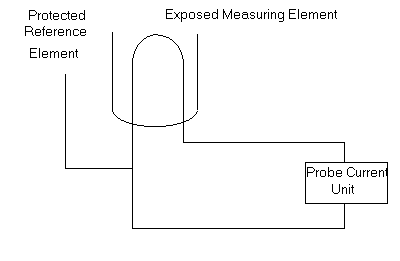
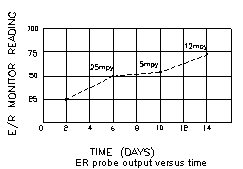
Typical ER data is shown in figure. It shows the ER output over a period of about 14 days. During this period the corrosion rate is initially 25mpy, then reduces to 3mpy and increases somewhat to 12mpy.
ER probes are basically automatic coupons and share many characteristics with coupons. A major shortcoming of coupon monitoring is that high corrosion rates for short periods of times maybe undetectable and cannot be correlated to process conditions. ER provides more frequent information on weight loss, and hence is used in continuous on-line monitoring.
As with coupons, ER probes must be allowed to corrode for a period of time before accurate corrosion rate measurements can be made. This is because a clean probe corrodes much faster than one, which has reached equilibrium with its environment. This will result in higher corrosion rate to be reported (in a short test) than is actually being experienced in a pipe or a vessel.
Probe Sensitivity Selection:
Consider an instrumentation to measure electrical resistance probe span into 1000 divisions. A probe with 2 mil span is therefore theoretically capable of measuring thickness changes of 0.002 mil.
In practice it is recommended that a change in indicated metal loss of 10 divisions or 1% of the probe span be required before the data is used to indicate corrosion upset rate. Indications of upward and downward trend can be obtained with as little as 4-division change, but care must be taken in interpreting such small changes because of other factors (e.g. Temperature changes) can also be responsible.
Thus the sensitivity of a probe with low span has higher sensitivity. However more sensitive the probe the faster it will corrode away and require a new probe to be installed.
For example, the comparison of Response Time vs. Useful Probe Life of CORROSOMETERâ is as under:
|
Elapsed Time to |
Corrosion Rate with 10mil Span Probe |
||
|
Early Trend Indication (4Div) |
Meaningful Rate Data (10Div) |
End of Useful Probe Life(1000Div) |
|
|
1.6 hours |
4 hours |
17 days |
5.6 mm/yr. |
|
4 hours |
10 hours |
1.4 months |
2.2 mm/yr. |
|
9.6 hours |
1 day |
3.3 months |
0.94 mm/yr. |
|
18 hours |
1.8 days |
6 months |
0.51 mm/yr. |
|
1.1 days |
2.7 days |
9 months |
0.33 mm/yr. |
|
1.5 days |
3.7 days |
12 months |
0.25 mm/yr. |
|
1.8 days |
4.6 days |
15 months |
0.20 mm/yr. |
|
2.2 days |
5.5 days |
18 months |
0.27 mm/yr. |
|
2.9 days |
7.3 days |
24 months |
0.13 mm/yr. |
Different styles of probes are suited to different applications. A wire-loop probe is more susceptible to pitting attack. This causes the wire-loop to corrode at a specific location and hence breaking the circuit when the pits have penetrated the element completely.
Cylindrical elements on the other hand are affected to a lesser degree by pitting because of the larger circumference of the measuring element.
Wire and tube-loop elements have a tendency to be electrically shorted by a bridge of corrosion-product. This is especially prevalent in low-velocity streams. The effect of such bridging is to reduce the measured metal loss of probe, indicating a misleadingly low corrosion rate.
Cylindrical probes demonstrate more resistance to such bridging due to their construction.
The main benefit of the ER technique is that it can be utilized in continuous on-line process monitoring. Multiple probes can be used to access various locations in the process stream. Telemetry can be used to send this information back to a central location so that corrosion rates and the effects of the process changes can be identified.
One of the best aspects of ER technique is that it does not require a continuous electrolyte current path to make measurements. Therefore, they work in multiphase environments that contain liquid hydrocarbons and they can be utilized for monitoring corrosion in non-aqueous and even gaseous process environments.
The limitations of the ER technique are that they provide representative data for general corrosion. They do not have the ability to accurately detect localized attack. ER probes while available in varying sensitivity, typically require several days to determine a reliable corrosion rate trend. Therefore, if the process is prone to rapid changes in corrosivity, ER probes typically may not provide accurate and reliable corrosion rate data.
In some cases, namely where H2S is present, they can be prone to error due to the presence of conductive sulfide corrosion products on the sensing element, which may lead to non-conservative results. The results of ER probes should be compared to those obtained from coupon exposures during the same time period. While ER data may not give reliable indications of the absolute corrosion rate, they can yield useful indications of trends and changes in plant corrosion activity.
Electrochemical Methods
Electrochemical corrosion monitoring is based on the assumption that corrosion is basically an electrochemical process that can be monitored through the measurement of potential and current that characterizes the corrosion process.
Thus electrochemical potential which indicates driving force and a current that indicates the rate of the process. This corrosion current can be converted to a loss of metal by employing Faraday's Law.
The main benefits of electrochemical methods are that they can provide faster and more dynamic information coming very close to being able to measure an "instantaneous" corrosion rate in the system. Therefore, it can identify rapid changes in process corrosivity.
Linear Polarization Resistance Method
In this method the instantaneous corrosion rate of a metal in a conductive fluid is found using the DC Linear Polarization Resistance (LPR) technique.
As described earlier, corrosion is an electrochemical process in which electrons are transferred between the anodic and cathodic area on the corroding metal resulting in oxidation (corrosion) of the metal at the anode and reduction of cations in the fluid at the cathode.
Stern and Geary demonstrated that the application of small polarizing potential difference (D E) from the corrosion potential (Ecorr) of a corroding electrode resulted in measured current density (im) which is related to corrosion current density (icorr) by the equation :
D E = babc______________
im (2.303 icorr )( ba + bc )
where ba is the Anodic Tafel Slope
bc is the Cathodic Tafel Slope
Since the Tafel coefficients are more or less constant for a given metal/fluid combination im is proportional to icorr which is proportional to the corrosion rate.
The above equation and the whole LPR technique are only valid when polarizing potential difference is very low (typically less than 20mV). In this region the curves approach linearity, hence the term LPR.
Inspection of the equation shows that D E/im is a resistance term called the Polarization Resistance, Rp. The resistance to the current flow between electrodes of a two-electrode LPR probe is the sum of polarization resistance values at each electrode and the resistance of the solution between the electrodes (Rs).
Thus,
D E = Im (2Rp + Rs)

The corrosion rate obtained from the LPR measurements is inversely proportional to the polarization resistance (slope of potential vs current plot). Therefore, high values of polarization resistance generally yield low corrosion rates.
From the above equation it is apparent that the LPR technique provides instantaneous readings of polarization resistance. In practice, however, the determination of the polarization resistance is complicated by the capacitance effect at the metal-fluid interface (double layer capacitance).
The following figure shows the equivalent electrical circuit of the corrosion cell formed by the measuring electrodes showing Rs and double layer capacitance.
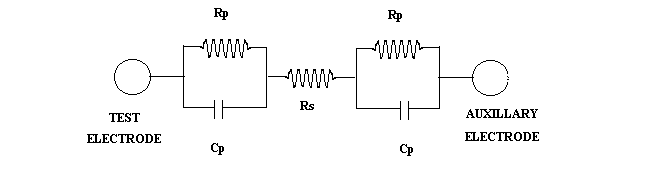
The effect of the double layer capacitance is to require a direct current flow to initially charge up the capacitors to the polarizing potential, resulting in the decaying exponential current flow. Thus the valid measurements of icorr and corrosion rate can be made only after the decaying current Im approaches current asymptote. The actual time required can vary approximately from 20s to 6 minutes, depending on the metal/fluid being measured.
Choosing too short polarization times can result in current reading much higher than actual, sometimes by a significant amount.
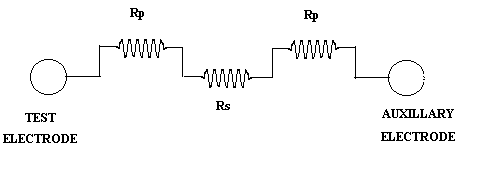
In most industrial applications, conductivity of the solution is high and Rs is low as compared to the polarization resistance Rp, hence can be neglected. In these cases, im is an accurate measure of the polarization resistance, and therefore corrosion rate.
However, if the solution resistance increases or the polarization resistance decreases enough to make the solution resistance a significant portion of the total resistance, then the accuracy of the LPR is affected. Such situations occur, at high corrosion rates (low Rp) and low conductivity (high solution resistance) and are manifested by the indicated corrosion rated being lower than the actual corrosion rate.
This analysis depends strongly on the ability to measure current flow through the solution. Therefore, it has limitations in many multiphase (e.g. gas/oil/water) systems and simply can not be used in non-aqueous and gaseous environments.
Standard analyses of electrochemical data usually assume the measured corrosion rate is the result of general corrosion. In actuality, many cases are observed where less than 10 percent of the surface of the specimen is actually corroding as is the case when pitting or other forms of localized corrosion is encountered.
In some environments, non-corrosion electrochemical reactions can lead to the measurement of current that does not contribute to corrosion. A common situation is that H2S or other soluble sulfur species can complicate electrochemical measurements since sulphur can be easily oxidized and reduced particularly at elevated potentials.
As in the case with ER probes, electrochemically derived corrosion rates should be compared to corrosion coupon data. Again, the trends may be meaningful, but the absolute corrosion rate values may be different.
Electrochemical Impedance Spectroscopy
One of the newer techniques is Electrochemical Impedance Spectroscopy (EIS) which utilizes an AC signal to excite or perturb the corroding specimen.
EIS monitors the electric response of the metal/fluid interface to the applied AC signal over a frequency spectrum usually in the range of 10kHz to 50microHz.
The principle advantage of EIS is the precision with which small sinusoidal perturbations can be measured in an electrically noisy environment and powerful methods that are available for analysis of electrically equivalent circuits.
One of the problems with EIS data is that the analysis is relatively complex compared to the commonly used LPR and ER techniques. The data representation above allows the separation of the various components of the system resistance that are assumed to be a part of the polarization resistance, that can lead to error in LPR corrosion rate measurements.
Most important of these components is the solution resistance in environments of low conductivity, which can be separated from the actual polarization resistance.
The main limitations of these techniques are that the analysis of the data is complex and its interpretation is not fully developed for all applications. They require application of a theoretical equivalent circuit to analyze and interpret the data. Quite often these techniques still require benchmarking with other more common corrosion monitoring techniques such as corrosion coupons before meaningful data can be obtained.
Electrochemical Noise
Electrochemical noise is a generic term describing the phenomenon of spontaneous fluctuations of electrochemical systems. It manifests itself in two guises, as potential noise or as current noise, depending upon the mode of measurement.
The sources of electrochemical noise may be classified in two categories.
Charge carrier effects contribute noise whose spectral density, the amount of noise present in a given bandwidth, is essentially constant over a wide range of frequencies and is of low amplitude. This category covers noise by charge being transferred in discrete amounts .
A second source of noise relates to surface processes occurring on the electrodes and specifically to their inhomogenities. These give rise to fluctuations at frequencies of approx. 1Hz. and below. The observed spectral density of these fluctuations in general varies with frequency and the amplitude can be much higher than that cause by charge carrier effects.
Measurement of Electrochemical Noise:
The measurement and analysis of electrochemical noise may be accomplished using either analog or digital equipment and techniques.
Potential fluctuations are measured between two ‘identical’ electrodes placed in a test cell. This arrangement minimizes the potential difference between the electrodes, enabling the voltmeter to operate on its optimal sensitivity range as the overall accuracy of measurement is limited by the resolution of the voltmeter.
Environmental changes tend to affect both electrodes equally, reducing the amplitude of such variations. The similarity of the electrodes also guarantees that any observed fluctuations originate from the test electrode.
In situations, where this arrangement is not practicable, measurements are best made using a suitable inert (noise free) electrode such as Palladium.
External electromagnetic interference does not affect the measurements.
General Characteristics of Noise Amplitude Spectra :
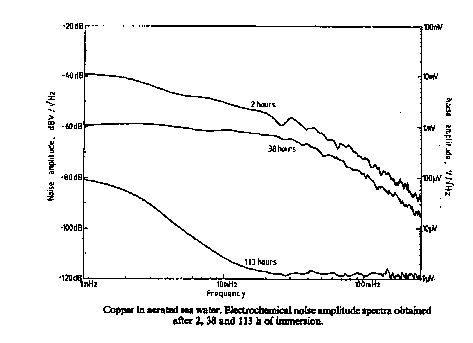
We consider the EN Spectra of Copper in aerated sea water which exhibits certain features.
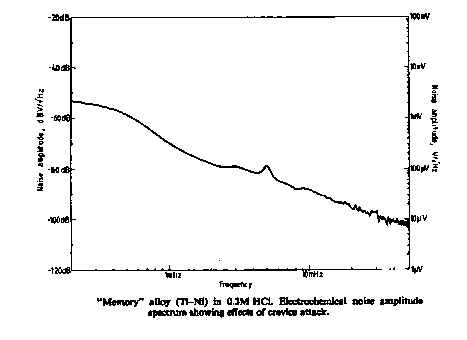
A roll-off of –10dB/decade indicates pitting attack
A sharp peak at a single frequency indicates crevice attack
Very little is know of the origin of these fluctuations and there is no single theory explaining its behavior, although certain mechanical models do exist.
This (1/f) type of noise, where the noise power varies inversely with the frequency should result in the slope of –10dB/decade on amplitude spectrum plot. Any additional slope is caused by secondary effects such as contribution of resistance – capacitance (R-C) combination
Therefore it seems possible to assume that the –40dB/decade slope observed is made up from the (1/f) noise contribution (-10dB/decade), a charge transfer-double layer effect (-20dB/decade) and a diffusion contribution (-10dB/decade).
It has been proposed, that there is a qualitative correlation between the rate of attack and RMS amplitude of noise. The data obtained so far indicates that the noise amplitude is independent of geometry and area of corroding electrode leading us to believe that it is related to actual penetration rate.
At this stage, it is difficult the quantify the findings. Although some of the features can be explained based on the knowledge obtained from Electrochemical Impedance, they may be inadequate and misleading.
However, this shows that real corroding electrodes maintain a state of dynamic equilibrium, the noise indicating changes in equilibrium and the spectra indicating the range of rates at which equilibrium can change.
Summary
Corrosion is an electrochemical reaction tending to convert metals into their ions hence causing their loss, which is undesirable. This leads to losses both in cost and safety of the structure, and hence proper monitoring is essential.
The rate of corrosion is not constant, but depends on many factors. Even small upsets in the process may trigger off major corrosion downstream.
Corrosion Monitoring is being done since long time, by methods such as Visual Inspection, X-Ray Radiography, and using Ultrasonic waves. However, each of these methods have limitations that they are not on-line. The effects of corrosion are seen after its effects have been manifested.
Corrosion Coupons is a conventionally used method in which the identical metal is first accurately weighed and allowed to corrode in a similar/ same medium. The loss of metal is determined and corrosion rate determined.
However, this does not provide a means of Online-Corrosion-Monitoring. The results are obtained only after about 30 days and if need be, corrective steps can be taken in further designs. Also it is not possible to pin-point out the exact cause of unaccounted corrosion.
The Electrical Resistance Method uses the simple principle of resistance to ascertain the rate of corrosion. As the probe gets corroded its thickness reduces registering the corrosion rate.
This can used in non-aqueous environments and in useful for monitoring corrosion due to gasses.
The difficulty with this technique is that although it presents good information about generalized corrosion but fails to provide good information about localized attack. Also, the probe needs replacement at regular intervals posing recurring expenses.
Linear Polarization Method measures the instantaneous corrosion rate of a metal in a conductive fluid, by the application of a small polarizing D.C. potential and measuring the current produced. The corrosion current density and hence the rate of corrosion is proportional to the measured current, knowing which the rate of corrosion can be determined.
This analysis strongly depends on the ability of the solution to conduct the current and fails in non-aqueous systems. Also, the simplifying assumption of neglecting solution resistance may lead to major errors in the rate measurements.
Electrochemical impedance spectroscopy replaces the D.C. excitation with A.C. signal of various frequencies and monitors the impedance offered.
For low frequency excitation, results are similar to the LPR i.e. the value of (2Rp+Rs) is determined. However at very high frequencies the double layer capacitances are shorted and hence Rs is directly measured.
The main limitation of this technique is that the analysis is complicated, and is not fully developed for all situations, and the comparison with other techniques is necessary.
Electrochemical Noise employs the detection and analysis of Noise Amplitude Spectra, produced due to spontaneous fluctuation in electrochemical systems.
Although certain features have been identified with certain types of corrosion, determining the exact rate of corrosion, is still under research.