Frontliner's Voyage
Big Boats
One day when I was 35 years old, I sat looking out my office window thinking there must be more to life than shuffling papers in this man made world. What good is money if this is all there is to life? There must be something more real to see than all of this. Surely, I thought, there is a place in nature for me with all His happy creatures in their happy and natural lives. So, even though I never met anyone who sailed a boat and had never seen one up close, something drew me to Seabrook, Texas to look at the big sailboats. I simply got in my car and headed south without even looking at a map; I figured I could find the ocean without one. It just so happened I did and I also found a marina while driving along a roadway I had never been on before. So I went in and parked alongside all the other cars as if I belonged there. Just as I stepped on the dock where I discovered lots of these big things parked, I began to feel I was trespassing. The boats looked really expensive with lots of complicated stuff hanging everywhere - fascinating. They were mostly over 30 feet long and several feet wide with expensive looking windows, rails and ropes everywhere. Inside there is often a lounge area in the middle with two or three other rooms always including a bathroom and a sleeping area. Everything looks very special and very expensive and I later learned it is both. The docks were concrete walkways that float on foam squares and slide up and down on poles sunk into the bottom, which allows for the tide coming in and out. Only one boat could fit into each of the 'slips' or stalls where they float tied to the dock, which all looked about the size of swimming pools. There was a nice ocean smell in the air and sea gulls could be heard calling in the air high above, which gave the whole scene a kind of peacefulness.
There was a man on one of the boats as I rounded a corner who looked at me as I passed. I thought he would surely tell me to leave, but as I started to turn and go back, he said, "hello". So I said "you have a nice boat." Within an hour I was sailing his boat onto Galveston Bay. It was a Cal-27 that was as polished and clean as any I've seen. The 27 stands for the length of the boat, the term 'Cal' is short for California, where they were once manufactured by Jenson Marine. When I stepped onto the deck the boat didn't move much. The Captain, Ray Childers, was a nice fellow, a little older than me and had been sailing for years. He said the boat was pretty stiff, which meant the deck didn't move much when you walked on it.
That whole day was a new adventure for me. He invited me onboard and we talked awhile and looked at his boat. His Cal 27 looked about the same size as the other boats nearby and the deck was about 3 feet above the water. He called this a lot of free-board. The Cal had a small, gasoline engine somewhere inside the back end and I could see water coming out the exhaust pipe at the back. It turns out they cool the engines of some boats with sea water, then run the water through the exhaust manifold to cool it and to get rid of the water. This way the ocean serves as a radiator to keep the engine cool. Pretty soon he untied the dock lines and we motored down the channel toward the outlet to Galveston Bay from Clear Lake. There were interesting sights, sounds and smells everywhere. There were brightly colored shrimp boats lying tied alongside the channel and sea gulls flying everywhere, like an Old Spice commercial. The smell of those shrimp boats was a bit of a shock. I don't think they get all the critters off before they park them, which would also help explain so many seagulls there. A little farther down there was a row of restaurants and people sitting on decks outside watching the boats go by. It felt like being in some kind of show as they all looked when we passed. Then we reached the entrance to the Bay. The water looked so big and wide it was quite a while before I realized I was on a big boat and could relax. After a few minutes he told me to take the helm, left it in my uncertain hands, went to the middle of the deck and began wrestling with the big sail and a lot of rope. It looked really complicated and I expected it to get all tangled up and him to give up and sit back down. In a short time he had the sails up and the boat leaned slightly, not nearly as much as I expected, then he came back and turned off the engine. Quietness fell. The only sound was a light fluff of water from the front of the boat. I was surprised how easily the boat lumbered along and how fast the sails made it go. It seemed to me if the wind was pushing a boat that fast it should turn over. Later, I discovered those boats have tons of lead in the very bottom of the keel so even if they do somehow get knocked down they'll come back up, even if it tears off the sails and mast in the process. I had never been in such a peaceful place or one so uncertain. It must be comparable to flying in a glider plane with movement and a wonderful view of the world yet, without any nose. We were traveling along speaking in low voices which was loud enough. We sailed for an hour till the land appeared to be far away from our quiet place in the middle of Galveston Bay. Then he changed our direction and finally brought us back skillfully through a narrow channel crowded with boats and hundreds of people watching from restaurants along side the Clear Lake channel entrance.
Something happened that day or something awoke in me that I knew nothing of before, like little Bilbo on his first trip to the mountain. I realized what it means to be alive and free in this world. There are wonderful things to do that promise the best this creation can deliver, but we must be willing to look at the world differently. I suddenly realized that happiness in life is not how comfortable or wealthy we can become; that only makes us old before our time. Now, I know that joy and happiness are in the same place as when we were children, and it's like Helen Keller said, "Life is either a daring adventure, or it's nothing".
Next day, I knew roughly what was going to happen; I was going sailing one day. Every weekend was a trip to another sailboat yard. Clear Lake mostly, but I also went to Corpus Christi where I examined a Cal 29 listed in a boat trader magazine for $10,000, but it was in such poor condition it would have only been a work project.
After a year of searching, traveling and occasionally going out on the Bay with Ray Childers, I found the boat to buy. It was a Cal 29 moored at Pier 21 in Clear Lake. It was baby blue with a white stripe on the side below the deck. It was only two feet longer than the Cal 27 but it was quite a bit larger and weighed twice as much. A six-foot person could walk inside and not touch the ceiling. The mast was a good deal taller, and it carried a lot more sail. Inside there was a bunk on each side at the rear, a couch that made into a full size bed in the middle and room for two up front in the V-berth, in all it could sleep 6 persons. It had a nice big galley and sink along the right side of the main cabin with a gas stove, refrigerator and a large icebox. On the wall behind all this were sliding panels that revealed storage for food and spices or other things. Above that were the two long windows on each side. The opposite side had bookshelves under the windows. The bathroom between the main cabin and the V-berth was not very big, but it had; a marine toilet, a sink, shelf storage and a shower. The toilet emptied into the ocean and the shower emptied into the bilge to be pumped out. There were doors so that it could be separated into three different rooms. It was a one owner and I found some sawdust in one of the lower storage compartments left from the manufacturer. I figured it had not been used much, but I was wrong about that. It turned out to be the best choice of boats for me not because of the sawdust, but because someone had covered the bottom with more fiberglass. It was probably done to prevent blisters occurring inside the fiberglass while sitting in the water, but it added about five thousand pounds to the boat and a good deal more strength to the bottom that would later come in handy.
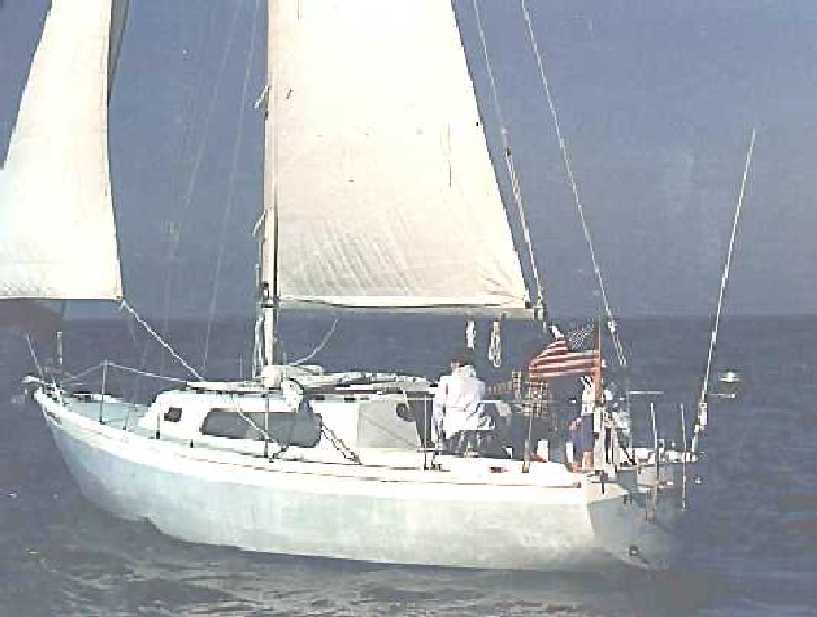
Originally named 'Cool Long', I renamed the boat 'Frontliner' after the idea in a song by Dallas Holm. Boats are always the feminine gender and she was a marconi sloop, meaning she only had two sails. With a mast that stood 43 feet above the water, she was twenty nine feet long, nine feet, three inches wide. I painted, polished and scrubbed for months until she looked as good as all the others around. Several things had to be repaired or added before she could be taken out to sea safely. First, the bilge pump switch had been installed up-side-down and it didn't work unless the bilge was empty. If the previous owner had filled water up to the switch in the bilge, it would have stopped working and if there was a hole in the boat, she would sink. The first owner bought good rope but not nearly enough and the anchor was not nearly big enough. I replaced the 10 lb Danforth with a 35 lb CQR or plow and added four hundred feet of 1/2 inch, three-strand anchor rode with 100 feet of chain to the ground tackle. This would prove very valuable later on. There were times when all other boats would drag away in a storm while I stayed nicely where I put that anchor. Other little problems were not so easily solved. I never did figure out why the roller furling kept jamming, the thing that makes the front sail roll up. On the top and bottom of the front sail called the jib there were these bushings that spin around as you roll up the sail on a track around the forestay. They would often stick and the sail would not roll up. It did that at the most inconvenient times, but I would just run up the mast steps that I installed and tie a little piece of rope on the top bushing and then to the mast so it would work fine. Finally, somewhere in the Straits of Florida I just left that little rope there. The only reason to remove it would be to change the sail and I seldom did that because the boat sailed so well with just the cruising sails. I had two other jib sails, a spinnaker and a storm jib that hardly ever got used. The largest jib was called a 160 and it reached all the way back to the cockpit it was so large. It probably cost about three thousand dollars and was made of heavy canvas with leather reinforced gromets. I remember using it one time in the Gulf of Mexico beating into the wind. The wind was dying one evening and I thought it would be fun to try it out. So up it goes and with a wind of about ten knots I was making 6 knots beating close hauled, amazing. That means I was going really fast headed almost directly into the wind. After removing the engine, overhauling it and replacing it by myself at Marina Del Sol, I still didn't discover the problem with the engine running poorly was a clogged fuel line. I discovered this somewhere in Louisiana past New Orleans in the midst of my trip. A taxi took me from the marina at Gulfport, Mississippi, to a local auto parts store where I picked up some neopreme fuel hose that solved the problem and far as I know that engine never missed another stroke.
I spent the following year working on the boat and learning to sail. Ray went with me and taught me quite a lot and most importantly made me do things I thought too dangerous, like sailing back down the channel and across the lake without power. At first everything looks dangerous and most people just avoid what they should be learning to overcome to the effect most never really learn to sail their boats. It's hard to control a sailboat under sail in narrow places because of the changing winds. There must be a thousand boats on Clear Lake that never leave the dock. The owners sometimes visit them and spend money on them and invite people to come see what they have, but they never go anywhere. Another reason they never leave the dock is most people can't stop chasing dollars. There is really no place to stop. It's always just around the corner but no one ever gets enough. It's a dream many people have, no doubt among others, to let everything go and just sail away. Money is like the ring in Tolkien's Trilogy, some dream of letting go but no one ever does because it possesses them. Working in Adult Protective, social work, I noticed this pattern over and over. I saw people work until they literally could not go to work any more, then they would go home, give all their money to the doctors and in about two years they would die. Life is a terrible thing to waste in pursuit of imaginary security or status.
During my stay at Clear Lake, it was my pleasure to meet several nice people. Some of the sharpest and most trusting were a couple named Dan and Annette Forrester, who lived in the apartments where I was keeping my boat at the time. They had a traditional, gaff rigged, clipper, wooden boat about 45 feet long. It looked like something from a Treasure Island story. We visited and helped each other working on the boats like dock mates do on weekends. We would also take short trips onto Galveston Bay from time to time. One memorable trip occurred on a fourth of July outing as we intended to sail to a nice little anchorage near Galveston Island and watch the fireworks while grilling steaks. This boat could have carried fifty people but there was only the three of us on board. We usually motored across Clear Lake and into the channel before raising the sails because of the traffic and because a boat is much easier to manage under power than under sail. Although I remember having engine trouble once and having to sail all the way down the channel, across the lake, and into my slip with no auxiliary power. That was tricky. On this day we had no such trouble. The wind was steady and low and the sky was clear. There was not much traffic on the water and we had no trouble at all sailing the thirty-ish miles to Galveston during the day. When we got to the turnoff in Galveston where we intended to turn and follow the narrow intercoastal waterway channel across a large, otherwise shallow, marsh-like area we encountered problems. Dan decided to go below and do something with the navigation stuff he had on board. He put me in charge of the helm and went below. I stood there, sailing this big traditional sailing ship behind the usual wooden wheel just like the old whaling vessels must have had. As we approached the turn the channel became very narrow and it was impossible to know how far they dug out the bottom for the channel between or beyond the channel markers. I tried to stay inside the markers just to be sure we didn't go aground. As we approached the turn I could see a barge coming from the opposite direction going about the same speed. We were about the same distance from the corner and it would have been really dangerous to meet that thing on a turn, because he needed all the room and maybe a little more to turn the corner with his 500 foot length. I became really uncomfortable at this point and spoke to Dan, below deck, saying, "I'm really not comfortable here, I don't know these waters and there is a barge coming from the other way". He said, "oh, don't worry, just stay to the right and you'll be fine". I told him I had a really bad feeling about this, but he assured me there would be no problem. Well, I've had that feeling many times before and since, and at some point I guess I'll learn to do something when it happens, but not that day. I did at least start the engine just in case. I tried to stay as far to the right as possible and out of the way or at least near enough the edge to dash to the right if he came across before we met and passed. I had no idea they put the channel markers in the wrong place, marking the corner and a lot of four foot deep water. So, just as I began to turn to the left and line up with the channel, we began to mush into mud. I immediately applied full power and steered to the left, but it was too late. We were in the goo, as they say, hard aground. Not only did we go in under full engine power but also full sail. The engine is not much compared to the sails which serve as the main power of a sailboat. You can use all the engine power and make the boat go the opposite direction with the sails. We were not likely to get out of this before the fireworks started at sundown some four hours away. Of course we tried all the tricks like carrying the anchor out in the dingy to a place we would like to be, dropping it over the side, then using the ship's wench to drag the ship to the right place. But today we were too deep in the mud. We were only likely to break the wench or the keel or something pulling at an angle of 20 degrees off the port bow. About this time some people came up in a power boat and offered to help. It was easy to see some of them were already pretty toasted from drinking beer. We thanked them and said it wouldn't do any good and there is no reason to mess up their boat and nice things like that. About this time, I think Annette was the one who said, "look out for that anchor rope there in the water", but it was too late. By the time we could make them understand they were already over the rope and it wrapped around their propeller. So, we got to spend some time with these lovely people anyway. I've noticed life is like that. In the process of getting the rope off their boat, they cut it and let it fall to the bottom. On the other end of that rope there was a four hundred dollar, 65 pound anchor, some chain, and all the fittings that connect such things. Now we were there without an anchor. The party people left and we decided to grill the steaks and call someone to get us off the bottom. The steaks were good. The tow boat arrived about 6 hours later because they said the tide was going out when we went aground and there would be nothing they could do until more water arrived. Sure enough, when they arrived you could still walk around the boat in waist deep water. Within three hours they were able to dig us out using the prop wash of twin, eight cylinder racing engines with large propellers. They tied ropes onto the docking cleats at the rear of our boat and the same on theirs and just raced the engines until the water washed us out of the mud. But this must have blown away the anchor rope because we were never able to find it again and it was all lost. On the positive side, we could see three sets of fireworks from where we were grilling the steaks and the breeze was the same as where we intended to go only about 2 miles away. On the down side, Dan dropped about seven hundred dollars on the anchor and the towing bill. Things happen and we learn as we go.
The Dogs
One of the funniest things I ever saw happened while I was staying overnight on my boat near the apartment of my friends Dan and Annette. One early morning as I doodled about inside before the day began, I heard the sound of someone whistling to call a dog. So unusually clear and perfect was the whistle that I looked out to see who the person might be and watch the result. My eyes scanned the small area of apartment doors about 50 yards away, oddly failing to see anyone that should have been clearly visible where the sound emitted. Then suddenly round the corner of the building came a cavalry of house dogs running up to stand barking and looking all around confused near one of the door steps. I looked even harder for someone or perhaps a window where someone might be sitting near to explain the event, when there came the most contagious laugh from the same mysterious location, obviously directed at the dogs for being so confused. Then suddenly the reality of the whole event came bursting to my mind and bent me over with laughter when I realized it was a parrot in a golden cage, hanging over the doorstep that had managed the event. Without help or encitement the bird had detected the dogs and called them to the door only to laugh at them in the most classical and human fashion you can imagine.
Beginning the trip
After learning to sail my boat and spending lots of money on it, I ended my career with the Parole Division in Texas. I just quit after spending ten years in police work and five years supervising parolees. I had about $10,000.00, the boat and a car which I returned in exchange for what I owed on it. Most of the things I owned went into the dumpster. All my extra clothing went to Good Will and I was ready to make final changes and prepare for my journey. There seems to be no place to stop getting a boat ready for the sea. I met several nice people at the docks who helped me find things I needed like an Autohelm which steers the boat automatically. With help from a girl named Erica, who owned a boat at Seabrook, I was able to get a used Autohelm for $250.00 from someone she knew. The Autohelm is a two foot long rectangle that attaches to the tiller on one end, to the boat on the other and has some high tech instruments inside with a worm gear that makes corrections according to changes in a magnetic heading. If the boat turns even one degree it automatically moves the tiller until the coarse is corrected. It can steer the boat much better than a person and never gets tired. After using it I cannot imagine sailing without two of them. At the time they cost about $650.00 new. I found more things that needed to be changed or added and discovered all this can get expensive. Simple little fittings that connect the standing-rigging to the deck cost about $45.00 each. I bought a nice commercial Single Side Band radio for $250.00 and made the backstay into a 33-foot antenna using glass high line insulators. I installed a hand operated bilge pump in the rear lazerette, a depth finder from Walmart and a new VHF radio. I put a new coax inside the mast and insulated all the wires in the mast with pieces of foam on a string, pulling it through from top to bottom to stop the ringing when the boat rocked, which will drive you crazy. I had the boat hauled, repainted the bottom with paint that cost $150.00 per gallon and was ready to try my hand at sailing alone. I had never been on the ocean.
One day in November, 1992, I walked past my friends, Chuck and Lori Harvell, on the dock at Marina Del Sol and said, "I'll see you later, I'm going to Isla Mujeres." He still remembers being amazed at me saying that so casually -- I don't why. All of them got off their boats and gathered around as I was preparing to leave as if they had trouble believing it. My plan was to sail to Galveston, spend the night there and after a front passed during the night, follow it across the Gulf 667 miles. I had a Garman Global Positioning System the size of a pocket radio that gives your location anywhere in the world within a few yards, even in a storm. It works with anything from 4 to 40 volts and has a battery pack or a mounting bracket for ships power. On board was twenty gallons of fresh water in five gallon containers and the onboard tank held about the same. With waves and wishes of good luck and a few nautical maxims from the mates on the dock, I backed Frontliner out of the slip and motored away. I had no intention of ever coming back.
The wind that day was blowing about twenty knots from the north and I thought that was a lot of wind. It was blowing about the same from the south when I came back and it made me laugh. By evening I reached the Tea Cup anchorage near the Yacht Club at Galveston, Texas. The bilge pump had been coming on all day pumping water out of the bottom of the keel. I had to find where the water was coming in or the ship could sink. It took about an hour to unpack the rear of the boat as that seemed to be where the water was coming in. Sure enough there was a tiny crack about half an inch long and wide as a piece of paper at the bottom of the cockpit drain that was allowing a tiny trickle when water slopped into the drain from the waves that kept filling up the bilge. Using some neat stuff called Underwater Epoxy I found earlier at a hardware store, I stopped the leak and repacked the supplies. That night it was my job to listen for the bilge pump to make sure the leak was stopped and to watch the weather. If that tiny leak had been below the waterline, say around a thru-hull fitting or something, I might have been able to reach a boat yard from where I was before she sank, maybe. That’s how fast they go down with all that lead in the bottom. A single bullet hole under the water line would sink a boat in about 15 minutes if not plugged with something. Imagine what a 50 caliber machine gun would do fired several times through the hull, little did I know I would one day have to think about that while sailing Frontliner.
While anchored near the commercial docks there in Galveston, in the night a large ship was leaving the docks. My view of this large ship, about 900 feet long, gave new meaning to the words big and heavy. It tried to use it's own power to get going and went out of control spinning sideways and going aground headed right for me, only stopping a few yards in front of me. Tugboats were pushing and pulling on it to get it headed in the right direction and the water under my boat became a muddy torrent. I thought it would come over and squash me like a bug any time as it loomed above me in the night. Finally, they managed to get it moving and I was very relieved to see it pass by. I wished I had not seen that happen because then I couldn't sleep the rest of the night there.
The wind came about midnight. It blew about forty knots but there was not much rain. I had not used my big anchor since I thought I was in a protected place. The boat began to drag and the rocky shore was only about fifty yards away down wind. I threw other anchors out and started the engine to help keep the boat off the rocks. Starting the engine did the trick. Apparently the bottom is hard mud there and the anchors would not bury themselves.
When morning came, I had not slept at all during the night and my TV fell and broke during the storm; it wouldn't be the last time something like that happened. I did have some success making blueberry muffins on top of the stove though. I felt fortunate just to be in one piece and decided it must surely get better. Then I stared the engine and pulled in all three anchors. They were all fowled with black, sticky mud. While fueling up at the nearby fuel dock the anchor that would not hold fell into deep water beside the dock as I was cleaning off the mud. I just left it there. I motored in the direction of the jetty and dodged the ferryboats full of cars and people that use the same waterway as the ships, fishing boats and pleasure craft. They were all much larger than my little sailboat and I was the only one headed to the open sea.
Leaving the jetty and entering the real ocean there was a wall of water about seven feet tall just standing there colored green. It was caused by the large amount of water being pulled from the Bay by the tide through the small opening into the sea and the surge of the sea driven by the wind in the opposite direction. When I crossed that point green water came over the bow of my boat which was nearly six feet above the water. Beyond that the sea had a gentle swell and there was not much wind. It didn't matter much which way I started since my course was into the wind, I couldn't head straight to the destination yet. I set sail almost due south and watched as the oil wells slowly crawled past. Then I began to feel a little funny. I had considered seasickness and had no idea how it would affect me. In an attempt to stop the problem before it came on me, I began taking Dramamine tablets about every four hours. The instructions on the bottle apparently represent the maximum dosage. I would find less than that amount makes some people sick.
Night began to fall on the ocean and it struck me that maybe I had not considered everything about this lonely adventure. To offset those thoughts I noticed that sunset on the ocean is remarkable. There is nothing to interfere with the scene. The orange and blue and yellow simply stop where the dark blue water makes a straight, horizontal line around your world. The bottom half of the world is a living mosaic that constantly changes by sight and feel. The waves you see around you are just like the ones you feel lifting and dropping the boat. At sea the visual world is limited by the curve of the earth and you can only see about seven miles. Seeing these natural boundaries somehow reminds me of our place in this world. It's altogether humbling really.
Unfamiliar fears began to arise in my mind as I sailed some hundred miles into the darkness of the Gulf, leaving what seemed my entire life behind. Then I remembered the boundary line marked on the charts of the old sailors that says, "Beyond here there be Dragons." Many theories have arisen to explain that boundary but in that darkness and at later times, I contrived another explanation. There is a point that is beyond reach of help and comfort whether on land or at sea where you realize you are really separated from civilization. At sea, it's often when you can no longer see land and there is nothing but the water and the sky and it feels like God is watching you. At this point thoughts arise that would not do so any other time and life becomes much more like a dream. That's when some people go berserk. For some the line may be a hundred miles and for others it may be a thousand, but some place on some dark night far from home and any comfort, there is a place where everyone can find out what dragons are inside themselves. Beyond there some people become dragons.
I was never too attached to this life anyway and I don't think there's much to lose here so I just tried to think about something else. It soon became easy to think of something else, I got sick from taking too many Dramamine pills. It was not a nauseous feeling so much as like being poisoned or having a hangover. When I'm sick I don't like doing anything. Here I began to discover anew that like it or not, many things have to be done anyway. It was about two o'clock in the afternoon the second day out when I decided to turn back to Galveston. I had been out one and a half days and all I wanted to do was dock somewhere and go to sleep. Sleep is what I wanted most and I soon discovered it was the last thing I was likely to get.
I turned the boat around and headed back to Galveston. The next thing to happen amazed me. Only about a hundred yards from where I turned around the wind changed. Suddenly it was no longer from the east, now it was coming from the northwest. I could just barely make Galveston on the heading I had with this wind. After a couple hours I noticed the wind was changing again and this time, I had to change my course from Galveston towards Port Author. Oh no, and the night began to come again and I wished I could go to sleep. It would not be the last time I wished that. It occurred to me that if I went to sleep in the midst of the hundreds of oil wells I would hit one, sink and wake up in the water or not at all. This made me really sad. I think I could actually feel my spirit getting older with these thoughts. I must have grown allot during these days, I know I suffered allot.
After three days out I was headed back and still sick. The only thing I could stand to drink was pineapple soda. Water tasted so bitter I couldn't drink it, which is how I determined I had taken too much Dramamine. The only thing that tasted good was canned peaches. So, for all the days I was out in the Gulf, all I ate was canned peaches and pineapple soda. I sailed as close to the wind as I could and still I was not headed to Port Arthur. Soon I realized I would be lucky to make a Lake Charles heading, even further east and not the direction I wanted to go. I changed course again. The ocean was rough now, about six-foot waves and getting bigger. Night came on the ocean again and once again, on my longest day, I saw the moon rise and shine across the glittering, black waves. Even in all this discomfort and sickness there was such a remarkable beauty about the sea. On the ocean at night the stars go all the way to the water in every direction and are magnified closer to the horizon. They're so bright in fact they are a hazard to navigation. It's hard to distinguish the lights of a ship from the stars. The sky was clean, the water was clean, the air was fresh and stars were bright overhead and in the water behind, stirred up by the boat. What? Looking back in the water I thought I was hallucinating. There was a million little green stars trailing out behind my boat. Turns out I wasn't and it's a sea creature that glows in the dark called photoplankton. The water is so clear it looks black if you look straight down even in the daytime. I was standing on the back of the boat looking down this night when I noticed a trail of stars like green diamond dust following me. There must have been billions of them because the waves made their own light in the darkness and I was making a trail of stars like the Milky Way with my boat. I stood and watched this for half an hour until I had to sit down and rest. The constant heaving of the boat over the waves takes a lot of energy out of you even sitting down. Times like this told me I was doing the right thing. I could never have guessed there were such things in the world or what it's like to see them in person. Whatever this trip cost in time or money, I knew then it was worth it.
The sun came up on the fourth day and my fingers were swollen, I guess because of toxins they say only leave the body during REM sleep. I thought I could feel my blood burning inside my veins as it pumped around. I was trying to not think about sleep but focus on the problem at hand, how to get home. After my soda and peaches I trimmed and re-trimmed the sails as I had done for days trying to make the best speed and heading when the wind began to change again. There was still not a cloud in the sky but the wind kept increasing daily and now it was about thirty-five knots but the waves were either about the same size or my ability to remember the day before was waning. The new course was now Vermilion Bay, Louisiana, a place I noticed on the map that had an entrance I might be able to get into. I was thinking since the wind was coming from the land the water might be smooth near the shore and I could enter the Bay and anchor. I beat to windward, meaning I sailed as close to the wind as possible all day and watched man-o-wars, similar to jellyfish, drift past like blue oblong bubbles with poisonous things hanging down in the water. Everything about the ocean can be cruel if you approach it carelessly. I think the idea is to understand it. The sun began to set on my fourth day and I became anxious. I didn't know people could function this long without sleep. I remembered once while in college, a friend named Scott and I drove to Galveston and went fishing. We stayed up over forty hours before we finally slept on the beach. During the night I got up, got in the car, started it and drove away -- still asleep. I remember waking up while driving down a very unfamiliar road. That was really scary and I was wondering what effect some stunt like that might have on my situation out here, out here far from any help. I started the engine, tightened up the sails and tried motor-sailing to reach land. Counting the lost sleep before leaving because of the storm this was the fifth night I had missed getting sleep.
On the night after the fifth day the wind increased and turned due north. I tried to make a new heading for New Orleans but could not even make that. My GPS said I was within fifty miles of the coast, but I could no longer head that way. Little did I know I was missing the biggest waves because I was in shallower water as I got closer to land. It was about three o'clock of my fifth or sixth night, I lost count at this point, when I was forced by the increasing winds to turn and run from the wind which carried me into deep water again. I was lying a-hull trying to take down the mainsail when the main halyard left my grasp. It began swinging like a sword of Damocles with a piece of stainless steel on the end. I could hear it slicing the air when it went by my head as I grabbed for it again and again. Finally I got a boat hook and began reaching for it while straddling the boom and holding the mast with the other hand. It was foolish but I was not using very good judgment at the time. I did, however, have on a harness and safety line.
I thought I had solved a problem because the line had stopped swinging around when I noticed the stars disappearing from the sky to the west. There was a blackness, an uneven horizon crawling up the sky making all the stars disappear. I sat there amazed, watching and said aloud, “What’s making the stars disappear?” It still never occurred to my dull mind that it was a wave of water until it hit. First the boat went sharply down like the water was pulled from underneath it. Then it tilted sideways and began rushing upward so fast that the gee forces made me feel so heavy I could hardly move. Then I was on top and the stars came back along with the wind. This wave must have been over 30 feet high because the stars disappeared up to around 40 degrees above the horizon but the boat had not tilted very far sideways and no water came into the cockpit so the only feeling was one of wonder. I'm glad I couldn't see that wave, even though it was just the first of many more as I was blown out into deeper water. I'm sure it would have been a fearful sight.
I never caught the halyard but it finally wrapped itself around the backstay so it was out of the way. It was time to look to the boat and these new, big waves. Next I let out a little jib sail and turned the boat down wind. Running from those waves was not as scary as catching them abeam to (sideways). At one point I feared they were going to break over the back of the boat as they lumbered up from behind, towering above me with a rushing noise and frothy white tops, which was the only thing I could see in the dark. I put a gallon of oil in the cockpit drain and punched a small hole in the plastic jug so it would trickle out. It was amazing. The water was white and breaking on both sides of the boat but no longer behind me for a space of about twenty-five yards across. I guess It was worth while to read those old sailing books after all. Frontliner sat nicely in that posture and the wind was considerably less, almost comfortable. Of course, it's often much more comfortable when you're going the wrong direction.
About four o'clock in the morning I decided to call for some assistance from one of the rigs I could see and there were many, so many it looks like a scattered city as far as you can see at night. I decided I might tie up to one of these and get some sleep and the people on the rig might give me a hand. Thinking had become more difficult by now as I was becoming ambivalent and giddy. I picked out one of the brightest rigs and made for it. After not being able to reach anyone on the radio I noticed I must have stepped on or kicked the radio because all the little push buttons were sunk back into the shell so that I could hardly reach them, and I noticed no one was answering my calls. Next plan was to set off some emergency flares. The boat was beginning to sputter and run poorly and I thought it was running out of gas. About this time I noticed one of the lower shrouds that holds up the mast swinging because it had unscrewed itself some time during the night. I didn't care enough to go forward and screw it back together. I pulled out a six-gallon fuel container from storage and put it into the gas fill. Then I threw the can overboard because I was just going to light some flares and I didn't want the boat to catch fire. Turns out, that was a good move, because when I got it home, there were little burn marks all around the cockpit and on the cockpit cushion. Just as with the radio, no one responded to the flares or the fire works I set off. I have discovered you need those $30.00 rocket flares that go 1000 feet and last a few minutes if you want anyone to respond to them. Anything less just doesn't get noticed.
A Steel Oasis
I approached the rig anyway and was going to get off with or without anyone's help. Coming up from down-wind I put the boat in neutral and ran to the front, grabbed the fifteen pound Danforth anchor with 25 feet of chain and twirled it around a few times letting it go at the rig. It looked like a pachinco ball bouncing off everything until finally falling in the water. By this time the boat had drifted away from the rig in the fifteen foot waves that were the more common between the big ones, so I had to run to the back again, put it back in gear and approach the rig. This happened five times until I was so tired I was afraid I was going to lose my strength and be forced to sail another day and night. Finally, I decided to let the boat run and just get off when it hit the rig. If I lost the boat, so what. When I reached the rig this time, I let it bump the rail and just ran to the front and jumped over the handrail onto the walkway. Then I looked at the boat just sitting there not moving up or down. So I got back on, grabbed the anchor and got back off. Still the boat just stayed there for a minute while I wedged the anchor in the handrail. Then another wave came along and the boat went up and the mast hit one of the walkways on the deck above. As I watched for a minute it was still floating, so I figured it had not driven the mast through the bottom. Then I walked up the stairs leaving all my worldly possessions on board, the boat lights still on and the ignition key was on. I noticed a coil of rope hanging on a pipe about the size of my anchor rope, so I took it down, went back downstairs and extended the length of the rope about a hundred feet with the anchor in the middle. I remember seeing the anchor come out of the water when a wave passed and the boat lurched back like a bucking horse, then the anchor would sink again as the wave passed. I knew it would do this over and over and buffet the tremendous force on the rope. Then I went up the stairs smiling like I was headed to heaven and all by trials were over.
I found what they call a dog house on the third floor of this large oil rig. I lay down on that curiously unmoving floor, closed my eyes and tried to let everything go. It was surprisingly hard to get to sleep. I discovered later it's common to find it hard to sleep after being in a high stress survival mode for days. When sleep finally comes it's common to lose touch with recent time and wake to a state of emergency that had occurred a few days earlier. One example I remember as a couple of my friends, who were up about eight days from Galveston to Pensacola, had similar trouble. When they were finally docked and Lori went to sleep two days after, in the night she awoke, sat up and announced, "honey, I think I better go out and drive". We ribbed her about that for a while.
I awoke to the sound of a helicopter. Lumbering to my feet, I went outside the door of this steel oasis I had appropriated in the night. All the memories of the past week came rushing back and none seemed to be lost. I stood still trying to understand what was happening as I watched the helicopter flying away. I don't think I really appreciated the size of this rig until now. It was at least twenty stories tall and the size of an average parking lot, all made of steel. They had not even seen my 30-foot, 13 thousand pound sailboat floating alongside. I walked up the stairs anyway to see if they had left anything. There were two men bent over welding on something on the top deck when I approached. I had not shaved, rested or eaten very well for a week and my pants were stiff with salt like two stovepipes. I must have looked like the walking dead. When they saw me walking toward them their mouths fell open and they turned to run away. I laughed at the sight and they turned and came back, figuring I was not a ghost. They asked one question after another without even pausing for a breath. Then they walked over to the side of the rig and looked over to see evidence to verify the story that I arrived on a sailboat. They said they couldn't believe I was here because the wind was blowing sixty miles an hour last night. It didn't seem that bad to me, but I was very tired not thinking too well. They said they couldn't even come to work because the weather was so bad. Norman is the only name I can remember but both were really nice to me. They showed me another little cabin where there was food and beds until they could call their supervisor to see what to do with me. I chose the bed.
Shortly they came into the little cabin and called me. It didn't matter because I couldn't sleep anyway. They said I couldn't stay on the rig because of the insurance, but I could take a helicopter ride over to the main rig a couple miles away where I could have a hot meal and wash my clothes. It was then I noticed my jeans were round and stiff like stove-pipes from the salt in the air and the spray from the waves over the past week. I discovered something I never dreamed would be so; I don't like helicopters. I guess I just don't trust machinery enough to hang like a gnat over sudden death all depending on human design, care and maintenance of some machine built by the cheapest bidder. After a short flight in that noisy and expensive little insect-copter we landed on the main rig. They gave me some food from an earlier meal that tasted all right but I think I would have liked peaches and pineapple soda better.
When I awoke about 11:00pm, I had slept the clock around, they said they had called the Coast Guard in the night upon orders from the management and the Coast Guard had now arrived. Then I got to tell the whole story again and was lowered onto the Coast Guard eighty-two foot trawler, Point something or other, stationed in Galveston. They took me back to the rig where my boat was waiting. Riding on the Coast Guard boat was more uncomfortable than my little sailboat. It rocked so badly everyone had to hold on to something to stand up and by now the weather was nice and the waves were small.
After the customary search of my boat and checking for a criminal history, the Coast Guard Boson's mate advised me they would tow me back to Galveston so I could make repairs. I thought this was a great idea. I could sleep while I was towed back. Not so. It turned out the Coast Guard guys slept and I bailed water because we were being towed too fast. Oh well, I figured it was pretty nice of them to sail for seventeen hours to reach me, traveling some hundred and fifty miles out to sea. My steel oasis turned out to be about seventy-five miles south of Louisiana about even with New Orleans.
When we arrived at Galveston they let go the tow-rope and I started the engine. We had no idea if it would work. It did and I docked beside the Elisa, a famous old tall sailing ship. The Coast Guard followed regulations and wrote me a ticket for not having any emergency flares on board and no port-a-potty, since we had crossed the eleven mile line coming back in. That was ok with me; I'd rather pay that than the fuel bill and salaries for that eighty-two footer. Using over twenty-five gallons an hour with a six-man crew which, would have been about five thousand dollars. Later I called the Jag officer and he told me to forget about the ticket. I slept better that night than ever I could remember.
Next day, Sunday, the same day I left Galveston a week before, I climbed the mast and untangled the main halyard and inspected the engine. I had no idea I would not discover the reason for that engine failure until much later. I didn't really care and I hoisted the sail and headed to Marina Del Sol. I figured my slip was still available. There was some obvious damage to the front of my boat. The bow pulpit was twisted like a pretzel where it tangled in the handrail of the rig. The blue roller furling was smeared with yellow paint where it hit against the same rail when the wave went down. When it went back up, the mast struck the bottom of the next deck and I didn't have a clue what damage that had done. I sailed most of the way back to the marina some twentish miles with a wind blowing a healthy twenty-five knots. A couple times my boat almost broached because I was using too much main sail. Before I left that would have scared me, but now I laughed and just let out the main sheet to spill some wind and played with the boat.
I had no idea what I looked like after a week not eating much, not sleeping or shaving. When I arrived at the boat slip in this dreadful shape, people stared. Dockmates were interested in what had happened and what was next. The harbor-mistress, Beverly, said I could stay in my old slip as if I had never left. They were very nice at Marina Del Sol. It took a while to repair all the damage to the boat but I enjoyed every minute of it. The joy of all this was beginning to affect me somehow. I think tough times are needed before we can really enjoy or even recognize the good times.
I received $5,000 from my insurance company to repair the boat, so I did the work myself and added a new Autohelm, new rigging and a new bow pulpit that a nice guy named Eric gave me. Eric lived on a 42 foot Choy Lee, ketch rig with two masts that was the classic sailboat. I'm sure he will actually go sailing one day and I wish him all the best.
Now I had two Autohelms and it turns out two is the least a single-hander should have on a long cruise. I worked on the boat the entire winter and decided to get a crew even if I had to pay them to go along next time.
The Gulf Part II
By the time I was ready it was some time in March 1993. The boat was in good shape with a new bottom-job and some new radio equipment and rigging. I had added a baby stay and a storm jib making it into a cutter now instead of a sloop. So now instead of only one front sail, it had two. Somehow after all the improvements, adjustments and paying ten prices at marine stores for simple items, I had put nearly $10,000.00 into this boat besides the $15,000.00 I paid for it. I don't know where the money went, but I was worried about leaving on a trip with less than five thousand dollars. Little did I know there was no need to worry, there are no K-Marts and Boat US' floating around on the ocean, just Man-o-wars and Sargasso weed. All you really need is a good water maker, solar panels and a comfortable amount of space. The water maker is a water system that strains the salt out of seawater making it into fresh water. They are fairly expensive and at the time I was getting the boat ready they were too expensive for my budget. So I depended on buying water or catching rain, which turned out ok for me since I spent so much time in anchorages where I could get it. It would be much better to have the water maker because it would allow freedom to stay in remote places almost indefinitely.
I agreed to pay Erica five hundred dollars to sail with me to Isla Mujeres, Mexico. She wanted to bring her boy friend along free and I agreed to that too, he was a very experienced sailor with many a mile of single hand sailing behind him. They showed up at the dock about four hours late on the morning of the departure. We had planned to do some drills and let them get familiar with the boat before hand and this really made me anxious. Now after a couple years sailing myself, I understand there was really no need and I need not have worried. But then I didn't understand. Some of the dock people were ribbing me about it that morning and I was about ready to call off the trip and I think that may have been the idea of some of the dock people as well. It's hard watching someone else doing something you always wished you could do and it's something you will not or cannot do.
Somehow I kept my mouth shut, to some degree and decided to go on with the trip. I really wanted something to go right. We sailed out of Marina Del Sol about noon one day again with people waving and well wishing us a good journey. The sun was up, there was a light wind and we were escorted by Arima, a 35 foot sloop occupied by Chuck and Lori Harvell, who later met up and sailed with me to Florida. We experimented flying the tri-radial spinnaker on the side like a drifter. It worked pretty well till the wind changed and we had to take it down. We reached Galveston that evening and didn't even slow down at the entrance to the ocean. We headed out to sea in the best direction we could make. It was something like due south. Naturally the wind died when the sun set and we had to motor a while to get past the area where the large ships wait for daylight to enter the Houston Ship Channel. After passing that place we found some wind and were able to sail again. It's really great having someone to talk with during a journey like that. The company was about the only good thing I remember from that trip because the weather was cold. It was cold and wet. No matter how many clothes we put on, we were still cold. We all put on a wool sweater, a coat, two pairs of jeans, gloves, hoods, raincoats and anything else we thought might keep us warm. Finally, we gave up and just sat shivering. The morning was welcome because it promised at least warmer weather. No so. The day dawned overcast and gloomy and the wind was still out of the southeast, the prevailing direction and the way we wanted to go. We tried all day to make some headway in the right direction. Usually that meant beating hard to windward. I really hate doing that. It makes the boat bounce a lot and makes most people sick. I began to feel a little queasy, so I went below and tried to get some sleep. I had not been able to sleep since we left and I was getting really irritated. I began to imagine another week without sleep - oh no. I drank a large glass of wine before lying down to rest, thinking it might help me drop off. That was a mistake. It was a nice lambrusco, but it should have been a port, because I sprayed it over the port side about a minute after I lay down. That was the last time I was seasick and I actually felt a little better afterwards. It did not help my agitation though, I wanted something to change but I didn't know exactly what. Finally, after determining we had only made about a hundred fifty miles, I decided to go back. For some odd reason this was easy and we reached Galveston by daylight. I will never beat to windward across the Gulf again if there is any other alternative.
I gave both Erica and her boyfriend $100.00 for the day and a half trip and I think they went camping. I went back to the slip and met my dockmates who wholly approved of my coming back. I decided next time and there would be a next time, I would go alone down the Inter-coastal Waterway all the way to Florida. I had no idea what kind of decision I had made but it seemed the only way.
The I.C.W.
This time I left the dock there was no one around. They must have tired of seeing me off. Chuck and Lori were my faithful friends and Lori talked with me on the radio along with Frank, while I sailed to Galveston the day of my departure. Again the wind was blowing about 25 knots from the north when I left but when I passed the shore onto the ocean it slowed to about 10 knots. This time I didn't bother to stop at Galveston but intended to sail right past like last time and hurry out to sea. While leaving Galveston in the distance I noticed three white boats parked near an oil rig about two miles from the jetties. It turned out to be my friend Chuck, as he later related and we figured out. Sitting in a tropical paradise, he said, "I saw a blue sail boat headed east about 6:00pm and I didn't know who else it could be but you." Apparently, not many people actually sail out into the ocean alone.
I sailed all night eastward, which is a value to those who know the Gulf. Anytime you can make headway east you do it because the wind mostly blows from the southeast and most people want to go southeast. The Gulf of Mexico is a terrible place to sail because of the shallow water chop and the wind blowing the wrong direction or changing every hour to some other direction, which causes a lot of work to occur if the boat has sails. But this was really a beautiful night with a light wind and the stars shinning, a bit lonely though. Oil rigs passed left and right and I recognized some of them by sight and realized I must have passed by them on my first trip. About midnight I decided to enter the I.C.W. and head for Lake Charles. I was getting tired and there was no particular hurry. I would also be able to just pull over and tie the boat to something and go to sleep whenever I needed to. Approaching the entrance, I knew only from the charts, the wind died and the engine had to be started. This caused a problem. Starting the engine with the new Autohelm engaged caused it to get confused and it extended all the way out and jammed. By the time I could get it disconnected it was burned out. When I picked it up and shook it something inside was rattling around.
Lake Charles
The old Autohelm still worked and I sailed with a good wind toward Lake Charles inside the river looking channel called the Intercoastal waterway. It felt strange to be sailing with land on both sides. It took about half a day to reach the lake and I met another boat that left the marina a day before me headed for the open sea and on to St. Petersburg, Florida. I later learned that he had a rough trip and destroyed the engine motoring to windward across the Gulf. I arrived at Lake Charles in the early evening and docked at one of the docks with a lot of other boats. I was really tired and about all I remember is being greeted by a very nice man, I say that because he gave me a fresh grilled hamburger and a cold beer. I then went below and fell into wonderful sleep and didn't wake up till the next morning. Next morning, I had nothing to do but continue my trip. They wouldn't take any money for the nights stay and I filled up with gas at the marina station. I was off before noon traveling down this river path that would take me up-wind with protection from the sea. During the next several miles that I traveled in Texas, I was introduced to the locks and bridges, something that would become very familiar the next few months. Locks are places where the waterway is walled off and someone traveling has to go into a lock and wait for the water to lift them up or let them down on the other side. It is used to keep enough water in different parts of the waterway so the barges don't go aground on what would otherwise be natural shallow places. The bridges are places where a road crosses over the waterway and there is some kind of bridge. Sail boats have to wait for the Bridge master to stop traffic, open the bridge and allow them to pass because the mast of their boat is so tall. The mast is so tall it would hit nearly all the bridges and they could not pass any other way.
Traveling down the I.C.W. is interesting with all the wildlife and landscape and the water has no waves. It does, however, have water hyacinth, a strong current and huge barges that look like bundled up trains sometimes over 600 feet long. Any of these can mean the end of a fiberglass boat. The water plants will clog the intake of the engines and the engine will overheat. The current can slam any powerless boat into something and damage or sink it. The most exciting way to die is being squashed by the barges. They are so big and the little tug boats that push them look like toys in the distance. The captains were usually quite nice to me in the 'ditch.' They suggested where I should stop for the night, even if I had not asked, and they nearly always replied to my radio traffic in a helpful manner. Evidence of out of control barges could be seen all along the waterway where trees had been knocked down or damaged.


