TERRA COTTA WARRIORS
TERRA COTTA WARRIORS
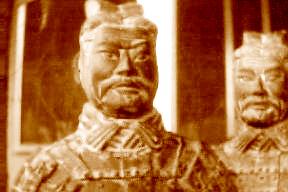
The terra cotta warriors were accidentally discovered by Chinese peasants while digging a well. This discovery prompted archaeologists to proceed to Shaanxi, China to investigate. No one knows why this site became buried and lost among memories in the clay and in the minds of China. What they found was the ancient burial-site of the first Chinese Emperor Qin Shihuangdi. These warriors were placed all around the burial tomb of Emperor Qin. Before Qin, masters were buried with women, slaves, and soldiers. This tradition during China's feudal period vanished during the life of Qin. To substitute for the actual humans, Qin ordered a massive clay army to be produced for his protection. Qin wanted the afterlife to be the same as his life on earth. Qin produced a warlike culture in China, which brought him many enemies. During his lifetime there were three attempts to assassinate him, so he had to be protected in the afterlife.
The first site was excavated in 1974. Although much of the site had been looted soon after it was built, archaeologists discovered 6,000 pottery figures. This oblong shaped site is 689 feet long, 197 feet wide. The trenches that contain the soldiers are 14.8 to 21.3 feet deep. The actual bodies of the soldiers were formed out of terra cotta clay. Each soldier was baked in a kiln. The positioning of the soldiers in the oblong shape shows an actual battle formation of the troops. These warriors were dressed and ready for battle. They carried spears and various other combat weapons. Each warrior is wearing an army uniform which distinguishes the soldier's rank. The soldier's uniforms were painted either red or green. They also wore either brown or black armor. Different types of warriors include bowman, infantrymen, and among these soldiers are six chariots. Each soldier has a distinct facial expression. Even the horses found at this site have different poses. Both the hands and the heads of the soldiers are detachable. These pieces of the body were carefully crafted and painted separately. The purpose of this was to provide the soldier with individuality and uniqueness. This also shows the quality of Chinese art during this time. These soldiers were made to be naturalistic. The height of the normal soldiers ranges from 5 ft. 8 in. to 6 ft. 2.5 in. Those that rode the chariots were 6 ft. 2.5 in. The commanders were the tallest out of all the soldiers. They stood 6 ft. 5 in. Clearly height represented the importance of the officer.
The second excavation occurred in May of 1976. This pit contains 1,400 warriors with horses. It is 64,000 square feet in area. Pit number two differs greatly from the first pit. The battle formation was square. This pit contains sixty-four chariots. It has divided groups which include infantrymen, cavalrymen and even commanders to guide the troops. This display of soldiers gives insight into the work that went into the Chinese army. Long distance battles had to be fought by using many chariots. The facial expressions of the men in this pit are also very different from those men in the first pit.
The third pit was discovered in 1980. This pit is the smallest out of the three discovered. It contains only one chariot, six warriors, and a small amount of weapons. This room is thought to be a group of special commanders. A fourth pit was also discovered. This room is bare. This room is probably empty because the workers did not complete the warriors in time for Qin's death.
Archaeologists continue to excavate the burial site if Emperor Qin. His actual tomb has not been excavated. These warriors will continue to give insight into the history of both Chinese art and war tactics. They represent a microcosm of life during the Qin Dynasty. The dynasties following Qin would pattern their lives after this great dynasty of the Fist Emperor of China.
Sources:
Schellinger, Paule & Salkin Robert (ed.), International Dictionary of Historic Places: Asia & Oceania. (Volume 5, 1995). Filtroy Dearborn: Chicago & London.
Kelleher, Bradford. Treasure from the Bronze Age of China. The Metropolitan Museum of Art: New York, 1980
THE TERRA COTTA WARRIOR MAQUETTE PROJECT
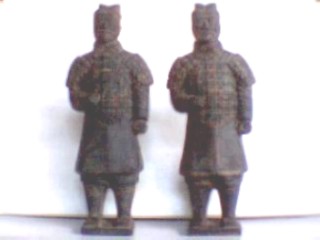
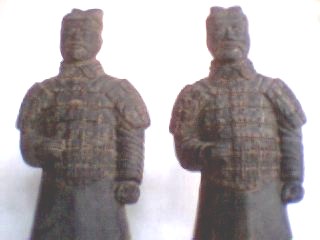
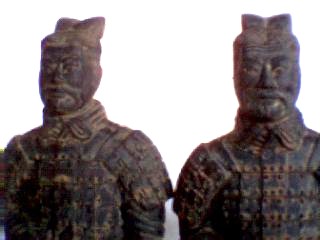
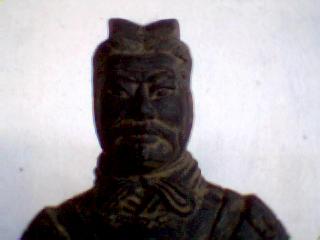
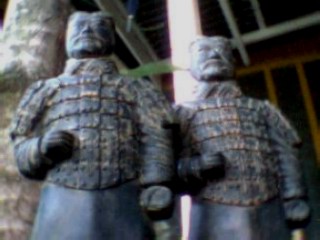
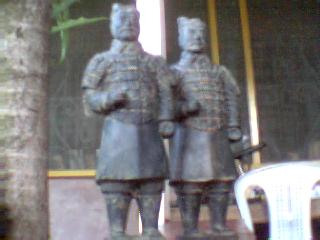
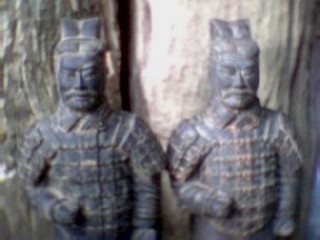
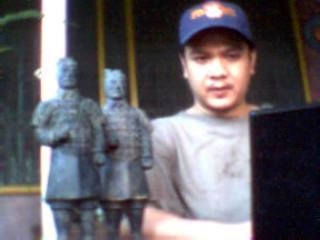
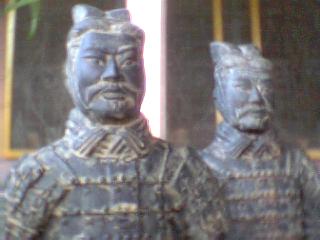
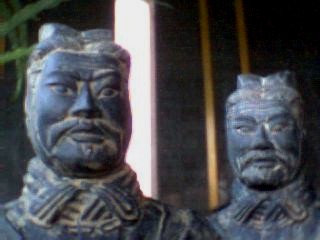
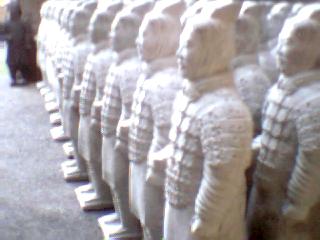
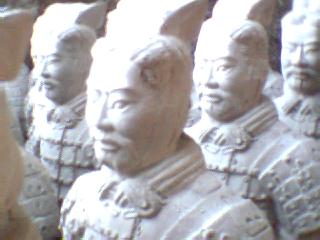
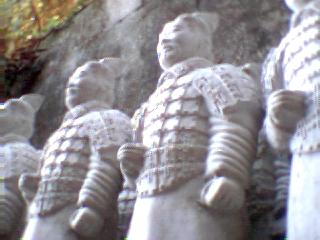
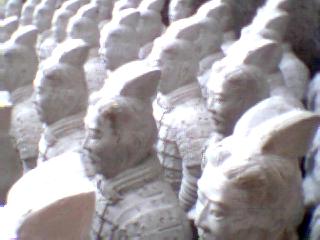
The figure on the right is the original maquette from which the mold was made. Mold was made out of silicon rubber with a Plaster of Paris backing support. It took almost two weeks to complete the mold due to the maquette's intricate armor design. The final cast was done using Plaster of Paris and pozzolan cement mixture. After curing, it is then coated with a black water based paint and was given a mud bath for weathered effect. All photos were enhanced with Corel Photo-Paint program.The guy on the 8th frame is just a terra cotta warrior "wannabe" BUT is rumored to be an Emperor Qin reincarnate because of his obsession to build his own army.
NEW PICTURES
RECENT UPDATES
New pics taken last November 28,2004. Here are my new recruits! Whoa!!! My army's growing...and i can't help but dream of world domination (haha),hmmm not bad. Ummm...my guiding principle: "LET THE WORLD END IF IT MUST...BUT FOR THE REST OF US, LET US KEEP CASTING. THE WHOLE WORLD (by the way) BELONGS ONLY TO THOSE WITH IMAGINATION!" DISCLAIMER NO ANIMAL WAS HURT DURING THE MAKING OF THIS PROJECT...well except for some creepy six legged flying creatures that accidentally landed on my work bench during the concrete pouring. I can't help but bury them inside the... All work & no play makes this job boring you know!
FOR COMMENTS, ORDERS, SUGGESTIONS & VIOLENT REACTIONS (don't bother):