| Show Cats and Showing |
| INTERESTED in becoming a CFA exhibitor? CLICK HERE! Below are some photos of current show cats, and some pictures from past shows. There are also suggestions for you if you'd like to consider showing your cat. |
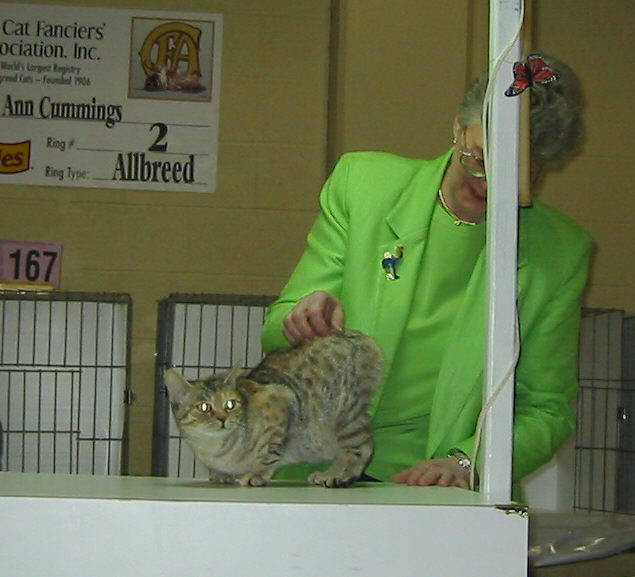 |
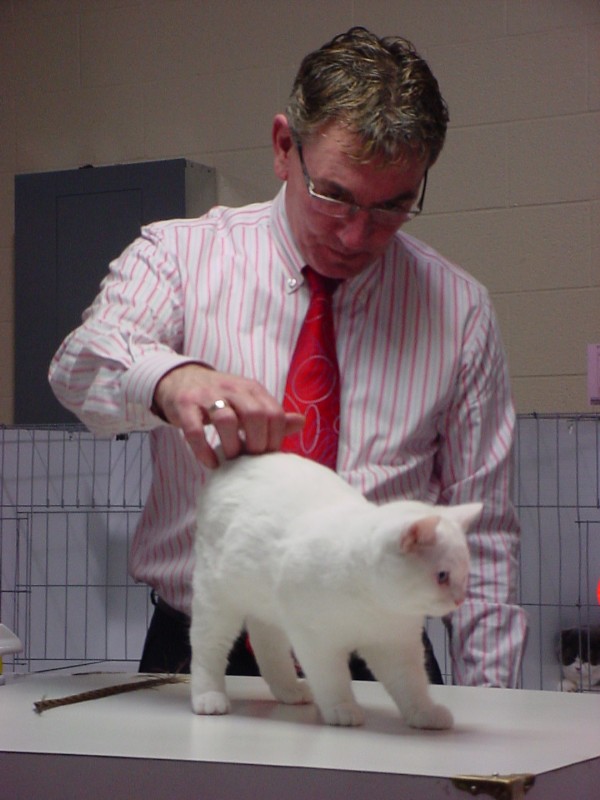
| This is GRC Sansq Dazzling Electrum of Romanxx (Dazzy) showing off for Judge Jo Ann Cummings at a show. Dazzy does the full "Manx" thing here, and as you see, Jo Ann knows how to get her to pose beautifully, to show off, as Jo Ann puts it, "her best asset which is no asset." |
| Cat showing is exciting, and tense, and unique, and sometimes disappointing (when you come home with a big basket of NOTHING), but the swell of your heart when the judge has YOUR cat out on the table and is saying nice things about him/her just cannot be equaled. It is a beauty contest, and a talent show, and a spectacle. The one thing you cannot do is to equate your own selfworth with how your cat does in the show, because this will make you either vain or insecure. The cat is there on *its* merits, not yours, even if you are the breeder, so enjoy the win, shrug off the loss, and love your kitty for allowing you to drag him/her out to this pecular place with all of these odd people! |
| If you cannot lose graciously, then you'll never be a winner, no matter HOW many times you come in first. |
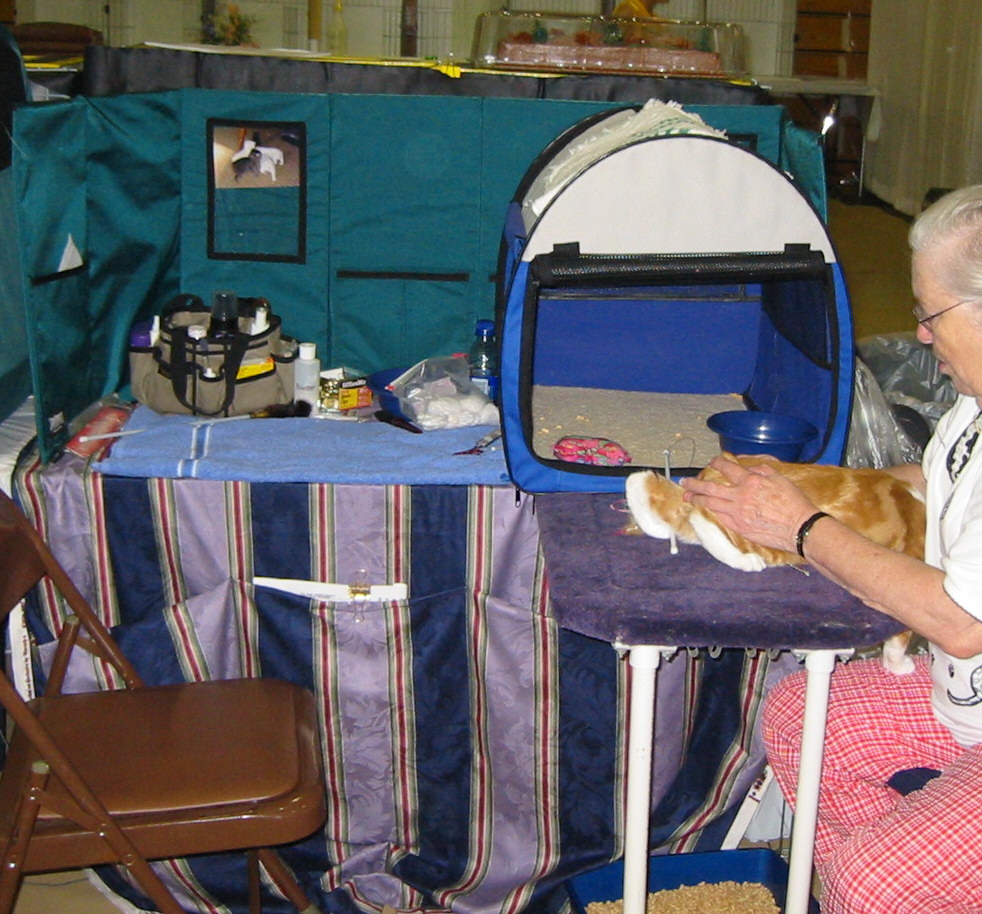
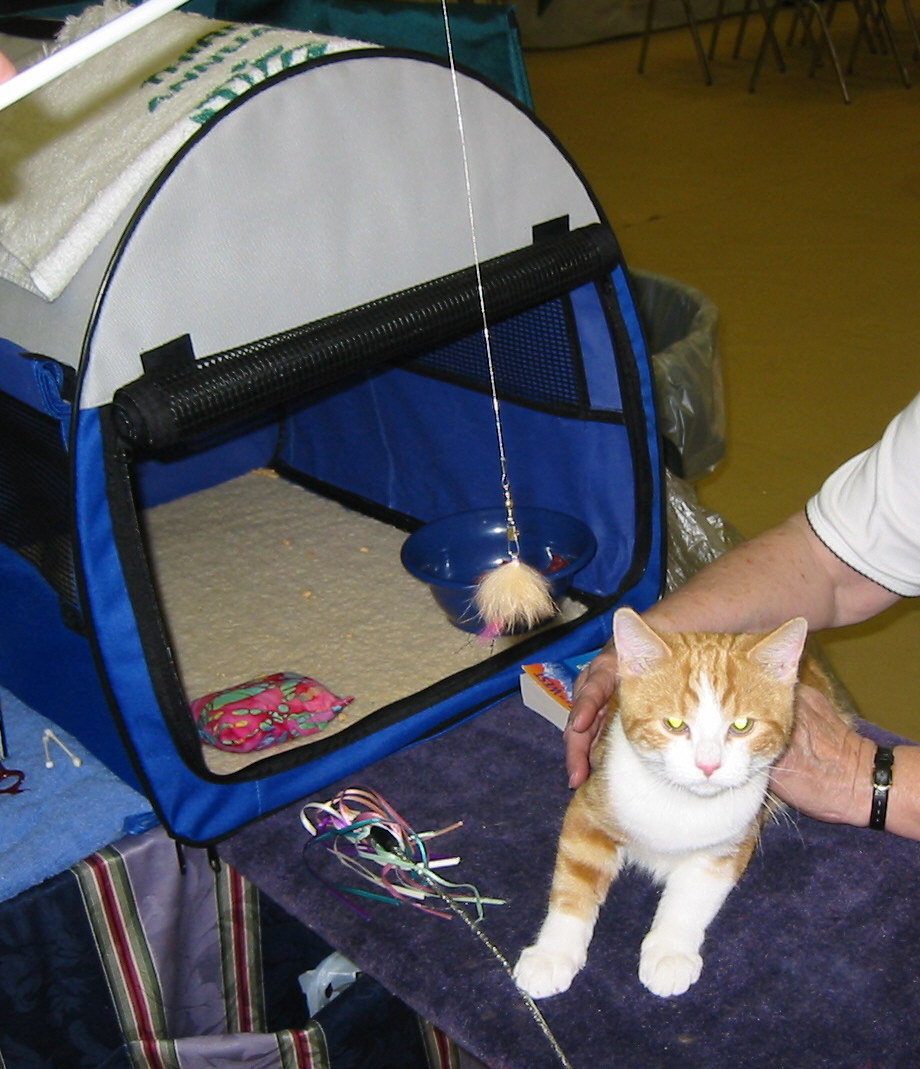
| At the right is my benching area set-up. I generally take only one cat, and so I use the other half of the benching area as my grooming space. I also have the small grooming table, for a little more room and so that the cat doesn't step into empty air when coming out! Taxxer hadn't quite decided that he was ready to show yet. Later, he relaxed and was playing on the table. |
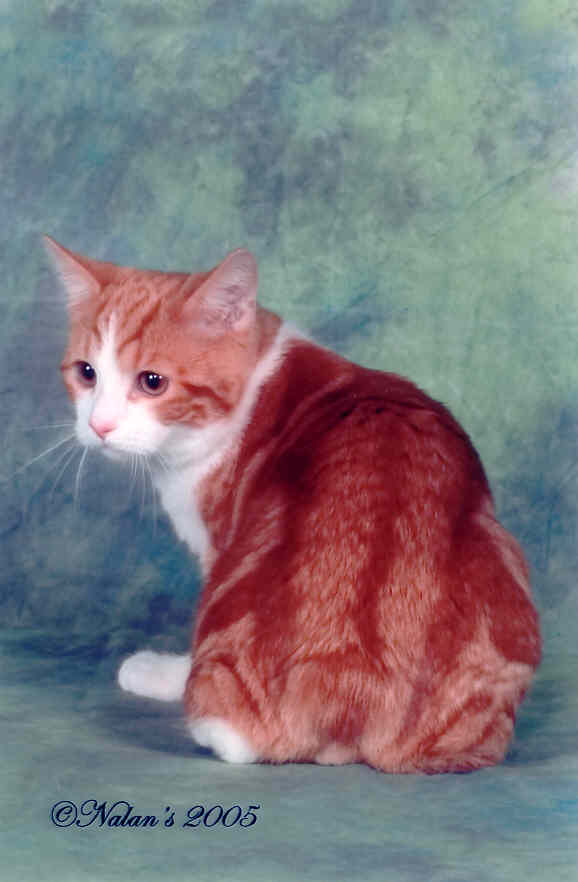
| Above, CFA Judge George Cherrie is judging TomTom. TomTom was just 4 months old at the time, and this was his first show. He ended up making *5* finals in the show! Good show cats must first of all be good pets, because unless they love you, they don't want to do well for you at a show. The good pet relaxes because it reads from you the comfort level you have at the show, and that there is nothing to fear from the activity and bustle in a show hall. At right is The Taxx Man in his professional photo, showing the results of grooming. |
| Some tips (including grooming) for preparing your cat for a show: (1) BEGINNINGS It is very important that you begin to work with your kitten when it is still very young, taking it places where there is noise, and unusual smells, and people. This gives the baby the chance to view such things and be around them without the necessity for being behaved in the show ring yet. Allow people to come into your home and encourage them to handle and pet the kitten, and encourage the kitten to tolerate this, and to play with strangers. You cannot expect a kitten who has never seen strangers or heard unfamiliar voices to fall right into the routine in a show hall. This may happen, but more often, the baby is overwhelmed by all the newness, and wants nothing more than to retreat from it all. Handle your kitten yourself as if you were judging, to get it used to the turning and stretching and fluffing and so on. (2) THE SHOW BATH This is crucial to showing your cat. Whatever kind of cat shampoo you decide to use (and there are many!) you should start out with a good degreaser, then use a conditioning shampoo that does not add oil. You want your cat's coat to shine with health, not oil. Key to the show bath is thorough and complete rinsing - get every speck of soap out of that coat!! All longhairs should be blown dry - every last hair on the body. Get the baby used to blow dryers early, and you will not have a nasty time doing it in a hotel room, or in the hallway or bathroom of the show (remember you can't use a dryer inside the show hall itself), should that become necessary. You will need to experiment with the different shampoos, because every cat is different, and what works for one will be a disaster on the next. Give your first show bath several weeks before the show, to see if you've chosen the right shampoo. If not, you have the chance for "do-overs," before it's show eve, and you realize you have made a mess! (3) GROOMING SUPPLIES There are many of these. If you're not certain which you ought to use, ask an exhibitor of your breed whose cat's looks you admire to suggest what may be useful. A good comb (the "greyhound" one that everyone tallks about is wonderful, if you can find one) but if you have a shorthair, you don't need to worry very much about combs OR brushes. You may want a chamois cloth to buff the coat before going to the ring, but if you've bathed well, the shorthair coat dries beautifully and needs little attention during the show. The areas to check are the neck and ears, for greasiness (spikiness), as well as the ridge along the back, and at the base of the tail. Should you notice this spiking of the hair, you may want to use some grooming powder, dusting it into the coat and then brushing it out completely. Use care with powder, especially in a dark coat, because it may dull the appearance. You DON'T want powder to puff out if the coat is patted or fluffed, so be certain it's all out before taking the cat to the ring. Don't get it into your cat's eyes, either, or you'll have a weepy-eyed cat in the judging cage - BIG no-no! (4) AT THE BENCHING AREA You need to have some kind of cage curtains to cover the outside and floor of the benching cage. These may be as simple as sheeting and towels, or as elaborate as you want to make them, complete with decorations and feathers and centerpieces for the top. The real purpose of cage curtains is to keep your cat from coming into contact with those on either side and to the back, and to give your cat a bit of a retreat from the activity of the show hall. Consider a way to lower something over the front, to protect your cat from well-meaning spectators who want to play with it. You don't know where their hands have been, and you don't want them transmitting some disease to your perfectly healthy cat. Many exhibitors will not allow anyone to touch their cats - thise is perfectly acceptable. If, however, you have a kitten or young cat, you may want to let spectators pet in furthering your acclimating your cat to showing and judging. Keep a bottle of hand sanitizer at your cage, and have people use it before touching, and petting should not be a problem. You need food and water bowls for your cat, a litter pan, and your grooming supplies. Some exhibitors find that they want to pay the extra to have a grooming space next to their cage; others purchase little tables that hook onto the front of the benching cage floor. Still others buy or build table tops/bottoms that use the carriers to set up a grooming space. There are those who simply groom in their laps - shorthairs lend themselves to this nicely. If you go to some shows and observe before taking your cat out for the first time, you will see how others do it, and pick up more tips for showing. There's always something new you can learn, and always something you may think of that others want to learn. Be open to new ideas, and remember that you want to show your cat because *it* will enjoy it as much as because *you* will enjoy it! Most of all, remember that you want to have a good time!! Meet others, look at the cats, explore the vendors, enter into the world of cat showing for the fun and the thrill and the companionship. You get out of it (as with most things in life) what you are willing to put into it. The rosette you may win is nice - the sharing of a common interest and passion and love with others of like mind is GREAT! If you have any questions - I'll be glad to chat with you. Contact me at [email protected] |
 |
 |
 |
 |