The Roman Gods names and their Greek names with which they are associated are listed below, with the Greek name in parenthesis: SATURN (CRONUS), JUPITER (ZEUS), JUNO (HERA), VESTA (HESTIA), MINERVA (ATHENA), CERES (DEMETER), DIANA (ARTEMIS), VENUS (APHRODITE), MARS (ARES), MERCURY (HERMES), NEPTUNUS (POSEIDON), VULCAN (HEPHAESTUS), LIBER (DIONYSUS), and DIS PATER or PLUTO (HADES).
The way that Romes religion started is told in this next story: Numito and Amulius, (am-u-lie-us) brothers and distant descendants of Aeneas (son of Ares and Aphrodite, and survivor of the ransacking of Troy who wandered for seven years before settling in Italy), inherited the kingdom of Albania. Rather than share the rule of the kingdom, Amulius killed his brother, and his brother's sons; and then forced his daughter to become a Virgin so that she would not bear any children who might kill him to take over the kingdom.
She became pregnant anyway and gave birth to twin sons, Romulus and Remus. King Amulius arrested her and ordered his servants to drown the twins. The servants placed the twins in a basket and tossed it into the Tiber River. The basket washed ashore where it was found by a she-wolf, who fed them with her own milk. A friendly bird also fed them by placing crumbs into their mouths. A herdsman eventually came across them and took them into his home to raise. When the two twins were grown they found out the true story of their birth, they raised an army of herdsmen who attacked, and killed Amulius.
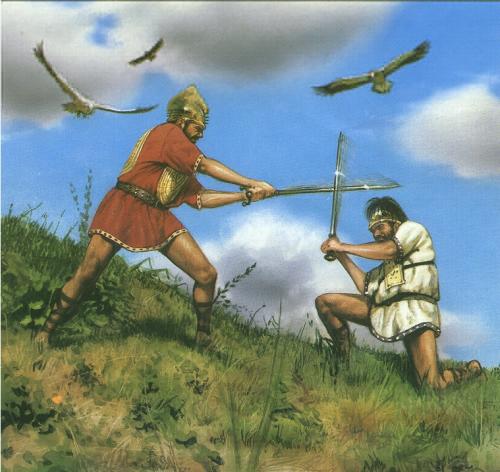
They returned to the scene of their rescue by the Tiber River, and began plans to build a town there. They could not decide who of them should rule, so they asked the Gods for a sign. They each awaited an answer from the God they believed in on one of the seven hills there. Romulus was a Mithrigan (mitt-rhi-gan) which meant he believed in Greek mythology. Remus was a Christian. Remus saw the first sign; six vultures in a line flying overhead. Romulus then saw twelve vultures in a line flying overhead, and thereby claimed kingship for himself. Remus disagreed, claiming kingship by virtue of seeing the first sign. The disagreement escalated, and ended only when Romulus killed his brother. He then established the new town, naming it Rome after himself. He also established a new version of Greek religion, naming all the gods after a planet or mythical creature.
These are some of the ways that Roman mythology has developed. It is still a tradition in Rome. Although the religion supposedly died years ago it still carries on in the hearts of some Roman people today, they hope too keep that religion going for a long time.