Human Rights in China
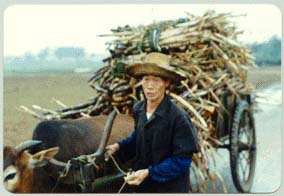 A farmer transports his sugarcane harvest in China's Guangdong Province. |
By Xu Wenli
(Xu Wenli is a leading Chinese dissident and human rights activist who was arrested by the Chinese government on Nov. 30 for his role in organizing and trying to register an opposition party in China. In recent weeks, the Chnese Government hassentenced four democracy activists to long prison terms. Last mont, Xu, a veteran of the Democracy Wall movement of 1978-79, was sentenced to 13 years for attempting to establish the China Democracy party. Xu was charged with "attempting to overthrow the state power" and endangering state security. Qin Yongmin, another Democracy Wall activist, was sentenced to 12 years on the same charges. Wang Youcai, a participant in the 1989 Tiananmen Square protests, was sentenced to 11 years for attempting to overthrow state power. Also sentenced last month was Xhang Shanguang, who received 10 years for talking to a reporter about farmers' protests. Xu submitted the following two-part essay (part one appeared in the Dec. 19 Sampan and Online Magazine) to the China Strategic Institute shortly before his arrest. It was translated by his daughter, Xu Jin, a graduate student at Boston University. For information on Xu Wenli contact Ms. Xu at 969-8635.)
At this moment, the most important platform for China's democracy movement is the human rights issue. Under the leadership of the CCP, China has a terrible human rights record. Therefore, this issue must be stressed in the overall move to bring democracy to China. Now, through the help and pressure of the international community, the CCP has recognized that human rights is a very serious problem, which has at times caused China to "lose face" and damaged its international image. But the basic attitude of the CCP is still to evade responsibility for these abuses and even continue to cover up the extent to which it violates the civil and political rights of its own citizens. I think it is time that the CCP change this attitude and their outdated approach.
In order to explain the gravity of the human rights problem in China, I will cite some of the most important human rights abuse cases. First, the biggest case of human rights abuse is that of Mr. Zhao Ziyang. Unfortunately, this case has been neglected by foreign governments, world opinion, and even by the Chinese democracy activists in China and abroad. A possible reason for this neglect of Mr. Zhao's plight is that he was former leader of the CCP. Therefore his case of human rights abuse wins no sympathy. I disagree with this reasoning. We know that Mr. Zhao's personal freedom is more restricted after issuing a letter he wrote to the CCP's 15th Party Congress calling for re-evaluating the June 4th incident.
In this incident, Mr. Zhao stands on the side of the people and is still insisting on this correct position about the 1989 student movement. From this point of view, his character and courage deserve our admiration, no matter what wrongs he had committed or what shortcomings he possessed before his mistreatment. Also, if such a person like Zhao can regain his freedom of speech and action, the political and economic reforms are expected to be pushed forward. In light of these two points, I personally hold that the case of Mr. Zhao is the biggest case of human rights abuse in China. We should show more concern for him, and the western countries should engage in a dialogue with the Chinese government about Zhao's human rights condition.
Second, we should fight for the early release of prisoners of conscience like Sun Weibang, Liu Xiaobo, Hu Shigen, Gao Yu, Liu Nianchun, Chen Lantao, and all other political prisoners, including those in Tibet and Xinjiang. Sun Weibang, a veteran democracy activist, had been jailed after participating in the Democracy Wall movement. After the Tiananmen Movement, he was sentenced for 12 years as a result of an unfair trial. Sun is still serving his term. The religious prisoners are often neglected by the people. In fact, this problem is very serious. They were sentenced for "counter-revolutionary offenses" for their ordinary religious activities. Now, the "counter-revolutionary offenses" have been abolished, but this has not resulted in any kind of review of the cases of those sentenced as "counter-revolutionaries." All these political prisoners should be released. The Chinese government should promise not to hand out these kind of sentences in the future.
Third, we should furthermore urge the CCP to ratify the International Covenant on Civil and Political Rights without any attached conditions or strings. After the signing and ratification of this covenant, the Chinese government should act in compliance with the stipulations. I hope that the CCP will not attach any strings to enforcing the covenant, such as emphasizing that China has its special national conditions. As a matter of human rights, there are no special conditions. We cannot say that Chinese are different from any other country in terms of human rights. All nations are made up of human beings, and its political leadership should follow the same standards in protecting the rights of its citizens. The international community and Chinese democracy activists should monitor the behaviors of the CCP in accordance with the Covenant, and criticize the CCP if it fails to implement the Covenant.
Fourth, we should push for reevaluating the 1989 Tiananmen Square democracy movement or June 4th Incident. The reevaluation of the incident need not be bestowed as a favor by anybody. Rather, it demands that the CCP alter the wrong conclusion arrived at and make a public apology to the dead and their relatives for the June 4th massacre. The government should compensate for the victims and their family members.
Action Plan: Urging the CCP to Take Concrete Steps
Now, the CCP and Jiang Zemin have arrived at a propitious time for carrying out comprehensive political and economic reforms. Though there are still some problems with economic reform, the Chinese economy is recovering and developing; the domestic political environment is relatively stable. In spite of the fact that China is often severely criticized for its human rights record by other countries, relations with other nations are rather stable and productive. There are some territorial disputes with, for instance, Japan concerning the Diaoyu/Senkaku Islands, and with the Southeast Asian countries regarding the Spratly Islands; but these problems are not as serious as before. Therefore, the timing and opportunity are excellent for pushing through comprehensive and far-reaching political and economic reforms. In light of this situation, I would suggest pressing the CCP to take the five following initiatives:
1. Giving Zhao Ziyang his personal freedom and right to free speech. The current CCP leadership should engage Mr. Zhao as senior advisor so that he can give full play to his wisdom and contribute to China's political and economic reforms. This will not shake Jiang Zemin's present position; on the contrary, it will improve his image.
2. Releasing political prisoners and other prisoners of conscience.
3. Reevaluating the Tiananmen Incident of 1989. Currently, the domestic and international environments are relatively stable. The CCP should know how to judge the hour and size up the situation by reevaluating the Tiananmen Incident of its own volition, affirm the greatness of the movement, apologize to the relatives of the dead, and compensate them for their losses. During the Tiananmen Movement, the citizens of Beijing and the students acted very peacefully and rationally; indeed, they deserve the Nobel Prize for their doings.
4. From the point of view of the economy, the CCP has decided to shift to a market economy and go further down the road of reform. This decision is right. Of course, we know that the market economy will not solve all problems facing China, but this course commits China to the continued openness to the outside world, economically and politically, which is a step in the right direction. However, we hope the CCP will not be perfunctory, but will earnestly carry out a complete and comprehensive reform including political reform. If CCP can do this, it would be a great blessing for the Chinese people. Political reform should go forth step-by-step, not by taking one step forward, and then two steps backwards.
5. Under the present circumstances, there are some political reforms that are easy to carry out. For example, the government should relax the controls on free speech and guarantee that nobody will be persecuted for expressing different views.