Quincy MCAS Scores Tops in City
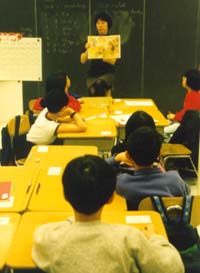 Third grade bilingual teacher Lai Lai Sheung in her Quincy School classroom. |
For years the Josiah Quincy School in Chinatown has been considered one of the best elementary schools in the Boston Public Schools. A high percentage of its students has consistently moved on to one of the city's prestigious exam schools and its students had been scoring well on tests such as the Stanford 9.
So it should come as no surprise to learn that the Quincy School scored higher than all other Boston public elementary schools in last spring's Massachusetts Comprehensive Assessment System test (MCAS).
The MCAS are state-mandated tests meant to gauge the effectiveness of learning in the state's public schools. Students in the fourth, eighth, and tenth grades will now be tested annually in English, math, and science (this year they will also be tested in history and social science). Students who take the tests are placed in the following assessment categories: Level 1 - failing; Level 2 - needs improvement; Level 3 - proficient; and Level 4 - advanced.
In English, 18% of Quincy School students scored in Level 1, 59% in Level 2, 21% in Level 3, and 2% in Level 4. In math, 25 percent scored in Level 1, 32% in Level 2, 25% in Level 3, and 19% in Level 4. In Science, 16% scored in Level 1, 31% in Level 2, 43% in Level 3 and 10% in Level 4.
Most of the city's elementary schools had weak scores in the "advanced" and "proficient" categories and generally did last well in the tests than affluent suburban schools. Other Boston elementary schools that performed well were the O'Hearn School in Dorchester and the Jackson-Mann School in Brighton. At the O'Hearn School, 14% of students were "proficient" in English, 14% in math, and 23% in science. At the Jackson Mann School, 11% of students were "proficient" in English, 16% in math, and 26% in science. In contrast, Quincy's "proficiency" scores were 21%, 25%, and 43%, respectively.
In a Community Newspaper Co. ranking of Eastern Mass. elementary schools based on student scores in the "proficient" and "advanced" categories, Quincy School scored much higher than all other Boston elementary schools but lower than the top suburban schools. According to this ranking, which averaged the English, math, and science scores of students performing in the top two assessment categories, the Quincy School received a score of 40, compared with 84 for the top-ranked Bridge School in Lexington. In contrast, the Patrick O'Hearn School of Dorchester had a rating of 25 and the Jackson Mann School a rating of 24.
In comparing the Quincy School's performance in the proficient category with that of schools across the state, the Quincy scored above the state average. In English, for example, the Quincy School had 21% in the "proficient" category, compared with 19% statewide. In math, the Quincy had 25% in the "proficient" category, compared with 23% statewide. And in science, the Quincy had 43% in the "proficient" category, compared with 42% statewide.
In an interview last week, the school's three new leaders said they will strive to maintain the school's high standards and work to improve student performance on the tests in the coming years.
Since former Quincy principal Bak-Fun Wong's departure last year to become deputy school superintendent for school leaders and clusters, Barbara O'Donnell has been appointed principal and P.K. Chan and Maud Wright have been appointed assistant principals.
"This is a school that has really developed a staff, a feel, a culture that is vibrant and works," said O'Donnell. "We're all different; we will all bring a little something to it, I'm sure. But the bottom line ... is that we don't want to lose here what's been developed; we want to maintain it and build upon it."
O'Donnell attributed the school's impressive performance to the educational culture that has developed at the Quincy School over the years. "I think the last two principals who were here were absolute visionaries," said O'Donnell, who has been at the Quincy School for 12 years and has served as a teacher and assistant principal at three schools.
O'Donnell said Wong was a "people person" who made teachers, administrators, and students feel valued and who constantly sought input and new ideas from the staff. Wong, she said, allowed teachers to take risks and was always eager to generate new ideas to improve the quality of education at the school.
The school's success can also be attributed to its teachers, who take a team approach to their work and are often allowed to concentrate on subjects in which they have special expertise. A teacher who is especially skilled in math, for example, may be allowed to teach math courses for several grades rather than teach all subjects to one class.
Also contributing to the school's success is its diversity and effort to instill in children a respect for other cultures. Every year the school has Chinese New Year and African American celebrations to expose the children to each other's ethnic culture.
"Some of our kids are immigrants," said O'Donnell. "Many of them are native born, but their parents are immigrants. This adds a nice diversity. We are seeing children who are coming from families where there's a great respect for the history of the culture, where there's a great respect for elders, where there's a great respect for education and that's wonderful for us and it's also a model for other kids to see. So I think it has a positive effect."
The school, added Chan, also makes an effort to make sure Chinese parents feel welcome at the school. Letters are sent home in Chinese and English and a Chinese-speaking social worker is available at the school, said Chan, a bilingual fourth grade teacher at the Quincy School and the city's bilingual coordinator before his appointment as assistant principal.
"When parents come to this school, they don't feel they are not invited," said Chan. "They're welcome; at any time we have people who can speak their language and can address their needs; this is very important."
Although O'Donnell points out that many educational strategies initially used at the Quincy School are now being used in other schools in the Boston Public School system, she said there is still room for improvement. "Of the three areas, English language arts is the one that we're concerned with," she said.
Chan suggested that the percentage of students in the "needs improvement" category for English (59%) could be attributed to the fact that English is not the first language of many students. The Quincy School, which has a bilingual education program for Chinese students, has a multi-racial student body which is about half Chinese.
"Even though we were the number one school in Boston, we still feel we have a long ways to go, said Wright, who was an art teacher at the Quincy School for eight years and a teacher in the Boston Public Schools since 1978 before her appointment as assistant principal. "We see kids who are still in need and we're reaching out to those children. We have an after-school program right now ... We're really trying our best to get those kids that are at the lowest levels up to a higher level because we know how important it is to have them succeed. It's not just the strong ones that we're concerned about ... We're always striving."
In an effort to help students perform better on the MCAS and other tests, teachers have been giving students examples of the kind of problems they may encounter on tests and helping them solve them when they run into difficulties. "If you're helping children learn to take the tests, it helps the child," O'Donnell said.
"I don't mind having tests because, let's face it, throughout life we're going to be judged in one way or another," said O'Donnell. "I think it's what the test is testing and the quality of the test that's going to be important. I think right now the MCAS is still in an evolutionary process. I think they are still trying to figure out exactly how long and ... and what degree of difficulty is appropriate for each grade level."
O'Donnell suggested that the fourth graders took the tests for about 17 hours over a number of sessions and that lengthy testing time may be a problem. "That's a long time for fourth grade kids," she said.
Chan, meanwhile, said the tests can be used to gauge "how well the teacher is teaching," while Wright suggested that the tests and the people designing them may have a "Eurocentric" bias that may pose problems for children growing up in other cultural settings.
Although the Quincy School had the highest MCAS scores of all Boston public elementary schools, it still scored lower than many schools in wealthy suburbs. Educators say a number of factors contribute to the gap.
"In an urban setting you're going to have a lot of added burdens and you'll find that in our school as well as in any other Boston Public School," said Wright. "But what's good is that we have a strong support system ... and all of this adds to our kids wanting to do better or doing a little better than kids in some of the other schools in Boston; we do have a very strong community."
Wright emphasized that the Quincy School now has an after-school program for children who need special help.
Wong, meanwhile, suggested that a broad range of factors may contribute to the lower test scores of students in large urban centers such as Boston, including socio-economic factors and more mobile populations. He believes, however, that the scores can be raised once teachers and administrators gain more experience with the MCAS tests and begin teaching material in the classroom that is more in line with its content. He also said that reforms made over the last few years at earlier grade levels should eventually show up on the test scores. In addition, Wong believes that the school day should be lengthened to improve the overall quality of education in the schools.
In an interview last week, Wong said that while many Chinese children are doing well in the school, others are not. And while family influence and support for education within the family has contributed to the success of many students, he suggested that some parents may not be spending enough time with their children. Parents, said Wong, need to be available at home to encourage children to do homework and avoid watching too much television.
"You can see more and more families now that are not doing that," he said, adding that many parents may be putting too much time and energy into working and earning money. "The biggest complaint is the parents are not spending enough time with the kids," said Wong.
O'Donnell, meanwhile, pointed out that the city has given the Quincy School the go-ahead to create a Quincy Upper School, which would allow students to continue their education at the school through grade twelve. That plan, however, is being held up because school officials have so far been unable locate an appropriate site. The school department had been eager to acquire the adjacent site of the former Don Bosco Technical High School on Washington Street, but the Salesian Order decided to sell it to the Corcoran Jennison Company to develop as a hotel and the new site of the South Cove YMCA.
Selling it to a hotel developer was a more lucrative alternative for the Salesian order than selling it to the Boston School Department for use as a public school.