Making Movies
Asian American Filmmakers Hit
Their Stride
Text
and Photo by Robert O'Malley
When the Boston Museum of Fine
Arts screened the documentary film "Kelly Loves Tony" earlier this
year, many of the Asian American young people in the audience were
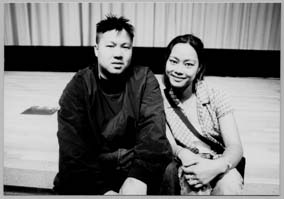
inspired by the determination and resilience of Kelly Saeteurn,
one of the film's main characters. Saeteurn is a 17-year-old daughter
of Iu Mien refugees from Laos who was planning to go to college
when she unexpectedly became pregnant with her boyfriend Tony Saelio's
child. After the baby is born and the couple moves into Tony's parents
house, Kelly begins a long struggle to balance her roles as mother,
wife, and college student. What sets "Kelly Loves Tony" apart from
most documentaries is director Spencer Nakasako's decision to give
Tony and Kelly a video camera to film their daily lives through
this critical period. The film works because it explores such universal
subjects as the fragility of relationships, the struggle to maintain
personal dreams in the face of adversity, and the conflicts that
arise when the values of youths and adults clash.
While many of the young people watching the film may not have identified
with the prospects of being a teenage parent, they did identify
with Kelly's determination to hold on to her dream of attending
college and her insistence on maintaining her independence in a
household where Asian and American values were bound to collide.
Like many of the young people in the audience, Kelly was the daughter
of immigrants and had internalized both American values and traditional
Iu Mien beliefs.
"You have taught me about adversity, about making the best of you
situation," said one member of the audience to Saeteurn, who, along
with her husband Tony, had traveled from California to attend the
screening. "There's really not much out there for us (Asians) to
see," said another. "You are a very strong woman and I admired you
watching the film."
"Kelly Loves Tony" is one of many recent films by Asian American
directors that set out to explore the struggles and concerns of
Asian Americans, particularly the young. Last year's Boston Asian
American Film Festival at the MFA, for example, included several
films exploring generational conflicts and the impact of race on
the lives of Asian Americans. In "Yellow" by Chris Chan Lee, a young
Korean American struggles to deal with his father's high expectations
and the cultural gaps that make communication between father and
son strained and ultimately dishonest. Similar themes are developed
in Rea Tajiri's "Strawberry Fields," which tells the story of a
Japanese American teenager who sets off on a quintessential American
road journey, only to end up face to face with her parents' unspoken
history and confinement in an internment camp during World War II.
In the past, mainstream culture has offered
few media images of Asian Americans or explorations of the kind
of conflicts and situations commonly experienced by them while growing
up in America. Mainstream films in America have largely reflected
the concerns and conditions experienced by the white majority. And
while African American filmmakers such as Spike Lee have finally
started to document in feature films some of the struggles of African
Americans, Asian concerns have generally remained invisible. In
recent years, the only mainstream film to offer a glimpse of a diverse
group of Asian American characters was Wayne Wang's "Joy Luck Club."
While some of today's Asian American filmmakers are eager to put
on film the kind of concerns that will likely resonant with young
people growing up Asian in American, others are making films that
are not overtly ethnic. Those who shy away from making ethnic films
suggest they could very well make an ethnic film at some point in
their careers, while those leaning toward more personal stories
don't rule out making mainstream films in the future.
"A lot of us grew up with the same story, the same issues that
haven't really been addressed as a film issue," says Chi-Ho Lee,
who has worked as a cameraman on an independent film and recently
tried to film his own script in Boston. Family expectations, cultural
differences between parent and child, speaking Chinese with family
and English with friends, social expectations, and model minority
stereotypes are the kind of issues he believes should be explored
in films.
"As a Chinese American I think I do have a responsibility to address
some of the issues," adds Lee, who came to the US from Hong Kong
when he was 8 and grew up in Florida. Lee doesn't rule out making
films later in his life that have little to do with being Asian
American, but for now he is intent on exploring more personal material.
Lee says he admires the films of Chris Chan Lee and Spencer Nakasako
because they speak to his own experience as an Asian American. He
wishes he could have seen similar films while growing up in Florida,
but recalls that it was almost impossible at the time to find films
"with believable Asian characters."
"If Asian American don't make films about Asian Americans who will?"
asks Lee. "Certainly no one else in Hollywood is going to." Lee
notes that while Hong Kong directors are making inroads in Hollywood,
there's a big difference between Hong Kong directors and Chinese-American
ones. It's a distinction, he suggests, that may often be lost on
the mainstream world. "They're Chinese but they're not Chinese-American,"
he says of Hong Kong directors. "They're two totally different animals."
While some criticism has been leveled at Asian American films for
rehashing themes to the point of cliché, Lee argues that such criticism
doesn't take into account the fact that mainstream films also overwork
an array of tried and true themes. "I hear that a lot," he says.
"But how many cowboy movies have been around," he says. Asian American
concerns that first appeared in films only five years ago are suddenly
"being called hackneyed and done," says Lee.
"There's still so much Asian American history" that hasn't been
explored in films, he adds. "They just don't see it as important,
maybe because we don't make a stink about it."
Earlier this year, Lee tried to film a script he wrote about an
Asian youth who is involved with both a Chinese woman and a Caucasian
woman. While he found two producers who were willing to back his
project, he soon found himself at odds with his partners. "I guess
we had different motives," says Lee. "We just weren't going down
the same avenue."
"My personal goal was to tell the story and hopefully get people
to think about certain things," particularly the kind of issues
that crop up for young people growing up Asian American, says Lee,
who explains that he and the producers eventually went their separate
ways.
Bonnie Wong, who was one of those producers,
believes that it's important for Asian American filmmakers to take
fresh approaches to their material. The founder of her own production
company in Boston, Wong points out that many of today's Asian American
filmmakers are dealing with issues of cultural identity and the
experience of "being an Asian in America." Are they more Chinese
or more American? is the kind of question that often crops up in
this material, she says.
Wong, however, worries that some of these filmmakers may be overworking
certain themes. Asian males, for example, are dealing with the issue
of being marginalized in a society largely dominated by a white
male sensibility. "I think there have been a lot of films that have
been made about that, but it's no longer fresh," she says. "With
me it's no longer original."
Wong argues that Asian filmmakers should be moving beyond such
preoccupations and exploring themes that will appeal to a broader
audience. "I like more universal story ideas and I don't really
care where they come from or what they're about," says Wong, who
is currently writing a screenplay.
Wong says she prefers films that "reach out to more than one group
of people" and argues that it's the story rather than the ethnic
content of a film that matters most. She worries that not many people
outside the Asian community would be been able to relate to the
content of some ethnic films. "That was one of the things that had
bothered me about the film I was working on," she says.
"I don't want to be pegged as an Asian American filmmaker," adds
Wong, who points out that the Taiwanese film director Ang Lee has
been making films that have nothing to do with his Asian background.
She says the issue has spilled over into Hollywood, where TriStar's
Asian head of production, Chris Lee, is being criticized for not
making more Asian American films.
Quentin Lee, a Los Angeles-based director, says the Asian American
content of his films is coincidental. "Sometimes it's very stifling
to be always put in these categories," says Lee.
The director of "Flow" and the recent critically acclaimed film
"Shopping for Fangs," Lee says his ultimate goal is to produce films
that have a universal sensibility. "Shopping for Fangs," for example,
is a psychological thriller with both Asian and non-Asians characters.
Lee, who recently served as assistant to director Peter Chan on
the film "Love Letter," which was filmed in Rockport last summer,
notes that Asian Americans are a diverse group and include Asians
born and raised in America and those who came here at a later age.
Lee, who came to the US from Hong Kong when he was a teenager, believes
that real differences exist between the two groups that may influence
their approach to filmmaking.
Those who grew up in America, for example, often become upset if
others treat them as being less than 100 percent American. The American-born
are also more likely to be eaten up by the racial politics of the
US. People who arrive here at a later age, on the other hand, are
less concerned about how people define them or whether they're considered
100 percent American. "I never expected that right," he says, adding
that the American-born sometimes tend to be "a little provincial"
in this regard. Lee says there needs to be a bridge between the
groups and an openness to a "more fluid" Asian American identity,
particularly in regard to filmmaking. Lee suggests he tries to bring
such a sensibility to his own films.
While Boston filmmaker Ellie Lee has written
a script based on autobiographical material, she has so far avoided
making films that deal directly with her ethnic background. Lee,
for example has made "A Look," an animated short that won MTV's
Free Your Mind Competition, and the award-winning "Repetition Compulsion,"
an animated documentary on homelessness and domestic violence that
recently appeared on PBS's P.O.V. series.
"I feel like it's a little overly self-indulgent for me to make
films just about being Asian American," says Lee, who worries that
an audience may not be there for such personal films. "But I think
being Asian American always influences my work. Like being an immigrant
and those experiences always inform my empathy for my character."
While the African American director Spike Lee has made ethnic films
that have reached a large white audience, she says there has yet
to appear an Asian American director who has done the same. Selling
ethnic Asian American films is also difficult because Asians make
up only about 2 percent of the movie-going audience in the US. She
suggests that this explains in part why few people have seen such
films as "Yellow."
"I don't know how they find an audience," she says of Asian American
films, adding "I've only been able to see them through film festivals."
Like many Asian Americans, San Francisco-based filmmaker Anita
Chang says she has found few images in mainstream American life
that speak directly to Asian Americans. She suggests it's important
for Asian filmmakers to change this by creating images of Asians
that haven't been seen before by a broader audience. "I see so few
images that really speak to me," she says.
At the same time, she adds, filmmakers need to be aware of the
fact that certain themes over time may become clichés and need to
be refreshed. "I definitely feel there should be fresh perspectives
on film," says Chang, who attended Tufts University and grew up
in Springfield.
That, however, doesn't mean that filmmakers should be fixated on
commercial considerations or avoid making films that deal with ethnic
material. It's important, she says, for filmmakers to stay true
to their artistic impulses and visions.
Chang, whose films "One Hundred Eggs a Minute" and "Mommy What's
Wrong?" were shown at the MFA this year, describes her work as being
"politically motivated but aesthetically based."
In "One Hundred Eggs a Minute," she focused on a woman who grew
up working in her parents' fortune cookie factory. The film explores
issues common to the immigrant experience, such as the conflict
between family obligations and the pursuit of individual goals.
Chang notes that the Asian American population has largely consisted
of immigrants and perhaps hasn't been rooted in American life long
enough to see its artistic life flourish. Focused on more practical
concerns, immigrant parents generally don't encourage their children
to go into the arts. She believes Asian Americans will make more
significant contributions to the arts "as those ties to the old
world loosen and people become more secure economically."
"I think it's getting there," she says. "It's like growing pains
right now." Chang points out that some Asian filmmakers have produced
"debut films" that will likely lead to more mature ones.
"It's going to happen," she says.
Return to Sampan Home Page
|