A Not-So-Benevolent Action
The Chinese Consolidated Benevolent Association
Puts a Social Service Agency on the Street
AACA Continues Programs in Chinatown Area
Community Leaders Question CCBA's
Use of Community ResourcesMany Say Organization Lacks Accountability
The Chinese Consolidated Benevolent Association (CCBA) last week forced the Asian American Civic Association (AACA) - one of Chinatown's major social service agencies - to vacate its office and classrooms at 90 Tyler St.
In a community drama that went largely unnoticed by the local media, AACA teachers and counselors worked into the night of Nov. 10 to pack the agency's computers, books and files to prevent CCBA from confiscating them the following morning. The AACA equipment was eventually transported by trucks to storage facilities and several sites where AACA will continue to operate its programs, including this newspaper. (For details on where AACA's programs are currently operating see the ad on page 2.)
After a last minute law suit failed to avert a court-ordered eviction, CCBA's lawyer informed AACA that the sheriff would appear to confiscate the agency's property if the agency wasn't out of the building.
The Old Quincy School building at 90 Tyler St. was given to CCBA by the city's Public Facilities Department for $1 in 1983 in the belief that it would be used as a "community center" in which AACA would be provided space for its multiservice center and language and skills-training programs.
On hand to observe the eviction last week were former CCBA presidents Wilson Lee and Paul Wong. Although Wilson Lee, whose family owns the Dynasty Restaurant, had repeatedly vowed during his tenure as CCBA president in 1996 and 1997 that he would not evict AACA from the building, Lee last week repeatedly visited the agency while the move was in progress to ask for the agency's keys. Also appearing to observe the result of his handiwork was Paul Wong, the CCBA president who first moved to evict AACA from 90 Tyler Street during his term in 1992. Conspicuously absent during the move was Robert Leung, a restaurant owner, print shop operator, and beer distributor whose sometimes abrasive approach to problem-solving in the Chinatown community has brought him into conflict with both AACA and the Kwong Kow School. It was Leung, for example, who became embroiled in a dispute with the Kwong Kow Chinese School - the second major tenant of the Tyler Street building - after claiming that he was its rightful chairman and that Kwong Kow was not independent of CCBA. Kwong Kow board members have since filed a suit against CCBA in connection with the dispute.
According to many observers in Chinatown, Robert Leung, Wilson Lee and Paul Wong are allies who together exert behind-the-scenes control over CCBA, which in recent months has also been battling
with members of the Chinatown Business Association. While CCBA has traditionally held Chinese New Year, August Moon, and Taiwan national day events in Chinatown, the Business Association this year has scheduled similar events to compete with CCBA's. Those allied with the Business Association include Frank Chin, Billy Chin, Kai Lau, and Ricky Moy. While all of these Business Association members have at various times been involved in CCBA activities, they are now at odds with its current leadership.
In addition to flouting the will of Boston Mayor Thomas Menino and Boston Redevelopment Authority (BRA) officials in evicting AACA from the building at 90 Tyler St., CCBA has also drawn criticism from community organizations engaged in providing social services for the area's Chinese community. Leaders of the Chinatown Neighborhood Center, the Chinatown Coalition, and the Chinese Progressive Association, among others, suggest that CCBA failed to act in the best interest of the Chinese community by forcing a major provider of language and skills training programs on to the street. They argue that the Tyler Street building was given to CCBA in the belief that it would be used as a Chinatown "community center."
This recent Chinatown debacle and other recent events that have put it at odds with other organizations call into question CCBA's ability to provide leadership in a Chinese community that has changed significantly since the organization was founded more than 70 years ago. Described as Chinatown's oldest organization, CCBA serves as an umbrella organization for the Chinese community's business owners and family associations. Largely controlled by the business community and operating under traditions more closely linked to Asia than America, CCBA has often come into conflict with newer community agencies that operate less traditionally and follow practices more in line with modern-day non-profits in America. While CCBA likes to think of itself as being rooted in Chinese tradition and language, AACA's goal has been to prepare immigrants for a new life in America by providing them with English-language and skills-training courses. CCBA focuses solely on Chinese community concerns, but AACA's interest is the broader and more diverse Asian and immigrant communities.
Sherry Dong, the Mayor's Office of Neighborhood Services' liaison to the Chinese community, said that while the mayor believed it was important for AACA to remain in the building, he had been constrained in his actions by the existence of a legal ruling in the case. "This was clearly a private dispute from the beginning," she said, adding that the BRA was brought in to mediate the dispute at the request of AACA. Dong said the city is now seeking possible spaces for AACA.
AACA's decision to leave the building last week came after a suit filed by AACA's lawyer failed to get a Superior Court judge to stop the eviction. CCBA originally moved to evict AACA in 1992 following a dispute over the operating expenses AACA was required to pay as a component of its rent. AACA lawyers contended that the organization was being forced to foot the bill for interest payments on what it believed were illegitimate loans that CCBA had made to itself. When AACA refused to pay the interest component of its rent, CCBA moved to evict the organization in 1992.
In a countersuit, AACA argued that it had a right to remain in the building because the original proposal through which CCBA acquired the 90 Tyler Street building for $1 in 1983 stated that AACA would be using it. The courts, however, ruled that AACA could not enforce that written commitment because it's name was not on the lease. The court then ruled that AACA could be evicted from the building and ordered it to pay a $47,000 judgment, which represents the interest on the loans that AACA considered illegitimate.
Following the court ruling and an unsuccessful AACA appeal, many observers believed that CCBA would be reluctant to put one of the community's largest social service agencies on the street. Over the last year, the BRA met with representatives of both groups in an effort to mediate the dispute and to help the parties develop an arrangement by which AACA could stay in the building. In recent months, it appeared as though an agreement were imminent but negotiations collapsed after CCBA failed to follow through with the terms of a verbal agreement it had made with AACA in June. At that time, the two parties agreed that AACA would receive a six-months lease with an option for renewal provided that AACA began paying the court judgment. AACA also agreed to pay $6,000 per month in rent, compared with the $3,500 it had been paying. The latest agreement collapsed when CCBA sent AACA a license to operate rather than the agreed-upon lease. Believing that a license offered little protection for the agency, AACA requested a lease. CCBA, however, refused, saying that if AACA did not sign the operating license it would move to serve the eviction.
AACA board members continue to assert that the real issue involved in the dispute between AACA and CCBA is the way that Chinatown community resources are being administered. They argue that the only reason CCBA received the Tyler Street building in the first place was because it had told the city that AACA would be a major user of the building. Once CCBA gained possession of the building, however, it proceeded to transform what was meant to be a community resource into an organizational resource.
AACA executive director Chau-Ming Lee argued that CCBA behaved in a similar way when it received the SCM building at 50 Herald St. from the local medical institutions. That building had been given to CCBA on behalf of the Chinatown community to be used for the creation of new community housing, but once CCBA received the property it used almost $700,000 in rental income from the building for its own expenses. AACA's executive director and board members argue that the CCBA has been accountable to no one in the community and has misused community resources.
AACA board members also say that AACA lost the court case largely because the judges ignored the fact that the building was meant to be a community center used by various community organizations. The issue was strictly viewed as a disagreement between the owner of a commercial building and a tenant. CCBA had the advantage in the courtroom because the deed to the building was in CCBA's name, even though the building was transferred with the understanding that it would be a community building used by AACA. If the same type of community resource were to be given to the Chinatown community today, it's safe to say that CCBA's track record in handling other community resources would argue strongly against it, according to a least one provider of services in the community.
In a meeting with other community leaders last week, AACA vice president Paul Yee emphasized that AACA has always paid its rent and that the dispute over finances originated with the interest charges the organization was being asked to bear. CCBA leaders have been telling other newspapers and people in the Chinese community that AACA was evicted because it hadn't paid its rent.
Yee argued that one way to get CCBA to live up to the obligations spelled out in the original proposal would be for the city to file a suit against CCBA for its failure to use the building for its intended purpose. Some in the Chinese community would also like to see the building - which has been poorly maintained under CCBA's stewardship - become an historical landmark because of its significance as the first graded school in the US.
In Chinatown, the leaders of several social service agencies expressed concern over the way CCBA handled the dispute and the effect it would have on immigrants using AACA services.
"I think AACA is a valuable community resource," said David Moy, director of the Chinatown Neighborhood Center, who added that it would be a "pretty devastating loss for the adult learners in the community" if its services were to be interrupted. He said any loss of AACA programs would present a major gap in services because AACA provides higher level English and training courses to complement its own basic ESL program. Moy added that CCBA's decision to evict AACA from 90 Tyler St. "doesn't appear to be in the spirit of the original conveyance of the building."
"It certainly contradicts to a certain degree their (CCBA's) own claim that they serve the community," said Moy, who along with others suggests that CCBA lacks accountability in the community.
"I'm not sure who they're accountable to," he said, adding that most non-profits have to be accountable to boards, funding sources, and citizens groups. "A level of accountability appears to be absent," he said.
Moy suggested that the Chinatown Neighborhood Council may want to look into the matter and suggested that the city should also perhaps take a closer look at what happened at 90 Tyler St. last week.
"I think the building was given to CCBA to be a guardian for the community," said Lydia Lowe of the Chinese Progressive Association. "It was really meant to be a community center for Chinatown."
And while Lowe suggested that there were two sides to the dispute between AACA and CCBA, she argued that CCBA's decision to put AACA on the street was not in the best interests of the Chinese community or of the students enrolled in AACA's programs.
Beverly Wing, of the Chinatown Coalition, said there are probably two perspectives on the conflict and that the truth likely falls somewhere in-between. But because CCBA is an organization that believes it has a "divine right to do whatever they want to," she said, fighting them may prove futile and distract AACA from its main goal of providing social services in the Chinese community.
She suggested that many people in Chinatown are reluctant to speak openly against CCBA because of family connections and social pressures.
Stephanie Fan, of the PEACH Corporation, said that while CCBA may have provided effective leadership in the Chinatown community in an earlier era, she said it "seems to have lost that over the years." She said the growth of such organizations as the Chinatown Neighborhood Council and the Chinatown Coalition "means that their authority is diminishing."
Fan also raised the issue of CCBA accountability, particularly its use of rental income from the SCM building. "From my perspective I really think CCBA needs to be more accountable to the community," she said.
"This is not good," she said of the eviction. "The people who get hurt are the people who need services."
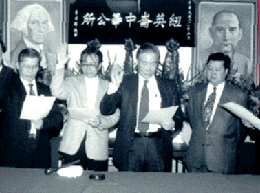
-Text and photos by Robert O'Malley(Photos: (top)Outgoing CCBA President Wilson Lee (far right) watches as new officers are sworn in on CCBA's 1998 inauguration day. Last week, CCBA President Robert Leung (second from right) gave the go-ahead to evict a major Chinatown social service agency from 90 Tyler St. Wilson Lee was on hand to pick up the keys. (below) An AACA teacher packs agency books and records on Nov. 9.)