Filmmaking With a Message
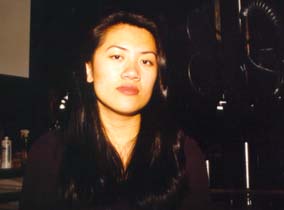 Ellie Lee at Harvard's film department. |
(Ellie Lee is a Boston-based filmmaker who was born in Hong Kong but grew up in the South End. A graduate of Harvard University, Lee has recently received a grant to document the lives of homeless women over a three-year period. Lee's award-winning animated documentary, "Repetition Compulsion," recently appeared on PBS's POV series and was an Official Selection of the 48th Berlin International Film Festival. Her animated short, "A Look," was shown on MTV. A teaching assistant at Harvard University for three years, Lee is currently working on a three-minute fiction film called "Mausoleum," which takes place in Mao's Mausoleum in Tiananmen Square.)
I never thought that I would be a filmmaker. I've always liked to draw, but it never occurred to me that you could pursue art as a profession. When I went to Boston Latin School I took some classes at the Museum of Fine Arts; they have these free after-school programs for teenage high school students.
I started working in homeless shelters while I was a freshman in college. By the time I was a junior or senior I noticed this strange pattern that all the women I was working with in the shelters were involved in really abusive relationships with men. I became increasingly frustrated that I couldn't work with them to get them the counseling they needed, to get them to the next step so they could get into a safe place emotionally and physically. Increasingly I started hearing the women confide in me these stories about how they had been sexually abused and violated or grew up with a lot of physical abuse and chaos when they were children. Before I had never kind of connected the dots. A lot of people don't think about the multitude of things that precipitate homelessness. But certainly it's been shown statistically that 79 to (I think) 87 percent of all homeless women in America have had these kinds of traumatic histories as children.
So when I started realizing this, I thought, my goodness, what can I do as an individual to sort of carry this message or make this more apparent. And naturally I just thought: film; film is the natural medium for this. And it was in my mind at the time because I was doing animation but was also coming from a photojournalistic standpoint. I had some experience doing quite a bit of still photography so I was trying to merge those interests. That's when it occurred to me that I could use film.
I did a short film my junior year about homelessness, and I just thought, this is it; this is exactly the medium I'm good in. And so senior year I embarked on a thesis about battered and homeless women. I decided at the time to do it as an animated film because I thought that that way I could protect the women's anonymity and dignity and talk about these very difficult issues in a very fresh and very innovative kind of way. Mind you this was back in '91. And I think that in 1991 even the issue of domestic violence wasn't really discussed, but it's something that seems quite clich� now. At the time, an animated documentary was also an unusual idea. But before I had a chance to finish the film [which eventually became "Repetition Compulsion"] I got into this weird car accident on Storrow Drive. My trunk opened and all my artwork fell out and was run over repeatedly by traffic in the rain. It was horrible. I had a version of it for my student film but it wasn't really finished. I lost over 600 drawings.
The kind of work I like to do isn't character animation; it's not like Disney animation. I'm more interested in finding the best way to tell the story. I like to experiment with materials. Sometimes it's animation, sometimes it's not. "Repetition Compulsion"? is all animation - about 3000 charcoal drawings. But it's also kind of a hybrid because there are documentary interviews that give it content. When I write or do things that aren't animated, I can't help but bring in other sensibilities - my animation sensibility and my documentary sensibility. So I'm always creating these hybrids.
The project I just got some funding for is a feature documentary about homeless women. My objective is to try to locate women who are on the edge of falling into homelessness and to document their lives over a period of three years. What interests me is not just their stories in the here and now but their story a year from now, and their story two years from now, so I can really kind of see the arc of their struggle.
I have to figure out a methodology to avoid exploiting the women, whether that means involving them in the editing process or something else. I worry about that and I think about it a lot. It's something I'm going to be very aware of when I go into the project. Obviously I want to empower them to tell me when to stop filming and when it's not appropriate and what questions are not appropriate. That's really key in terms of my relationship with the women. If I can't figure out a way to shoot it that's respectful, then I won't shoot it at all.
As a filmmaker I also have to figure out who's my audience. How can a present something that people normally don't want to see? Who wants to see a film about homelessness? Who wants to feel depressed? Like how can I present it in a way that's fresh so that people will feel compelled to watch because there's some sort of drama inherent in what's going on. These are human beings who in a lot of ways share similar kinds of things that you and I are going through.
It's great to make a film, but if there's no one interested in backing you up and showing your film it's kind of wasted effort. Unfortunately there hasn't been a real explosion [in Asian American films] like there has been for Spike Lee and African American cinema.
And part of it has to do with the fact that when they do statistics they say: Well only 2 percent of the movie-going audience is Asian, whether that be Asian immigrants or first generation Asians born here. It's a very small part of the population. And that tailors the kind of work that's being made. At this time I feel like it's a little overly self indulgent for me to make films just about being Asian American.
The first script I ever wrote was a very personal script. It's hard to describe because it's something I would never want to produce; it's something very introspective, a personal film about my family and about being Asian American and about being Chinese American, especially as an immigrant in America and what that meant. And it centered on characters loosely based on myself and my maternal grandmother. What's interesting is I felt it was important as an artist to write the script, but it's something I never really wanted to make strongly enough. I don't know what that means. I mean I feel it's very natural for all artists to do something that's very much about themselves, especially when they're 21 or 22. It's very common for a lot of my students to endeavor in self portraiture or very personal documentaries or things like that.
But I think being Asian American and being an immigrant always influence my work. Those experiences always inform my empathy for my characters. "A Look" is informed by my experience of being a voiceless woman and feeling like I had no power over certain situations when I was growing up as an immigrant. "Repetition Compulsion" is about abuse and homeless women. I myself was never abused or homeless but I can empathize with people who have no voice and are kind of powerless merely because of my experience being an Asian American immigrant growing up in a very poor neighborhood.
I'm a filmmaker but I always draw upon these experiences. I just recently saw a film about the Hollywood moguls called "Hollywoodism." It's about these Polish Jews who literally founded every major studio in Hollywood. They grew up within 500 miles of each other in Poland and they immigrated at the turn of the century and then headed out West. When they came to New York they encountered all kinds of anti-Semitism. They went out West to found these movie companies and within a few years lived within 15 miles of each other. They made films that weren't specifically about the Jewish experience but all their films were informed by their being immigrants and their being persecuted as Jews. A lot of the films before the Jewish moguls came along were from the perspective of people who were already in power, or they were films for the amusement and entertainment of the bourgeois or the very wealthy. D.W. Griffith's "Birth of a Nation" was about the Ku Klux Klan.
But the Hollywood moguls made films about the little guy trying to fight some big obstacle. Or maybe about a collection of people coming together to fight some greater evil. And what's interesting is that's kind of the archetype of what we think of as a Hollywood blockbuster film. It's the story of the little guy who has to fight against all odds to make it. But where did that come from? They said: OK, we don't have a place in America so how can we learn to make it work for us? How can we still get our ideas across in a very mainstream kind of way? So the films weren't necessarily about anti-Semitism; they weren't necessarily about being Jewish. So when I'm trying to make films, I don' t want them to be so specifically about the experience of being Asian American, but I know those experiences will always inform the kind of things I do artistically.