|
Chinatown |
|
An excerpt from a book-length photo-text documentary on |
|
Text
and Photos |
 |
|
Working
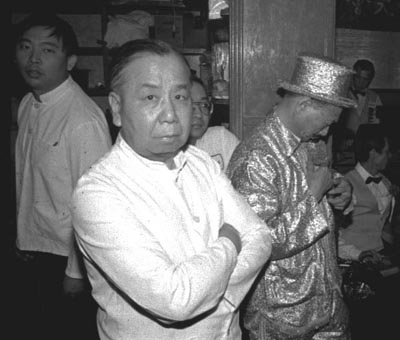
the night shift at the China Pearl Restaurant in Boston's Chinatown.
|
|
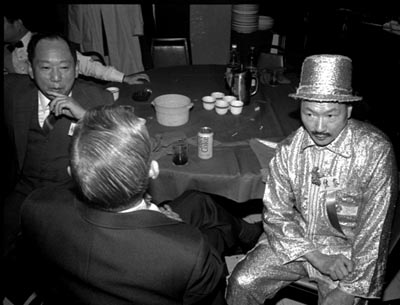 |
| A musical night at a Chinatown restaurant (1988). |
The Daily Grind
He has the angular, hardened face of a longtime restaurant worker. He sits in the office of the Chinese Progressive Association at the corner of Beach Street and Harrison Avenue.
For about 25 years Wan Cheung was a worker in numerous Chinatown restaurants. He's retired now, and often spends his days at the Progressive Association, not far from the Chinatown elderly housing complex where he has an apartment.
I was born in China and came to the US in 1972, he says. At the time I was 40 years old and living in Hong Kong. I had gone to Hong Kong in 1949 and was working as a machinist on a ship.
I was married in Guangzhou in 1951, but my wife died from throat cancer in 1962. I have a daughter who lives in China and another who lives in Hong Kong. My children didn't want to come here; they were married and were already settled into their lives.
I worked on the boat for 15 years. I traveled around the world. But working on the ship was really hard. The waves made me feel uncomfortable all the time. The boat was not stable. And if we had a bad captain life could be even more difficult. Because of this I didn't really like working on the boat.
In 1972, six of us - three sailors and three machinists - jumped ship in San Francisco. We were tired of moving around and decided to settle down. That's why I decided to get a job in the restaurant. At the time I arrived in San Francisco, the government wasn't so strict about immigration. I applied for a social security card and I got it in one week. When I came to Boston I was able to work in a restaurant. In 1986 I applied for amnesty and became documented.
I worked in Chinese restaurants for almost 25 years. I don't remember which restaurants because I worked for so many. Some of them have since closed. I retired in 1991 when I was 65 years old. I had a kidney stone operation and stopped working after that. I worked in the restaurants after I came to the US because I didn't know English. I worked in Chinatown restaurants and lived on Harvard Street. I usually went home at 1 o'clock in the morning and went to work the next afternoon at 2 o'clock. I had to wash the dishes; I had to peel the shrimp; I had to cut the pork. Then I would cook. I spent the whole day in the kitchen, from 2 o'clock in the afternoon to 1 o'clock in the morning.
It was a hard life working in a restaurant because we didn't have
a break. We had to keep working all the way through. If I finished
cooking one order I would soon have to cook another. I stayed in
the kitchen the whole time I was there. The kitchen is hot and sticky.
We work with knives, so it's also very dangerous.
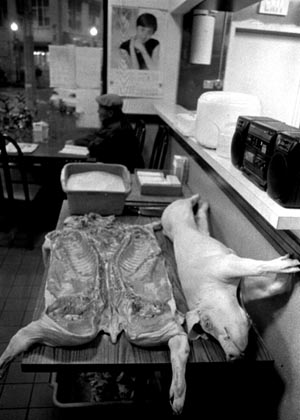 |
| Delivery time at a Chinatown restaurant (1999). |
After work I would just go home and sleep. When I woke up I would go to the restaurant and do the same thing again. The work was hard but the pay was not that good. When I came to Boston in 1972, the salary was about $500 a month; when I left the job in 1991 it was like $1,300 a month.
If I had been able to speak English I would rather have been a waiter. Being a waiter is better than working in the kitchen. I don't think I could get any better job in this country because I couldn't speak English. There were times when I thought about going to learn English, but I didn't have the time because I spent all of my time working and sleeping.
Working in Chinese restaurants I didn't really need to speak English; I only stayed in Chinatown. My only entertainment - my only activity - was going to see Chinese movies in a Chinatown theater. I didn't go shopping outside of Chinatown. I just stayed here. Chinatown had everything I needed. I didn't drive. Sometimes I would take the T to go outside of Chinatown to buy something, but I'd only go with my friends. I would never go by myself.
I didn't really have any interest in finding out what Americans were like; I really didn't care. But I think America is better than other countries. It's richer and easier to get a job here. The best thing about America is the way the government treats elderly people; they treat them very well. I live in the elderly apartment now.
Before I came here I thought it would be really easy to find a job; I thought I could quickly make a lot of money. Until I got here, I didn't really know that working here - working in the restaurant - could be so hard. But once I was here, there was no way to go back. I had no choice. I had to stay here. When I first came here I thought about returning, but I decided I was too old to ever go home again.
I think if I had spent my life in China or Hong Kong, I would, in some way, have had more freedom. If I didn't want to work in the restaurant, I could have tried to do something else. I could have gone wherever I wanted to go because I would have known the language. In China I could have been more involved in the life around me. I would have been able to speak up and argue with people. I could have let people know what I thought and what I wanted. But here nobody listens.
In China I would have had more freedom to move around and communicate with others, but I also would have worried more about my life and survival. In America I am confined to this Chinese community, but I know that as long as I stay here I am safe.
I feel the government treats people well here, though maybe I would have been happier if I had stayed in China.
Since I came here, though, I really don't think much about it. I just follow the routine. I go to bed; I go to work. That's it. I really don't want to think. I know that thinking about it would be useless. Even if I think about it, it's not going to change anything.
I work to eat; I eat to work. That's the meaning of my life. One happy period of my life was the time I was able to see Chinese movies in Chinatown, but now I can't even do that because there's no longer a Chinese movie theater here.
These days I wake up in the morning and first get something to eat for breakfast. I either eat breakfast at home or go out to Chinatown to get something to eat. After I eat my breakfast, I walk over to Boston Common to talk with my friends. I go to the park at about 8 in the morning. I just walk around. If I bump into a friend we will talk. At noontime I go back to my apartment to eat because they serve lunch there.
In the afternoon I come to CPA (Chinese Progressive Association) to read newspapers or see if I can do something. Sometimes I help CPA send out mail. Now they are preparing for their 20th anniversary, so I have been helping them collect ads. I go to each Chinese restaurant to ask them to sponsor us by putting an ad in our program book. If CPA has a steering committee meeting I will go to it too.
When I was sick in 1991 I came to CPA for help. After I went to the hospital for treatment, I received many documents I didn't understand. I came to CPA for help, and they translated the letters for me. I knew the services here were free. Before I was sick I really didn't know about CPA.
Later in the afternoon I return to the park again. In the afternoon there will be older ladies there who can talk. We get together to talk about our past. We talk about nothing that's very real. We talk about our history. What else can we talk about? I don't have any girlfriends. If I had wanted to remarry I could have done that a long time ago. I don't have to wait till now to do it.
After I leave the Common I go home to cook dinner and go to bed. I am old now. I cannot do anything. I live on a retirement plan and on SSI (Supplemental Security Income). The retirement money comes on the third of the month and SSI comes on the first.
I don't know what will happen tomorrow. I don't even know what
will happen after I go to bed. I am old, and that's just the way
it is.
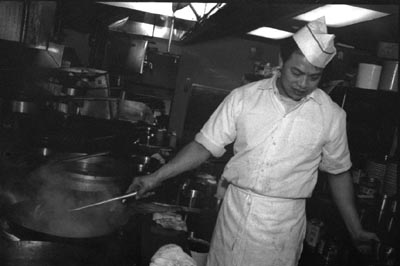 |
| Cooking the night shift at Chinatown's LeiJing Restaurant. |
Under the Table
Everyone knows what goes on in the restaurants but no one wants to talk about it.
Chinatown exists in a cocoon. It lives by its own rules and practices. It's like a city within a city, a government within a government.
Many Chinese businessmen have an interest in keeping the mainstream world at arm's length. Lao fan ("old foreigner" - a name for non-Chinese) ways are not Chinese ways. Sometimes it's better not to let the lao fans know too much about what you're up to; sometimes it's better to be silent even if you know how to talk.
When new immigrants arrive in Boston, many have no choice but to find jobs in the area's booming Chinese restaurant industry.
The immigrant economy is both a savior and a bane to many Chinese immigrants. It's a savior because it offers immigrants a job in America, a bane because working conditions in some of the restaurants are less than ideal.
Working in a Chinese restaurant provides a safe haven for non-English speaking immigrants who often find the mainstream world complex and threatening. Even if they want to, most immigrants find it impossible to get good-paying jobs in the mainstream economy if they don't know English.
But working in the immigrant economy involves a number of tradeoffs. Immigrants must play by the rules of the Chinese economy even if its practices are illegal and not in their best interests. Controlled largely by people who were born or raised in Asia, the Chinese restaurant industry follows the unspoken rules of Chinese culture rather than the established ones of American society.
While many Chinese restaurant owners are respectful of their workers - realizing that they're struggling to make new lives for themselves in America, just as they once were - some have only their own interests at heart. They have a take it or leave it attitude toward the worker, realizing that the worker often needs him more than he needs the worker. If a worker is dissatisfied, the owner can simply find another one to take his place. There will always be a steady supply of new immigrant workers waiting to replace those who would dare to step out of line.
Often the most vulnerable workers are the illegal ones because they can't go to the authorities to seek redress if they're dissatisfied with their bosses. They have no standing in American life and must take what they can get here. These illegal workers also put added pressures on legal workers who could easily be replaced by them if they demand too much of their bosses.
Turned in on itself and guided by its own rules, the Chinese restaurant industry has developed an array of financial practices designed to squeeze the maximum amount of profit out of its businesses. Like many small business owners in America, the Chinese entrepreneur isn't eager to pay taxes if he can finagle his way around them. He's also in no hurry to provide workers with benefits such as health insurance or workers' compensation. A worker in a Chinese restaurant almost never receives health insurance, relying instead on free health care or health insurance through a wife's mainstream job.
The workers themselves are also in no hurry to pay taxes. Those who came from China aren't accustomed to having the government take such a large chunk of money out of their pay checks.
In the past the mainstream world turned a blind eye to many of these practices, in part because it was difficult to penetrate Chinatown and know what was going on there. Mainstream officials only bothered to venture into Chinatown if they thought activities there were affecting the non-Chinese population; otherwise they simply ignored the Chinese community and saw it as different from their own.
In the early years of Chinese migration to Boston, Chinese immigrants came from a largely medieval world that had changed little for centuries. The Eastern and Western worlds were oceans and centuries apart.
But with the changing of immigration laws and the emergence of civil rights as a central social issue in the 1960s, the mainstream world has gradually begun to penetrate the once closed-in world of Chinatown. America has been able to enter Chinatown because the Chinese have finally been able to enter mainstream America.
America in the 21st century is not the America of the 19th or 20th centuries when racist exclusion laws kept Chinese out of America. And the Chinese who come to America today are not the Chinese of an earlier era.
Developments in communication and economic growth have drawn the Eastern and Western worlds closer together. Chinese no longer come to American dressed in Qing Dynasty pigtails or unusual costumes. Their dress is little different from American dress. Many know about Michael Jordan and other American cultural icons.
Globalism is shrinking the gap between the peoples of the world.
Although many Chinese immigrants continue to live outside mainstream
America, today's newcomers are far more savvy and less willing to
tolerate unfairness than they were in years past, especially if
they think they can make out better by taking the matter to the
authorities.
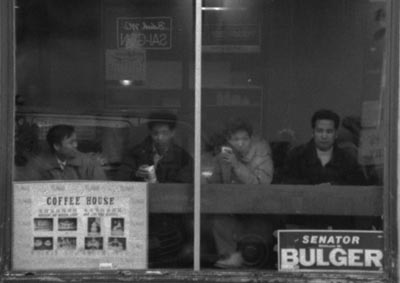 |
| Waiting for the bus at a Chinatown coffee shop. |
Speaking Out
It wasn't easy for the Chinese Progressive Association to take a public stand and pressure the Chinese business community to uphold basic US labor standards in the late 1990s. Subtle pressure is always exerted in Chinatown to keep the community's secrets within the community. A few years later, in fact, the Progressive Association would revert to a less aggressive approach after members of the business community cautioned that it was unwise to air the community's "dirty laundry" in public.
At the time, though, the Progressive Association was intent on focusing on working conditions in Chinese restaurants and other businesses where Chinese were employed. Besides restaurants, many new immigrants find work in garment shops, hotels, institutional food services, and factories.
Immigrants sometimes complain about racial discrimination and unfair treatment in some non-Chinese businesses, but they must often contend with an array of illegal practices in some Chinese-owned businesses.
Workers in many Chinese-run businesses, for example, are not paid overtime rates for hours worked in excess of 40 hours, says Lydia Lowe, director of the Progressive Association's Workers Center. Many Chinese restaurant workers also end up working six 10-hour days per week. "I think there are a lot of standard practices in the restaurants that are illegal," says Lowe.
While state law exempts restaurants from overtime regulations, she says federal law requires compliance.
The CPA has investigated instances in which restaurant owners have failed to pay workers on time or withheld wages when their businesses ran into financial troubles.
"There are a lot of times when the owner will say, 'I'm short of money. I can't pay you this month,'" says Lowe. "We've seen cases where this has dragged on for months." Restaurants are required by law to pay workers within five days of the end of the work period, she says.
In the late 1990s, a group of unpaid Chinatown workers sought back wages from the Grand China Restaurant, which ran into financial troubles and closed.
When the Grand China began to falter, partners Frank Wong and Jimmy Wong bailed out of the business, leaving partner David Wong to struggle alone to keep the restaurant afloat. The owner of the Washington Street building in which the restaurant was located, David Wong was forced to close the restaurant - said to be the largest in the city.
While Wong says his financial troubles made it impossible for him to pay his workers and suppliers, the payments were also apparently delayed because the three partners couldn't agree on who was responsible for the wages. Even though Frank and Jimmy Wong had withdrew from the business, their names remained on the company's legal documents, according to the Progressive Association.
David Wong eventually brought in a new partner and reopened the restaurant as the Emperor's Garden. Although the Grand China workers agreed to work for the new Emperor's Garden, they continued to seek their back wages.
About 20 Grand China workers eventually filed a complaint with the state Attorney General's office over the unpaid wages.
Some Chinese restaurants also try to wiggle out of paying Workers' Compensation to employees injured on the job, says Lowe, who believes insurance companies and restaurants often collude to avoid paying Workers' Compensation.
While abuses in Workers' Compensation affect only a limited number of restaurant workers, many immigrant workers are affected by the practice of paying wages under the table. Most Chinese restaurants pay workers a portion of their pay by check and the rest in cash. The owners follow this practice so they can reduce their declared income and thus their taxes.
In the past, many workers also preferred to be paid in cash so they wouldn't have to pay taxes, but an increasing number are seeing the benefits of being paid by check and the shortcomings of cash payments, says Lowe.
Workers paid under the table may not receive full social security benefits when they retire and may also fail to qualify for full unemployment and health insurance if they are laid off, says Lowe. They may also lack proof of income if they need to apply for Workers' Compensation.
Other concerns also come into play. Under-the-table workers may find it difficult to sponsor a family member who wants to immigrate to the US. In the 1990s, the government increased the income requirement of citizens sponsoring relatives to immigrate to the US. Lack of work documentation and failure to pay taxes may also make it more difficult to qualify for citizenship and business or education loans.
Other social benefits are also at stake. Non-citizen legal immigrants can only receive Supplemental Security Income (SSI) and food stamps if they have worked a minimum of 40 quarters, or 10 years, in the US. Workers can't get full credit for their time worked if they have been working under the table. Many older Chinese who have immigrated to the US late in life rely on SSI for survival here.
In addition to these practical reasons for being paid by check, there are also moral arguments, says Lowe. Paying taxes represents a willingness to contribute to the larger social good, not just one's personal welfare. Those who avoid paying taxes often take advantage of government services purchased with tax dollars, including education, elderly housing, trash removal, and police and fire protection. Those who refuse to pay end up placing a heavier tax burden on those who have taxes deducted from their pay checks.
Because under-the-table workers also record much lower incomes than they actually receive, many may qualify for subsidized housing even though their actual incomes may be too high to qualify. When benefits such as SSI and food stamps for many non-citizen legal residents were abolished by welfare reform legislation in 1996, a rallying cry for immigrant advocates was "We pay taxes, we have rights."
That argument, however, carries less weight if immigrants working in the Chinese economy are perceived to avoid paying their share of taxes. Not paying taxes may also reinforce "American stereotypes that Chinatown is a dangerous den of illegal activity and that Chinese people are sneaky and not to be trusted," wrote Lowe in an article on the under-the-table issue.
"I don't think that [paying taxes] is high in the Chinese people's consciousness," says Lowe. For some Americans, paying taxes is considered a civic duty, but "for some reason that doesn't seem to be a big thing to Chinese."
Lowe and others say that many Chinese immigrants have a poor understanding of the law and were not accustomed to paying taxes in China. Many come to the US with the idea that America is a place to make money, not pay taxes, says one immigrant from mainland China.
"These are the issues we want the whole community to support," says Lowe. "We're not trying to cause a lot of trouble for Chinese restaurants but we think there has to be some kind of standards."
The Progressive Association's Fu Quan Zhang believes restaurant owners generally place their bottom lines above the needs of workers. Isolated from mainstream life and working more than 10 hours a day, few restaurant workers have the chance to learn English or know more about the larger society, says Zhang, who was himself a restaurant worker.
Many workers are dissatisfied with their jobs, but most are unable to escape from their situations. Given these pressures, workers who are treated unfairly are generally unwilling to challenge their bosses. They're only willing to complain to the Progressive Association if they've been hurt on the job or had their wages withheld, he says.
Otherwise they go their way in silence, accepting stoically the
hand they've been dealt in America.
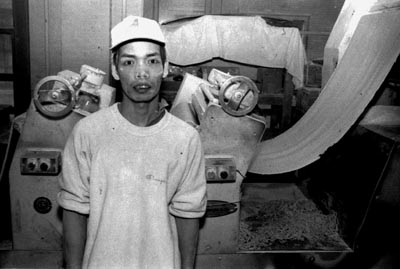 |
| Chinatown noodle shop worker. |
Fighting Back
Xiang is one immigrant worker who struck back at the Chinese restaurant system. In 1996, he was hurt on the job while working at a large Chinese restaurant in the suburban city of Quincy.
Xiang quickly found out that his boss was more concerned about his restaurant's bottom line than about his well-being. He was fired from his job as a cook two months after sustaining a back injury that made it impossible for him to continue working.
He told his story one day in 1998 in the office of the Chinese Progressive Association in Chinatown.
Because he was taller and stronger than many of his coworkers, Xiang's boss often asked him to move heavy bags of rice and beef. On July 7, 1996, his back suddenly snapped while he was lifting a bag of beef. Although he was unable to continue working, his boss didn't offer to take him to the hospital to have a doctor check out his injury.
Xiang's employer told him he would pay for his medical costs, but he wasn't doing it out of the goodness of his heart; the employer's real motivation, it turns out, was to keep the injury off his insurance records and avoid paying higher premiums in the future, says Xiang.
Xiang initially went to a local medical center to seek treatment for his injury. X-rays there showed irregularities in his backbone. Although Workers' Compensation should have covered his medical costs, Xiang initially ended up paying the bills himself.
If Xiang's boss had faithfully followed the procedures in place to protect workers who sustain on-the-job injuries, Workers' Compensation should have paid all of Xiang's medical costs as well as a portion of his pay while he was out of work. By law, medical costs related to on-the-job injuries are covered by Workers' Compensation, a workplace insurance system regulated by the state Division of Industrial Accidents and required of all employers.
After staying home for about three weeks, Xiang's boss told him he could return to work part-time at full-time wages. Xiang offered to work part-time and be paid only for the hours he worked, but his boss insisted on paying him for a full day's work. To Xiang, this seemed too good to be true, but his boss insisted. He thought his boss was just being "a nice guy."
He wasn't, says the 43-year-old Xiang. "It was a kind of trap."
After returning to work, Xiang's boss told him he should see a doctor affiliated with the restaurant's insurance company.
"The doctor said: 'You're okay; you haven't any problem, you can work,'" Xiang recalls.
But Xiang was still in pain and unable to do strenuous work. Then, three weeks after he was called back to work, he was abruptly fired. The boss said he could no longer do the job. He also told him he was ineligible for Workers' Compensation because the insurance company's doctor said there was nothing wrong with him.
But Xiang's story didn't end there. With the help of the Progressive Association, Xiang found a lawyer to fight what he believed was a blatant injustice. In time, Workers' Compensation would award him a lump-sum payment to cover the cost of his doctors' bills and lost salary.
After he was fired from the Quincy Chinese restaurant, Xiang entered a job-training program and studied English. He was unemployed for a year but eventually found jobs as a sushi chef at a local supermarket and hotel.
"I feel the American restaurant's conditions is better than the Chinese restaurant's," says Xiang, who was a herbal medicine salesman in Guangzhou, China, before coming to the US in the early 1990s.
In the American restaurants, he says, the work is less strenuous and the work-day is limited to eight hours.
When Xiang worked in the Chinese restaurant, he generally worked 10 hours a day on weekdays, 11 1/2 hours on weekends, and up to 17 hours a day on Christmas, New Year's, and Mother's Day.
When Xiang worked in the Chinese restaurant, he was paid $1,500 a month, and most of his payments were in cash. Occasionally, he says, he received a check for a few hundred dollars. "The Chinese all work this way," he says.
In the American restaurant where he was working in the late 1990s, Xiang was earning $11 per hour and was being paid by check.
Receiving wages in cash may be more attractive to workers in the short term because it allows them to avoid paying taxes, says Xiang, but in the long run, payment by check is better because it allows them to receive full Social Security and unemployment insurance benefits.
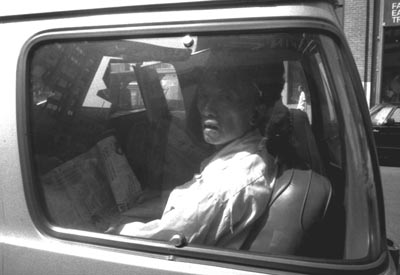 |
| Restaurant worker on a bus in Chinatown. |
Riding the Bus
In the late 1990s, Mandy Li was a worker in a suburban Chinese restaurant. Five days a week she made a trip into Chinatown from her home in East Boston to catch the restaurant van that would take her to her job in a suburban Chinese restaurant. When she wasn't working in the restaurant, she was also a student in an office skills training workshop in Chinatown.
Li had arrived in the US a year earlier and was still struggling to adapt to her new country. Like many recent immigrants, she had both hopes for the future - especially for her son - and disappointment over what she had found here in America.
In China I studied economics and worked as an accountant for 12 years, she says. I am 49 and came here with my husband. My husband was an automotive engineer in China, but he works part-time in an auto repair company here. My son is 20 and a university student in China. Every week I call him. He lives at the school during the week, but every weekend he stays at my mother's home. We came here because we wanted our son to come to America. After my son takes his TOEFL test, we will help him look for a university here.
When I came here I first worked as a baby-sitter because my English was very bad. I baby-sat for a Ph.D. student from Harvard University and lived with his family. At that time my husband hadn't a job, so he stayed at home to learn English. We rented an apartment for $400 a month with the money I earned from baby-sitting. I loved the baby, but the money I earned wasn't much.
Eventually I looked in the Chinese newspaper and found work in a restaurant. I started working there last November. I work five days a week from 11 a.m. to 10 p.m.; I am off on Wednesdays and Sundays. I board the company van near Tai Tung Village.
On the bus the workers often talk to me. They talk maybe about how they don't like America or how in America they have so much trouble with their jobs and families - so many troubles. I have maybe three good friends at work. The work is very tiring. Sometimes the workers are sick but they hide their illness.
At the restaurant I make salads for the salad bar. The salads are served to the American customers. I cut vegetables and fruits and put the appetizers in the oven. I carry the food to the table and clean the buffet pans. I also help the waiters clear the tables and carry the dishes to the kitchen.
I don't get tips. My boss pays my salary. I receive $1,200 a month and am paid in both checks and cash - half and half. I don't care if I am paid by check or in cash.
The customers at the restaurant are mostly Americans, but a few Chinese people come in too. The restaurant makes Chinese food but it's not like the food in China. In China they know how to prepare the food, but here the cooks have no training. Some of the cooks don't know the correct method, so the food is not very good. They don't know how to make real Chinese food. We say the food looks dirty, as if it had been sitting there for a few days. In Chinese, we say it looks like "gan dou," like dried beans in water.
Working in a restaurant is hard work. We spend too many hours working. There's not much lifting, but we just work too many hours. I'm always standing. If I were making $1,500 a month, I would be happy; but I'm paid only $1,200 because I have two off days. Other people have only one day off and get paid between $1,400 and $1,500.
I think the restaurant owner is a good person because he loves my country and helps other people. He gives some people free food and helps some students learn English and study hard. He came from Taiwan, but he doesn't like Taiwan's government. He hopes Taiwan and Beijing will someday be united.
Some of the workers work hard, but some are lazy. I think the workers who come from Fujian have no hope; they feel as though they haven't a future, haven't anything. Some of the workers, though, are happy. There are two waiters in my restaurant who always talk with the American customers. They are very happy. The Americans usually like our restaurant's waiters because they often joke with the customers.
I think most of the restaurant workers are happy to be here because America is a more developed country than China. They like the medical care and the insurance and the technology. They can make more money here than they could in China. I think Americans are friendly and willing to help other people.
But American culture and Chinese culture are different. Before I left China my idea of America was different from what it is now. I thought America would be a very clean country, but when I got off the plane I saw many very dirty streets. I thought, "Oh my God, America is dirty."
Second, I have seen many many people taking drugs in the subways. I don't like these people; I am afraid of them. I thought America was very safe, but I feel it's not very safe.
Third, the buildings here are very old. In Beijing the buildings are very beautiful, but the house I live in now in East Boston is very old and dirty. There are many mice and roaches in the house. I never saw a mouse in a house in Beijing.
Before I left Beijing I didn't know there were so many foreigners living here. I don't think I like having so many kinds of people living together. I hope to learn something from Americans. Many people living here have customs that are different from those of the Americans. I would rather live with the American people.
Last month I bought a computer. I hope to use America Online to pay my bills and find some information and send e-mail to my son and my sister. My sister is living in Sweden. She says she likes living there. She has come to America three times, but she doesn't like it here.
I have been here already about a year and three months. I think I will need to live here longer - maybe three or four years - before I get used to it. I came to America for the sake of my son and for myself. I very much miss my country because my mother, my younger sister, and my brother live in China. In China, I had a very good job in a hotel accounting department. It wasn't hard work.
I would like to become a US citizen so my son can come here and I can get insurance and a good job. If I get a green card or become a citizen I can look for a good job. I have a student visa now. I will try to get a green card but it's going to be difficult. If I work as an accountant in America I don't think I can get one.
A student visa allows me to stay here for three years, though I can get two more years if I study computer science. In the fall, I want to go to Quincy College to get a bachelor's degree.
My husband doesn't want to get a green card. Many times he says, "Let's go back to China!" He doesn't like it here. He knows some Japanese, but he doesn't know English. He designed cars in China, but here he fixes cars. After my son comes here maybe we will eventually go back to China.
My son is a young man. I hope he can control his future and get
a master's degree and a Ph.D. in America. He is a very good student.
He studies technology at Ligong University. I want him to come here
to study science at a higher level. After that, he can maybe go
back to China.
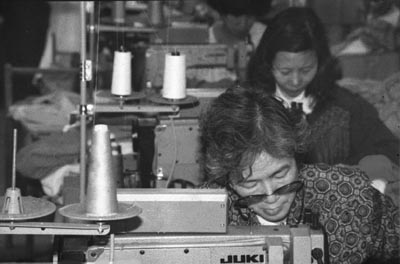 |
| Union garment shop, Chinatown. |
Stitching for a Living
At one time it used to be one of the Chinese immigrant community's biggest employers. The garment industry years ago was centered in the rows of brick buildings that dot the Chinatown area. But the flight of garment manufacturers to the South and other parts of the world where labor is cheap has led to a major decline in the industry in Boston.
Today's immigrant garment workers are divided between those who work for union shops and those who work non-union. Helen Jue is assistant manager in the Chinatown office of the Union of Needletrades, Industrial and Textile Employees AFL-CIO.
Jue has been working in the garment industry as a stitcher, floor worker, and union agent for more than 30 years. She was the first Chinese union agent to be hired by the Boston office. Jue started out as a stitcher when she was bringing up her family. As in many Chinese immigrant families, her husband worked in the restaurant industry while she worked in the garment industry.
I was born in China, not too far from Canton (Guangzhou), she says. In 1949 I went from China to Toronto, Canada , and in 1958 I came to Boston. After I married my husband we lived on Oak Street in Chinatown. Eleven years later, we bought a house and moved to Brighton, and 11 years after that we moved to Newton. My husband was half-owner of a restaurant.
Six months after I was married, I went with my landlady to learn how to stitch right here on Stuart Street, though about a year and a half later I had to quit the job when my first child was born. I didn't work again until my youngest son went to kindergarten. At that time, my sister-in-law came from Canada to live in my house and take care of my children, so I was able to go out to work again. I started over on Kneeland Street, over here on the corner. It was 1967. I would go to work in the morning and leave at 2 o'clock. When my sister-in-law left, I continued to work part-time but I had to be home to take the children to school in the morning. I came in about 9:30 or 10 o'clock and made sure I'd be home at 2 o'clock to pick up the children.
In the beginning I made skirts and later I made jackets. I made the whole garment. I did plain stitching on a single-needle machine. I liked the work. I had friends who worked there, and we had fun together. The boss never bothered us. We had to keep our mind on our work but we knew what to do, so we could talk to each other while we worked. We talked about all kinds of things. We were just friends and we talked. After work we'd go shopping together. Most of the people I worked with were Chinese, but there were also Italians, Spanish, all kinds of people. I talked to everybody.
When I worked for Kneeland Skirt, the boss there asked me if I wanted to be a floor lady. I said, "Okay I can help you out temporarily." But I ended up helping him out six or seven years. Eventually I didn't want that job anymore, so I quit and found a different job.
When my youngest son was 14 years old, the union sent somebody out to look for me. It was 1981 and the union needed a Chinese agent. Why did they pick me? That's what I want to know. They said because I always helped out the union people - the agents - when they came into the shop. They were doing what I do now. They came into the shop to talk with the workers.
Most of our [ Chinese] people have a little problem with the language, so when the union people came up I would have to translate for them. They never had a Chinese agent working here before they hired me. I guess I always helped them out. They came looking for me and asked me if I would work for the union. I turned the job down. I was interviewed three times, and each time he said, "Your children are old enough; you can work a steady job now. You go home and think about it."
Two weeks later they called me in again, but I still didn't want the job. I was still going home at 2 or 2:30 in the afternoon. I didn't want to work long hours. He said, "You go home and talk to your family. Maybe you'll change your mind."
One week later the agent called me again. "Our boss wants to see you," he said. So I went upstairs to the eighth floor. He said, "Look, I know you don't want the job, but we need help. We got lots of Chinese in the garment shop. Don't you want to help your people?"
That's what he said. And that's when he got me. So I said, "Well, all right, if you put it that way. Because our people - the Chinese people - need help, and I'm going to try. But remember, if I don't like it I won't stay."
That was 1981. Early March. So I said, "Okay, but If I don't like it, don't make me stay." He said, "I promise you." So I tried even though I had never worked as a business agent before.
In the first four weeks, I can tell you, I wanted to quit. Because I had never gone to work so early. That boss required us to be here at quarter to nine. When I was stitching I went to the shop at 9:30 or 10 o'clock and left at 2:00 o'clock or 2:30. But now it was 9 to 5. I told him, "I don't like it." And somebody working for the union - his name was Sam and he was very nice - said, "Helen, try again." I said, "I don't want this job anymore." He said, "You can try. Come on, when anybody starts a new job it's hard." So I tried it and I tried it and later I came to like it. Because I like to help people. I realized that a lot of Chinese people out there needed help.
My job is to do all kind of things to serve the shop. Every week I make sure I go to every shop to talk to the people; I talk to everybody, including the boss. If they need help I help them. Everyday I spend half the day outside. Sometimes if I need to stay out longer I stay out there. I talk to people in a friendly way. I say, "How are you? Is everything okay?" If someone says, "Helen, I need your help with my Blue Cross." I say, "Fine, what do you want to know?" If they say, "Can you explain to me what's covered?" I do my best to help them. At one o'clock I come back to the office. If anyone comes to the office with a question and they need help I will try to help them. Mostly the Chinese workers look for me. If there's something they don't know about the union - like why they have to pay this bill - they ask me.
Today I went to East Boston because I needed to talk to the boss at one of my shops. Normally, if somebody is unhappy with the boss they will call me and I'll go over there. Today I was in East Boston until almost 11 o'clock. I talked to the people and I talked to the boss. There was a problem over the price the workers were being paid for each garment. I wanted to make sure the price was right for the stitchers. That's my job. I'm friendly with everybody. I talk to them nicely. I don't scream, but if I need to scream I scream. In the last couple of weeks, I had to go to every shop to translate the new health insurance plan for the Chinese stitchers. I make sure they understand. I've been doing this for over 16 years.
The garment industry has changed a lot over the years. When I started with the union, most of the shops were in this area - on Essex Street, on Harrison Avenue, and on Kneeland Street. All those streets had garment shops, but it has changed a lot. New England Medical Center bought some of those buildings and the garment shops had to move out. When I started, the union had 72 shops. Right now we've got about 18. At that time, garments were manufactured in this country, but now it's cheaper to make clothing outside the US, though they're not really selling it cheaper in this country. They charge the same price but they make it overseas very very cheap. When I started working there were maybe 3,000 or 4,000 garment workers, but now we got about 1,000. Some workers have gone to non-union shops or found different kinds of jobs. Some of the garment workers found jobs in food service when the shops closed. When I first came here, there were not that many restaurants in Chinatown; now they have more.
Some new people come looking for garment jobs, but not a lot.
Right now it's bad because there are a lot of non-union shops out
there. Sweat-shops. Some of the non-union shops are in Chinatown.
The non-union shops don't pay more and they have no benefits. We
have benefits. I think I know why they want to work in the non-union
shops. Some young immigrants come here and they don't have that
much money. They know they can get free health care out there if
they say they are low income. The husband is working in a restaurant,
and they claim they are low-income. If they are sick they can go
to the hospital and get free care. That's what I hear.
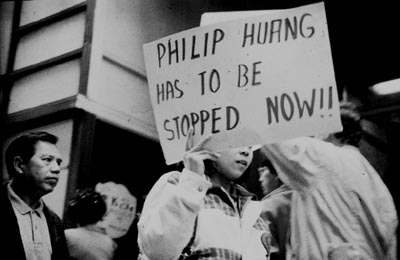 |
| Protesting the opening of a non-union garment shop in Chinatown. |
The union shop pays more money; we have an increase every year, but I heard the non-union shops pay them under the table. They pay cash. Near here there are at least a half dozen non-union shops. There's one on Kingston Street. I think we tried to unionize the shops but it's very hard. The owners don't want to come in the union because they have to pay the people benefits, and they don't want to pay them. In the non-union shops, they get no health care and they work long hours; but in our union shop, they only work seven to eight hours. These non-union people work all day; they come in at 6 o'clock in the morning and go home at 11 o'clock at night. They work long long hours - that's why we call them sweat shops.
Our union benefits are very good. Right now we have new insurance called HMO Blue. It's good because you only pay $10 when you go to see the doctor. You don't see any bill. Some people have heard about the plan and they're coming back. The union spends lots of money on benefits. We have vacation pay and benefits for people who are too sick to go to work. You get $75 a week for the first four weeks and $95 after that. You can get eyeglasses every two years. You can get retirement. You can retire at 62 or 65 and get a pension. A worker who retires at 65 after 20 years of work gets $2,000 a month. You also get 12 paid holidays and life insurance. If a person suddenly dies the family gets $12,000. We have all kinds of benefits.
The owners of the garment shops here come from many different places, but many are from China. Garment shops are everywhere in China, so there are lots of immigrants from China who know how to stitch. That's the only job they know. Some garment shop workers have been in the United States for a while - 15 or 20 years. Some of the younger people still go to the garment shops to look for work, but some look elsewhere. Some of them go to a training school, and the school will find them a job. Garment shops still have low pay compared to many other jobs.
We had one new union shop open last year on the fifth floor of this building. But we have also lost a couple of big shops. A big shop of mine closed because it couldn't compete with overseas shops. They didn't have that much work so they had to close. But there are still some new union members coming in. Some of the new immigrants don't understand anything about the union. Some learn about the union shops from friends and come in looking for work. If I know new immigrants who are looking for a job I'll ask them if they want to look for a garment stitchers job. I'll tell them about the union benefits. "If the boss wants to fire you," I say, "they cannot just fire you; they've got to give you a second chance; the union wants to make sure you get a second chance. That's my job."
My life hasn't been a bad life. I lost my son, and that was a really sad time. He was sick and he died of cancer. Except for that everything else has been good. My family is good. I think right now it's easier for immigrants. It's much different from what it was when I first came here; there are more people, more Chinese; you can make friends more easily, though it wasn't really hard for me to make friends in the old days either.
I'm going to retire soon. My daughter is married and I have grandchildren.
I take care of a baby two or three times a week. They'll have to
train somebody to take my place. Maybe I'll retire in a couple of
years. Warren (Pepicelli) says no, I can't retire; he says, "Maybe
in 10 years." When I walk out there at 3 or 4 o'clock a lot of people
know me. They say hello to me. It's all those years I've been here.
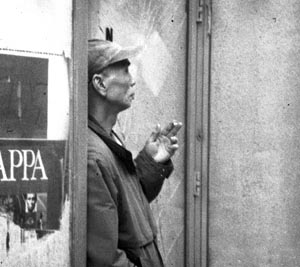 |
| Worker waiting for a bus in Chinatown. |
Breaking Away
Not everyone is willing to work for the bosses forever.
Da Ming Yang is a restaurant worker, but he doesn't want to be one much longer. Like other ambitious immigrant workers, Yang is determined to take the leap and open his own restaurant. In 1996, he was looking for the right opportunity to open his own place.
Yang's wife Yu Feng Chen and their two children had recently immigrated from a village in southern China to join him in Boston. The family was temporarily living with Yang's elderly mother in a crowded one-bedroom, elderly apartment on Huntington Avenue. Mattresses and beds were spread over most of the available space and the only wall decorations were a Chinese calendar and an ancestral shrine for "a young family."
On days when Yang was working and his wife was taking English classes in Chinatown, the children were being cared for by their grandmother.
Someday his two elementary school-aged children will go to college, he says. They'll work as engineers or maybe computer scientists. His own career options will be far more limited in America. He speaks little English and had only seven years of schooling in China. His job in a New Hampshire Chinese restaurant is one of the few available to him now.
But Yang is confident that the life he makes for himself and his family in the US will be better than the one that awaited him in China. In China his options would have been even more limited than they are here.
Restaurant work, he laughs, isn't something he likes or dislikes; it's just the way it is for him. Someday, he will be able to afford a better house and open his own restaurant. He recently looked at a restaurant in Providence but hadn't enough money to buy it. Not long ago, his younger brother bought his own restaurant in Vermont, so he knows it's possible.
For now, though, he must save his money and sacrifice present comfort for future gain. "What I want is to have a sweet life," he smiles. "But for the time being I cannot afford it."