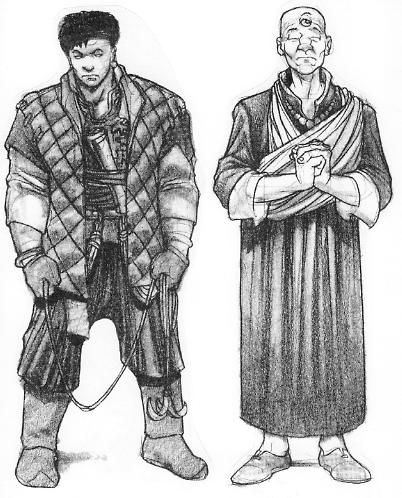
Thief Valeren
Level 1 - Sense Vitality: Enables the user to sense vital information about another being with nothing more than a touch.
System: Role Perception + Empathy (difficulty 7), number of successes determine ammount of information gathered:
1 = mortal, vampire or other (depending on users occult knowledge)
2 = how many health levels are left, how many are used up
3 = how much usable bloodpool (or equivelent depending on occult knowledge) is in the victim's system
4 = reveals diseases, hereditary or congenital
Level 2 - Anesthetic Touch: - THIRD EYE APPEARS - This can allow another undead (or Yin apected) creature to ignore their wound penalties for a time, or can be used to put Mortals to sleep. Characters with strong Yang, such as Hengeyokai or Hsien become groggy and disoriented.
System: Spend one Blood Point, role Willpower (difficulty 6), number of successes determine time the power is in effect. To ignore wound penalties the successes equal turns, for mortals the successes equal hours of peaceful sleep, and for Yang creatures teh successes equal turns spent disoriented. This power cannot be used on the user.
Level 3 - Transfer Pain: With a touch, health-levels can be taken or given using this power.
System: Spend one Blood Point per health-level to be transfered. While touching another being, the Orphan can either take any health penalties away from the patient (giving themselves the same wound penalties for the duration of the scene), or give any health penalties they have to a victim (the Orphan heals each point and the victim takes the penalties for each point for the rest of the scene, but not the actual damage). For aggravated damage two Blood Points must be spent, and the damage is tranfered by converted to Lethal and must be healed normally.
Level 4 - Sword of Zao-zei: By coating a bladed weapon with their own blood, an Orphan can create a weapon strong enough to give Shen pause.
System: By running his hand along the blade and coating it with his own blood (taking one health level of damage), the Orphan can make the blade glow with a golden light. The light can help guide a sneaking thief, or distract an opponent (difficulty to attack the Orphan increases by one). The blade also causes two dice of aggravated damage (on top of the normal Strength roll). This power lasts for one scene.
Level 5 - Barbarian's Vengeance: The Orphan's third eye guides his attacks, allowing them to land with deadly accuracy.
System: By spending three blood points while shutting his two normal eyes and opening his third eye wide, the third eye glows with a baleful reddness allowing all single brawl or melee attacks (only one move per turn, and that is the attack). If using advanced combat system, all die that would have counted toward Dexterity + Brawl or Dexterity + Melee may be considered successes and added to damage pool. This power lasts one scene.
Level 6 - Joining of Souls: The feared power of "soul-stealing" (similar to Obeah Level 5 of Chi'iu Muh Level 4) is not lost among the Wu-Zao. This terrifying ability can be used to mend the spirits of others, or as a spiritual diablerie in an area where there are few (if any) other Cainites do drink from. It is this power that causes the most concern for Kuei-Jin who claim that it is why the Wu-Zao remain at such a low generation, the Wu-Zao themselves claim to only use the more perminent aspects of this power against Akuma.
System: While the Orphan looks into the eyes of the target, the third eye stares into the targets soul. A blood Point and a temporary Willpower Point are spent, in most cases, to draw the soul in. The duel souls of the Kuei-Jin require two temporary Willpower Points. Once the soul is being drawn into the eye of the Orphan, a contested Willpower roll must be made (each character rolls against the difficulty of the other's permanent Willpower). If the Orphan gains more successes, the soul becomes trapped within the eye, if the Orphan botches, he is left in a catatonic state for the number of minutes equal to the target's permanent Willpower. If the target wins, nothing happens, if the target botches or fails, he is drawn into the eye regardless.
Without a soul, the target's body remains alive and only with the most basic automatic functions (breathing and pulse if applicable), other functions (eating, sleeping, etc.) will not be taken without being commanded to do so. The body remains under the command of the Soul-Taker as long as it lives without its own soul, others can attempt to command it by making a Willpower roll (difficulty 8) for each command given. (more on soulless bodies bellow)
Once the target's soul is in the Orphan's eye, the soul is more or less at the mercy of the Soul-Taker. During meditation (or sleep) the Orphan and the target will be able to meet and talk with each other on an astral level in the eye's mind. Combat in this state is pointless, as the laws of the universe bend to the Orphan's will. The Orphan can, with 6 hours of uninteruped meditation (and by spending a permanent Willpower point), raise the Humanity level, Hun Level, (or equivalent), or lower the P'o level (or equivalent). Each permanent point spent can affect the target by one perminent point (this cannot be used to lower Humanity or Hun, or to raise P'o). During this process the Orphan and target often spend time in conversation, mock combat or mock-quests within the eye's mind.
The darker power of the eye, the ability to eat the spirit of another, takes much less time, but has a greater cost. Two permanent Willpower points for most creatures, and four permanent Willpower points for duel-souled creatures are required for spirit-eating. Once these points are spent, the real contest begins. The Orphan and Target must each roll their temporary Willpower (difficulty 9) in an extended roll. The Orphan needs 4 successes to "eat" the soul, but if the target can earn 6 successes he may escape and re-enter his own body. Brave targets can continue the battle, because if they can earn 8 successes before the Orphan earns 4, the situations become reversed. The Orphan now becomes trapped within the eye and the "target" now rules the body of the Orphan (the target can then re-enter his own body by spending a temporary Willpower point whenever he choses, leaving the Orphan in torpor).
An eaten soul provides the Orphan with the knowledge (but not supernatural powers) of the victim, but well and if the target was a vampire (Kin-Jin or Kuei-Jin) a lowered generation as well (one level lower). This also carries the same tale-tale marks of diablerie.
Higher Levels: higher levels function identically to the higher levels of Obeah (Safe Passage, Purification, and Unbind the Flesh-Clad Spirit), although some resourceful members of the Wu-Zao use these levels to mimic the Chi'iu Muh powers of Purification (Hun or P'o methods) and Soul Exchange
|
Scholar Valeren
Level 1 - Sense Vitality: Enables the user to sense vital information about another being with nothing more than a touch.
System: Role Perception + Empathy (difficulty 7), number of successes determine ammount of information gathered:
1 = mortal, vampire or other (depending on user's occult knowledge)
2 = how many health levels are left, how many are used up
3 = how much usable bloodpool (or equivelent depending on occult knowledge) is in the victim's system
4 = reveals diseases, hereditary or congenital
Level 2 - Anesthetic Touch: - THIRD EYE APPEARS - This can allow another undead (or Yin apected) creature to ignore their wound penalties for a time, or can be used to put Mortals to sleep. Characters with strong Yang, such as Hengeyokai or Hsien become groggy and disoriented.
System: Spend one Blood Point, role Willpower (difficulty 6), number of successes determine time the power is in effect. To ignore wound penalties the successes equal turns, for mortals the successes equal hours of peaceful sleep, and for Yang creatures teh successes equal turns spent disoriented. This power cannot be used on the user.
Level 3 - Peacemaker: Using this the Orphan can spread an aura of calm over an area, encouraging negotiations and discouraging violence.
System: Spend two Willpower Points and lasts for as many scenes as the Orphan has available temporary Willpower after the cost is spent. In a small chamber, this power can make mortal enemies talk over their concerns without arguing, violence is impossible without extreme provocation (costs a Willpower Point to take a violent act). In a large chamber loud disagreements are still possible, but violence is difficult to initiate (Willpower roll difficulty 8). In a larger area (up to a mile in diameter) a general feeling of goodwill exists, but it can be shattered easily.
Level 4 - Calm of Zao-xue: This ability enables the Orphan to help another suffering from derangements, rage, Frenzy or R�tschreck, as well as Wave, Fire and Shadow Soul.
System: By spending two Blood Points while singing, talking calming or playing an instrument for the affected individual, and rolling Intelligence + Empathy (difficulty 8), the Orphan can begin to sooth the savage beast. The number of success subtracted from 6 determines how many turns it takes to work (each turn must be spent talking, singing, etc. to the madman). Victims of Frenzy, Rage or similar temporary situations are perminently calmed (until the next time anyway), victims of derangements are calmed for the duration of the scene. Shadow Soal requires the expendiature of an additional two Willpower points to combat. This power cannot be used on the user.
Level 5 - Watching the Echos: Allows the Orphan to learn some of what the recently departed knew by gleaning it from the area where the person died.
System: This power must be used within a week of death and in the area where the death occured. By spending a Willpower Point and rolling Perception + Empathy (difficulty 7) while shutting his two normal eyes and opening his third eye wide, the third eye glows with a warm golden light allowing the Orphan to learn facts the dead person knew (including how they died, where a particular item is, a secret kept before death, etc.). Each success allows one question to be answered (although the answers of the dead are sometimes vague). Botches could summon maleficent spirits.
Level 6 - Joining of Souls: The feared power of "soul-stealing" (similar to Obeah Level 5 of Chi'iu Muh Level 4) is not lost among the Wu-Zao. This terrifying ability can be used to mend the spirits of others, or as a spiritual diablerie in an area where there are few (if any) other Cainites do drink from. It is this power that causes the most concern for Kuei-Jin who claim that it is why the Wu-Zao remain at such a low generation, the Wu-Zao themselves claim to only use the more perminent aspects of this power against Akuma.
System: While the Orphan looks into the eyes of the target, the third eye stares into the targets soul. A blood Point and a temporary Willpower Point are spent, in most cases, to draw the soul in. The duel souls of the Kuei-Jin require two temporary Willpower Points. Once the soul is being drawn into the eye of the Orphan, a contested Willpower roll must be made (each character rolls against the difficulty of the other's permanent Willpower). If the Orphan gains more successes, the soul becomes trapped within the eye, if the Orphan botches, he is left in a catatonic state for the number of minutes equal to the target's permanent Willpower. If the target wins, nothing happens, if the target botches or fails, he is drawn into the eye regardless.
Without a soul, the target's body remains alive and only with the most basic automatic functions (breathing and pulse if applicable), other functions (eating, sleeping, etc.) will not be taken without being commanded to do so. The body remains under the command of the Soul-Taker as long as it lives without its own soul, others can attempt to command it by making a Willpower roll (difficulty 8) for each command given. (more on soulless bodies bellow)
Once the target's soul is in the Orphan's eye, the soul is more or less at the mercy of the Soul-Taker. During meditation (or sleep) the Orphan and the target will be able to meet and talk with each other on an astral level in the eye's mind. Combat in this state is pointless, as the laws of the universe bend to the Orphan's will. The Orphan can, with 6 hours of uninteruped meditation (and by spending a permanent Willpower point), raise the Humanity level, Hun Level, (or equivalent), or lower the P'o level (or equivalent). Each permanent point spent can affect the target by one perminent point (this cannot be used to lower Humanity or Hun, or to raise P'o). During this process the Orphan and target often spend time in conversation, mock combat or mock-quests within the eye's mind.
The darker power of the eye, the ability to eat the spirit of another, takes much less time, but has a greater cost. Two permanent Willpower points for most creatures, and four permanent Willpower points for duel-souled creatures are required for spirit-eating. Once these points are spent, the real contest begins. The Orphan and Target must each roll their temporary Willpower (difficulty 9) in an extended roll. The Orphan needs 4 successes to "eat" the soul, but if the target can earn 6 successes he may escape and re-enter his own body. Brave targets can continue the battle, because if they can earn 8 successes before the Orphan earns 4, the situations become reversed. The Orphan now becomes trapped within the eye and the "target" now rules the body of the Orphan (the target can then re-enter his own body by spending a temporary Willpower point whenever he choses, leaving the Orphan in torpor).
An eaten soul provides the Orphan with the knowledge (but not supernatural powers) of the victim, but well and if the target was a vampire (Kin-Jin or Kuei-Jin) a lowered generation as well (one level lower). This also carries the same tale-tale marks of diablerie.
Higher Levels: higher levels function identically to the higher levels of Obeah (Safe Passage, Purification, and Unbind the Flesh-Clad Spirit), although some resourceful members of the Wu-Zao use these levels to mimic the Chi'iu Muh powers of Purification (Hun or P'o methods) and Soul Exchange
|