Creatures of darkness war with each other in God's world, and the rest of humanity, for all their ignorance, are caught in the crossfire.
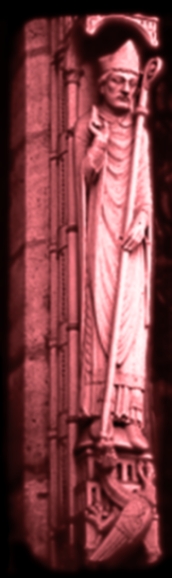 |
OVERVIEWHistory has few records of St. Marcellus (�Sacred to Mars�), but those who follow in his name say he was the son of a Celtic Parissii woman and a Roman Centurion. Converting to Christianity at a young age, Marcellus rose in status within the Church, becoming a bishop of Paris in the late 4th century.Legend has it he built a small wooden church near the banks of the Seine, only to have it destroyed by a blood-thirsty goblin. Enraged at the heresy, Marcellus took it upon himself to smite the demon in the Lord�s name. The dragon was driven to the river, where it sought refuge from Marcellus� crozier, but there was no escape for the unholy beast. The church was rebuilt, but the creature�s kin had their revenge. They martyred St. Marcellus in his own church on All Hallow�s Day, 436. His mission was not forgotten however, the Saint�s followers continued his calling, learning and cataloguing all they could on the nature of the inhuman monsters they sought to destroy. At first the loose band of dragon slayers continued in their patron�s name, and under orders from the Church, but as the centuries passed, it became clear that complete genocide was not possible. These creatures had clearly been created for a purpose, although what purpose that may be is not for mortal men to say. Followers of St. Marcellus adopted a policy of observation, intervening only when deemed necessary. This change in policy failed to meet with Church requirements, causing a rift between the fringe organization and its patron state. The rift became a canyon as official Church statements moved further and further away from �dragons� and �monsters.� By the 11th Century the Church had cut all ties to the mysterious order, branding any admitted members as heretics. In modern times order members maintain delicate ties with local parishes and diocese, but never in any official capacity and sometimes without the knowledge of local church officials. The first evidence of a fully organized society calling itself the Prieur� de San Marcellus appears in records dating back to the 12th Century. Today the accepted title is the Priory of St. Marcellus, although it known as the society or Order of St. Marcellus and members are known as Marcellans, Marcel Brothers and Sisters or more commonly, Priors and Prioresses. |
Prospective members must show a faith in God, although some Priors place less emphasis on Catholicism (as the Church places less emphasis on their work), and must be considered �inherently good� people, that is, they do not needlessly cause harm to others. As in any organization, a few bad apples do get in from time to time, though it usually isn't long before their own behavior has them expelled from the organization or killed in the line of duty.
Members follow the Five Articles of Honor religiously. Anyone caught ignoring a duties is strictly punished.
Five Articles of Honor:
First: Protect the weak.
Second: Combat evil.
Third: Uphold the faith.
Fourth: Help those in need.
Fifth: Guide the lost.
RITUALS AND OBSERVANCESIndividual Priories have local observances based on regional customs, as priories often integrate with local forms of Christianity (and more rarely other Abramic faiths).
Saint�s Night
|
 |
Clerk
Also known as disciples or squires, Clerks are the lowest echelon of the society (marked by the Merit: �Status: Priory of Marcellus ��). They are meant to assist active Pardoners in their duties, but often act on their own, under the commands of a superior Prior. A person must have at least Clerical status to be allowed to know the secret of the order, and obtaining that status usually involves tests of loyalty and faith. A Clerk will rarely operate without a more established member nearby.
Pardoners
Often called knights or magistrates, Pardoners (�Status: Priory of Marcellus ���) are so called because it is their job to go out into the darkness and find beasts who have overstepped the bounds set forth by the demands of faith. They must find supernatural beings and decide whether they deserve pardon (often more of a stay-of-execution than absolution) or condemnation. If it is the former, the beast is spared and allowed to exist for another night, if it is the latter, it is the Pardoner�s job to act as both judge and executioner, removing the beast from the rest of humanity to seek its final judgment. Pardoners can sometimes be charged with protecting entire cities or provinces on their own.
Friars
Sometimes called preachers or presbyters, Friars (�Status: Priory of Marcellus ����) are those members of the order charged with the job of missionizing to those in need of salvation, and in particular, those beyond the reach of traditional religious leaders. Although they may still act as Pardoners, the specific duties of the Friar require them to attempt conversion, or at least encourage repentance.
Parsons
More properly known as prelates or vicars, the Parsons (�Status: Priory of Marcellus �����) hold positions most similar to a parish priest. They lead local congregations of Priors and often manage a small area (serving as a true �Prior� in that sense), and answer directly to a Metropolitan.
Metropolitan
Referred to more officiously as Primate in Priory duties, Metropolitans (�Status: Priory of Marcellus ������) are generally speaking the head of a given area protected by the Priory. On rare occasions, an area may have more than one Metropolitan, in which case a primary is chosen, with a secondary known as the Auxiliary or Coadjutor Metropolitan. Some rare Metropolitans serve no distinct area, and are known as Titular Metropolitans. A single Metropolitan will often manage several Parsons.
The Lutetian Curia
Above the Metropolitans, though never met by most members of the order, are the Archpriors who form the Lutetian Curia, a council of experienced Priors who chronicle the activities of the order and, on occasion, issue commands or edicts about the current state of the Priory. Their number, location and methods are kept secret for obvious reasons.
Fighting Style: Holy War
(� to �����)
Prerequisites: Mortal (non-supernatural); Status (Priory of St. Marcellus) ��; brawl ��, Firearms ��, Weaponry ��
Effect:As a knight of St. Marcellus (Status ��), your character has begun training in an ancient fighting style designed solely for the purpose of battling the supernatural forces that plague the world.
Dots purchased in this Merit allow access to special combat maneuvers. Each maneuver is a prerequisite to the next. Their affects are listed bellow, each based on Skills, Attributes and Advantages as listed.
� Sacrosanct Resistance
The knight�s body and mind are as one when defending against supernatural attacks, even those attacks that cannot be seen or heard. Any time a supernatural power (Dominate for example) requires a contested roll against one of the knight�s Resistance Attributes, the knight may add his Defense rating to the roll. The Defense rating may also be added to Resistance in cases when the attacker�s dice pool is affected by one of the knight�s Resistance Attributes.
�� Reverent Hand
Guided by sacred teachings, the knight is able to physically prevent a supernatural creature from accessing inhuman powers. Aside from applying damage as normal from a Brawl attack, each success prevents the target from accessing stored supernatural energy (Vitae for example) for one turn. Note that this does not include energy spent prior to the attack. This ability can only be used once per target, per scene.
��� Hallowed Blade
Any tool can become an instrument of God in the hands of a knight. When using a weapon that has power against a supernatural (even an unconventional one, such as a silver letter opener against a werewolf or a broken 2x4 a against a vampire, etc), the knight faces no penalties for weapon choice or specified target area, provided the weapon or area selected has power against that type of creature. Staking a vampire�s heart with wood would not carry a -4 penalty, but using it against a werewolf�s heart would be as hard as ever. This ability lends some of the knight�s fortitude to the weapon only in that it allows non-weapon items to be used in unconventional ways, depending on the circumstance. Other penalities or bonuses are applied as normal.
���� Consecrated Spear
This ability applies similar benefits to ranged attacks (thrown or Firearms) rolls. Again, the weapon (bullet, arrow, spear, etc.) used must have a special effect on the type of supernatural creature targeted for the benefits to apply.
����� Righteous Judgment
While the Reverent Hand may block an opponent from accessing their power, a knight may pass Righteous Judgment to the creature, robbing it of some of its power. When this ability is activated, each success in a grapple attack (Strength + Brawl) subtracts one point of power (Vitae for example) from the opponent. Beyond that, the attack has all of the same properties as a normal grapple move. This power is often used by �laying on hands,� although the open palm and scripture quoting is more for effect than necessity.
Drawback: Spend one Willpower point per attack. Note that this Willpower expenditure does not add three dice to the attack.
Disciples
(� to �����)
Prerequisites: Mortal (non-supernatural); Status (Priory of St. Marcellus) ���
Effect:
Priory
(� to �����)
Prerequisites: Mortal (non-supernatural); Status (Priory of St. Marcellus) ���� (or equivilant multiple Priors contributing 3 points each)
Effect:
Blessed Item
(� to �����)
Prerequisites: Mortal (non-supernatural)
Effect:Blessed Items are different from any other piece of equipment your character could have for the simple fact that, unlike most items, Blessed Items provide a measure of protection against the supernatural. Each dot in this Merit represents the level of faith (and the relative rarity) the item possesses. More dots also increase the effect of the item. If used as a weapon against a supernatural entity, Blessed Items add their dot rating to a Weaponry-based roll, and if used for their intended purpose (say studying the bible, or using a blessed baseball bat to play baseball) then you can apply the 9-Again rule (these two effects cannot be used at the same time).
If he has a Blessed Item � or �� (likely prayer beads, a cross or Qu'ran that belongs or once belonged to a particularly faithful person or group) his item can be used to affect Ghosts (provided he can see them) by inflicting bashing or lethal damage, depending on the nature of the object, and have a mild warding effect on most supernatural creatures, usually just enough to give your character an extra second to get away. If he has a Blessed Item ��� or ����, it was likely blessed directly by a person of great spiritual importance (an archbishop, imam, or even the Pope or Dalai Lama), then the item has special power and can cause aggravated damage to any supernatural being, and can be could be used to bolster defense, with the items rating added to a Dodge attempt (when used for warding). A Blessed Item of ����� is extremely rare and only applies to a true relic. This can be the True Lady's Veil, or a piece of the sail St. Peter had when the sea was calmed or anything else considered one-of-a-kind and holy to a faith (like a saint or prophet's bones, or a stone held by Buddha, etc.). Immeasurably powerful items like the Holy Grail would fall off the 5-point scale.
A Blessed Item of �����, aside from having the normal Blessed Item benefits, would have one additional function specific to the relic (for example, the shield of St. George might protect against dragons) often applying a specific effect to a specific situation. The aforementioned piece of the sail might calm a wild sea wind (for turns equal to successes in an Intelligence + Occult + Blessed Item roll), or activate the wind in the desired direction over an already calm sea. Specific abilities of Blessed Items of ����� should be determined by, or approved by, the Storyteller.
Blessed Items are intended for non-supernatural use, and can only be utilized by those who are fully tainted by the supernatural although supernatural beings can posses them. Whether a being partially tainted by the forces of darkness like a Ghoul may use the items is at the Storyteller�s discretion.
Example: Robert has a 3-Wood he borrowed from Cardinal Glick. The cardinal blessed the item previously, making it a Blessed Item ���. Should Robert use it to tee off, he would be able to use his Wits + Athletics to hit (with a +2 bonus for proper equipment and any other modifiers that might apply), and he would be allowed to use the 9-Again rule for that hit only. If Robert used the club to attack a demon, he would roll his Strength + Weaponry + Blessed Item ��� (without the -1 that normally accompanies improvised weapons) and any successes against the demon would be considered aggravated damage.
Copyright © 2003 Yahoo! Inc. All rights reserved. |