news feature that led to the Tokyo lectures
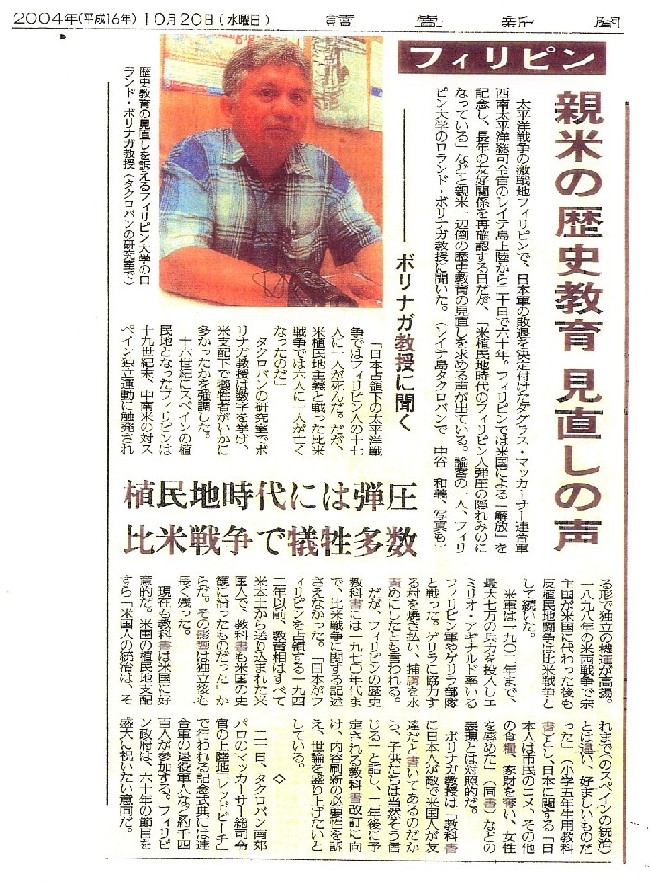
News feature in Japanese newspaper
(NOTE: On Oct. 20, 2004, the Yomiuri Shimbun, Japan’s leading daily newspaper, carried a boxed item related to the 60th Leyte Landing anniversary that featured the views of Prof. Rolando O. Borrinaga. The story filed by Mr. Kazuyoshi Nakaya, the newspaper’s Manila bureau chief, was based on an interview conducted at the School of Health Sciences in Palo, Leyte, in April 2004. The article prompted Prof. Teruo Tono-oka, the director of Office Tono-oka, a private research firm in Tokyo, to invite Prof. Borrinaga to lecture on Philippine history in Japan. He sent his invitation through the newspaper's Manila bureau. The following is the rough English translation of the article made by a Japanese student, Ms. Hiroko Hatae.)
Rethinking the pro-US history education
(Yomiuri Shimbun,, October 20, 2004)
The bloodiest battlefield of the Asia-Pacific War, the Philippines, would mark its 60th anniversary on the 20th of this month since General McArthur landed in Leyte Island, which set the Japanese Army to its defeat. This day has been a memorial day of liberation and confirmed the friendly relationship between the Philippines and the US.
However, there are some calls for the exclusive devotion to pro-US history education by saying, “they just hide the repression against the Filipinos during the US occupation.”
One of the controversialists, Professor Roland Borrinaga of the University of Philippines, told the story. “During the Japanese occupation, every people out of 17 Filipinos died, but 1 out of 6 people died during the Philippine-US War which was fought against the US occupation.”
In his office in Tacloban, Professor Borrinaga emphasized the large number of victims by showing some numbers.
In the late 19th century the Philippines, which has been a colony of Spain since the 16th century, inspired by the independence movement in Central and South America, raised its momentum toward independence. Ever since the colonial power transferred to America after the 1898 Spanish-American War, anti-colonial struggle continued through the Philippine-US War.
The US Army fielded a maximum of 70,000 troops and fought against the Philippine Army led by Emilio Aguinaldo and his guerrillas. The US Army was said to have burned down villages that helped the guerrillas and put the prisoners to water torture.
However, nothing about the Philippine-US War was written in the history textbooks until 1970s. This is because “before Japan occupied the Philippines in 1942, every Minister of Education was sent from the US continent and the textbook was written with the American view of history.” It continued after its independence from the US.
Until now, the textbooks are favorable to the US. It says that “the US occupation was different from the Spanish, and it was preferable”(5th graders’ textbook), which is contrasted from the expression on Japan that said, “the Japanese plundered people’s rice, food and home and raped women.”
“Since the textbook says that the Japanese are enemy and the Americans are friends, the children never doubts and believes it,” says Professor Borrinaga. He hopes to appeal the need for revised textbooks and to arouse public opinion towards textbook revision in two years.
On the 20th, about 1,400 veterans will participate in the ceremony to be held south of Tacloban, in Palo’s “Red Beach,” where MacArthur landed. The Philippine government is willing to celebrate magnificently its 60th anniversary.