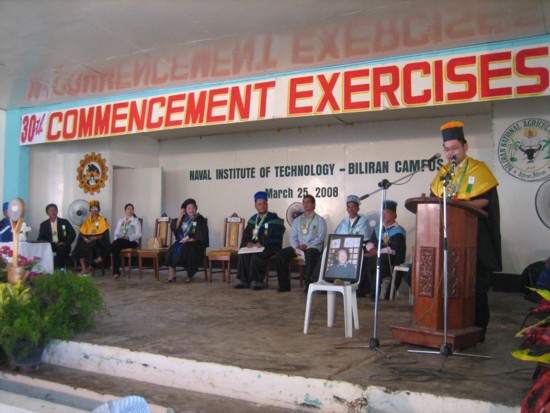
of the Naval Institute of Technology – Biliran Campus on March 25, 2008.
for Sustainable Peace and Development:
The Shitaba Seminar’s Challenges and
Learning at Biliran Island
Department of International Relations
Tokyo International University
Kawagoe, Saitama, Japan
Naval Institute of Technology – Biliran Campus in Biliran, Biliran Province, on March 25, 2008.)
Thank you very much for your kind introduction.
Hello, ladies and gentlemen. Congratulations on your graduation! I sincerely wish to extend my heartiest congratulations on the splendid achievements in your academic career to date.
It is my great honor to be invited here to speak in front of such a wonderful audience. On behalf of the late Prof. Tomoe SHITABA, his wife Mrs. [Hatsue] SHITABA, his current students, and all of the graduates of the [Shitaba] seminar, I wish to express my utmost gratitude to Dr. Edita Genson, President of NIT, Dr. [Nicasio] Elatico, Administrator of the Biliran campus, all of the staff, and everyone, for your kind cooperation.
Today, I would like to talk to you in regard to “International Collaboration for Sustainable Peace and Development: The Shitaba Seminar’s Challenges and Learning at Biliran Island.” First, I would like to briefly summarize our international cooperation over the last ten years. Second, I would like to point out three key factors of our collaborative activities. Finally, I shall quote one of Prof. Shitaba’s favorite sayings as my well-wishing words for your brilliant prospects.
First of all, I would like to tell you that the study tour in the Philippines saw the beginning of our seminar activities all over the world, including South Korea, North Korea, China, Mongolia and Germany from the 1990s. Nearly ten years ago, in March 1997, Prof. Shitaba visited Leyte Island on the second Philippines study tour. During that tour, Prof. Shitaba and his students discussed the paradigm of regional development for Leyte with the town mayor of Palo and some young leaders. [They] enjoyed these friendly talks over a bottle of tuba and were, as a consequence, able to discuss a great many things.
In life, Prof. Shitaba frequently looked back to that time. He was really impressed with the genuine ambition of one of the young leaders aspiring to turn the region into a “second Cebu.” But then, they were left with a fundamental question: Would such resort development as Cebu be suitable for Leyte? We proposed an alternative idea of development, fully drawing on the natural assets and historical legacies of this unique region, and more specifically envisaging Eastern Visayas as a symbolic location of world peace such as Hiroshima, Nagasaki and Okinawa in Japan. Based on this idea, Eastern Visayas should work toward becoming a truly unique region which could serve as a learning place for young people from all over the world to gather, to study and to engage in peace-building activities by taking into account the past, present and future of the region and farther abroad.
Since then we have visited Eastern Visayas every year as your partners, working together toward that goal. In 1999, together with Prof. Borrinaga, we set up an NGO under the name of Peace Development Fund (PDF), using the royalties from [the] Shitaba Seminar’s publications and individual donations as its funds. The PDF has been vigorously engaged ever since in regional problem-solving and peace-building activities, with Prof. Borrinaga serving as the PDF director-general as well as our study tour coordinator. In these processes, we have cooperated with an international NGO named Asian Community for the Asians (ACA) and a Japanese company named Effective Microorganisms (EM) System Network.
Now then, everyone, why have we been able to successfully cooperate with each other and continue our collaborative activities over these past ten [sic, twelve] years? There are three main reasons:
First, I would like to point out that Biliran is a very important region for furthering the Eastern Visayas Peace-Building Plan. For example, unlike Leyte Island which became a grueling battlefield in the Pacific War, Biliran seemed like an oasis to Japanese soldiers. Of course, born in the postwar period, we should not forget what happened here at that time. Thus, I sincerely express our mourning for those who sacrificed their lives in the war.
Yet, here in Biliran, according to a Leyte battle survivor, Kennosuke Nakajima, the Japanese soldiers had such friendly ties with local people that some romances developed between them. Please imagine that sixty years ago in this region, young people X like you and me took each other’s hand and helped to live with each other. Here was no national story between states. Rather, here was a story of the lives of ordinary people. It is in Biliran that we can study about War and Peace from the viewpoints of ordinary people.
Moreover, even today, Biliran continues to be an oasis to us, Japanese visitors. In fact, many students who have joined the [study] tour identify Biliran as the most memorable place. Here is an ideal location for us to reassess our lifestyle and reexamine Japanese society. While the number of casualties at Iraq in 2003 was estimated in the tens of thousands, in Japan in the same year more than 30,000 people committed suicide.
Now let me ask you: What is true happiness? What should a good society look like? We cannot help asking these questions in this environment, with the help of your thoughts and by experiencing your way of life.
Second, I need to address the Shitaba seminar’s activities launched for the purpose of educating “powerful global citizens,” with Prof. Borrinaga’s great support. In our seminar the terminology, “global citizens” means “people who actively reach out to society, tackling problems that affect their own lives at various levels, as they see and try to solve them in global contexts to preserve the interests of ordinary citizens.” Not surprisingly, Prof. Shitaba as a scholar specializing in International Politics used to just focus on theoretical studies. His turning point came when he studied in Cyprus from 1988 to [19]89 as part of a field research on its ethnic conflict. [From] there, he brought back the [fact] that he was unable to give any practical answer to the question from the local people such as “If you are doing research on ethnic hostilities, would you help us find a way to solve our problems?” And he realized [that] what was so sharply lacking in his research work was that real-world sense of life and viewpoint as a fellow-citizen and fellow-human being [was] not bound by nationality.
Then, coming back to Japan, he launched a new educational mission for developing global citizens who will possess a high sense of involvement in solving problems that affect our lives at local, national, and international levels.
There are three basic elements for [this] educational mission, which [are] “On-site learning,” “Theoretical studies,” and “Learning from external communication.” We think that “talk before action” solely is not enough in order to solve a problem. And yet, it [also] does not make sense to jump into action blindly. We need to take theory and practice based on a learning experience from an on-site study, in order to make a positive move forward. Feedback from the society helps us pave a way for our practice and learning style.
In addition to these core educational tactics, Prof. Shitaba also took a unique teaching approach called “Herbal therapy” for improving each student physical condition. Herbal therapy is one aspect of Chinese Medicine using plants and other natural ingredients to enhance [the] well-being gradually. In my understanding, it focuses on prevention from diseases rather than [on] cure by western medicines. Anyhow, as a starter, Prof. Shitaba tried to find out by asking a sufficient number of diagnostic questions to patients (students) and identify the casual relationship. This can be checked in routine reports [that] students turn in. Then, Prof. Shitaba concocted “herbal compounds” (I mean he made a special medicine), [in the form of] various seminar activities, to best suit [to] the condition of each student. The main philosophy at the bottom of the “herbal therapy approach” is that we need to change ourselves first, before we try to change the world.
The third key reason of our continuous cooperation is, needless to say, your warmest support and cooperation. Now, I would like to point out gladly that our new challenge to alleviate poverty and solve an environmental problem in this region has just begun through the utilization of Effective Microorganisms [EM] technology. A famous economist once discussed this kind of technology that everyone can use easily and effectively, empowering people, and thus motivated himself to make efforts in order to improve his life. Through this process, he found the fundamental importance of his rights as a human being and an ideal way to live as a citizen, which is one of the truest aspects of democracy [that] we at times tend to forget. I believe that EM technology will be an effective tool heading [towards] bright prospects [for] the future of Biliran.
In concluding my speech, let me give you one of Prof. Shitaba’s sayings as my well-wishing words for your bright prospects. It is about dreams coming true in the future:
“It is good to have a dream for your future career. However, the bigger your dream is, the less you achieve it by yourself. The reason is that the bigger your dream is, the more you need the support of others. Thus, at the very beginning, you should be modest. To be modest means not forgetting to always express your gratitude for the people around you, especially your parents.”
Thank you and congratulations.