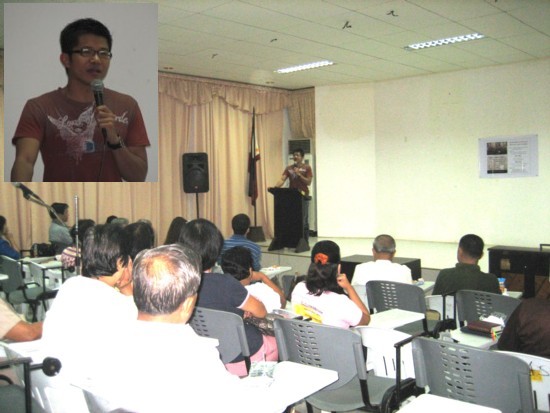
SYMPOSIUM AND BOOK LAUNCHING. Biliran Cong. Glenn A. Chong speaks before members of the local intellectual community at the Symposium on Biliran History and Culture and the book launching of Leyte-Samar Shadows: Essays on the History of Eastern Visayas by Dr. Rolando O. Borrinaga, a native of Naval. The affair was held at the New Audio Visual Room, Andaya Building of the Naval Institute of Technology last October 3. Congressman Chong provided the complimentary copies of the book that were distributed at the launching, the first ever to be held in Biliran Province. (Main photo by Oscar O. Borrinaga; inset photo by Engr. Leonardo V. Madeja, Jr.)
in the Context of National History
(Lecture at the Symposium on Biliran History and Culture, Naval Institute of Technology, October 3, 2008.)
Today, we launch my new book titled Leyte-Samar Shadows: Essays on the History of Eastern Visayas. It is a collection of essays on the history of Eastern Visayas that I have presented in regional or national conferences and/or published in academic journals over a period of 15 years. This book gives greater focus on developments in the “shadows” or the periphery of nationally-known historical events that involved the Leyte-Samar Region, and highlights the pivotal roles and viewpoints of the unknown and unsung heroes and actors in these events. It also provides a comprehensive inventory of journal articles and books on the history of the region that were published over 40 years since the late 1960s.
Although this is the first-ever book launching to be held in Biliran Province, this is the fifth launching of a book I have written or edited. I would have the sixth version in Banaue, Ifugao towards the end of this month with the launching of The Journal of History (Vol. 54, 2008), which issue I edited, at the 29th National Conference of the Philippine National Historical Society (PNHS). My previous book launching was in Tacloban last May 31, for the book titled Archbishop Lino R. Gonzaga: Christian Trailblazer from Leyte. The date was the late Archbishop Gonzaga’s 102nd birth anniversary.
Since you will be able to read the more technical and detailed aspects of my new book during your own sweet time in the days, weeks, months or even years ahead, let me focus instead on the personal circumstances that surrounded the research, writing and presentation of its chapters; on the human interest angle, as it is called in journalism.
When Noel Pla and I discussed the idea of this book launching in Naval together with Rep. Glenn A. Chong, the first thought that crossed our minds was that we would be dealing with the local intellectual community -- which means a small, sedate and independent-minded crowd that is often at odds with the powers that be. We were almost apologetic that this activity could not produce a large audience, complete with unruly and screaming young people in a noisy show-biz atmosphere that an ordinary politician prefers in a public forum.
Yet, small and low-key as it is, Biliran’s intellectual community has actually displayed its influence and impact during critical stages of our local history. For instance, it was only a small group of local intellectuals and a few appointed political officeholders that launched the Movement for the Provincehood of Biliran in 1986, and sustained it with two signature campaigns until success came in 1992. It must be noted that most of the elected local politicians at the time, including the congressman who filed the Biliran provincehood bill, opposed our goal until the plebiscite of 1992. The conventional wisdom of these detractors then had it that Biliran was not prepared to become a province, and therefore it was better dissolved and its component towns returned to Leyte. But the voters in many parts of mainland Leyte thought otherwise; they gave us their overwhelming “Yes” votes [which eventually came to 76% of the total votes cast]. In contrast, in the Third District that included our former sub-province, the “No” votes won. And in Biliran itself, only 55 percent voted “Yes,” thanks to the influence and vote-buying of the local opponents of our provincehood.
Times have changed since then. Many opponents of our provincehood have since forgotten their rhetoric, sang a different tune and clambered up their way to key positions in the Capitol. Kita ang nagtanom, apan ang ningkontra maoy nakakaon. This is the bitter irony that always confronts trailblazers everywhere.
A key component of our provincehood campaign was the publication of The Biliran Clarion. That served as our mouth-piece during those critical and uncertain years.
Then, during another critical stage in our history -- the events associated with the September 7, 2006 assassination of former Gov. Danny Parilla -- there evolved a strong clamor to revive The Biliran Clarion. I was pleasantly surprised during a brainstorming session when Atty. Glenn Chong said he had read the old Clarion issues as a child. And so the newspaper was resurrected, with Engr. Boy Ty-Farma as the initial editor and Atty. Chong, Fr. Marvyn A. Maceda and me among the identified contributors that included many others who preferred anonymity because of fear. The Clarion’s 10 revival issues from late 2006 to 2007 helped put a sense of order and sanity, even humor, and infused collective courage into our threatened lives and existence in our province in the wake of the Parilla assassination.
Both the Biliran provincehood movement and The Biliran Clarion helped chart my future course and accomplishments as a local historian and community journalist. But way back in 1986, quite a number of influential local residents viewed our activities as the musings, even hallucinations, of a group of known drunkards and drinkers. Some even exerted pressure to insure our failure. For instance, one member was active in his support of the Clarion at the start. But he soon asked to be unlisted and chose to support us behind the scene for a reason that the other members fully understood.
Complementing our provincehood thrust was the idea of writing the history of our future province. And so I started collecting materials from the Leyte-Samar Museum and Library of the now defunct Divine Word University of Tacloban. We discussed historical issues in drinking sessions during my occasional trips here, which slowly and surely built up the knowledge base for our local history. By 1989, I already had a running draft and extensive notes for a revised and updated history of Naval. We completed the task in 1990 and I submitted the manuscript to Kinaadman, the journal of Xavier University in Cagayan de Oro City, which had it published in 1992 under the title “Beginnings of Naval, Biliran Island: A Revisionist Account.” It carried the byline of Berting Bago, Ben Granali, Jose Gahum, and Tony Abilar, with me as the lead author.
After I received the off-print copies of the paper, I mailed one to my Grade II teacher, Mrs. Benedicta L. Macariola. I told her in a letter that I was submitting a long overdue assignment on the history of Naval that I failed to give her 25 years earlier.
The same paper has been updated as of 2007 and is included as Chapter 3 in Leyte-Samar Shadows. I should emphasize that this book is also dedicated to the memory of the late Berting Bago, Umbay Santolorin and Tony Abilar, departed fellow crusaders in the Biliran provincehood movement.
The history of Naval will be further expanded and provided with other details in the context of our new thrust, tentatively called “Naval 150,” which we initially discussed with Fr. Marvyn [Maceda] at the convent last week. You see, our hometown will celebrate its 150th anniversary as parish and pueblo in 2010. It is a great event to look forward to and prepare for.
The effort to write the revised history of Naval also built up the literature base for the writing of another paper titled “Atrocities and Intemperances: Revolutionary Ferments in Biliran Province from 1899 to 1909,” which was updated as Chapter 5 of the new book. I originally presented this as a paper in a regional conference in Tacloban in 1996, and this was anthologized in a book titled Resistance & Revolution: Philippine Archipelago in Arms, edited by Bernardita Reyes Churchill and published by the National Commission for Culture and the Arts (NCCA) in 2002.
The revised history of Naval also brought out another topic for speculative research around the word Bagasumbul, the old name of our town. I developed this into a paper which theorized that Lapulapu, the hero who defeated Magellan in the Battle of Mactan in 1521, was the person referred to as Bagasumbul in our folklore and old place-name. Bagasumbul literally means “like [baga] a symbol of a great victory or conquest [sumbul].” The original paper, titled “Lapu-lapu in Biliran? A Tentative Hypothesis,” was published in Kinaadman in 1995 and updated with new materials and sources as Chapter 2 of the new book. This is a very challenging topic of research, which is now 16 years old and still being pursued. Almost all assembled evidence and analysis so far strongly suggest that Lapulapu was the person known to our forebears as Bagasumbul, but none categorically said he was it.
The paper on the revolutionary history of Biliran from 1899 to 1909 already identified a previous revolt in Biliran around the 1770s. I eventually expounded this into a paper titled “The Biliran Religious Revolt (1765-1774),” which narrated the story of Padre Gaspar Ignacio de Guevara, who led what I consider as probably the most successful native revolt against the Spanish regime in the Philippines in terms of impact and future influence, although it is not yet included in our history textbooks. The commune established by Padre Gaspar in Biliran also seems to have been the Asian equivalent of the famous Jesuit-inspired experiment in commune society living among the Guarani Indians of Paraguay, in South America, around the same period.
I presented the paper in the 26th National Conference of the PNHS in Batac, Ilocos Norte, in October 2005, and it was published in The Journal of History (Vol. 52, 2006). The journal version is essentially the same as in Chapter 4 of the new book.
This paper became the main research reference for the consideration, approval, fabrication, and installation of the “Bantayan ng Biliran” historical marker by the National Historical Institute (NHI) at the Nasunugan Ruins on a hill just outside Biliran town. This first-ever NHI marker in our province was installed at a rehabilitated old watchtower and unveiled last September 10, [2008], the 496th Pueblo Day of Biliran.
Arranged by chronology of events, the four chapters on Biliran in Leyte-Samar Shadows cover 388 years of Biliran history from 1521 to 1909. A few pages of text about World War II in Biliran town in Chapter 10 titled “The Human Cost of Wars in Leyte and Samar” expand the time covered to 423 years.
Dr. Bernardita Reyes Churchill, President of both the Philippine National Historical Society (PNHS) and the Philippine Studies Association (PSA), noted in the Foreword that “Biliran Island assumes a historical personality” in this book. She also noted that, “Even the small island of Biliran could be situated in the context of national history when one attempts to situate the developments in the island in the light of similar situations in the rest of the Visayas and the rest of the archipelago.”
Let me tell you about the other eight chapters of the new book. Chapter 1 is titled “Barangay Triana: The Right Site of the First Mass in Limasawa in 1521.” This paper was first presented at the 28th National Conference of the PNHS in Tangub City, Misamis Occidental last year. [It also just came out in The Journal of History (Vol. 54, 2008).] The title is self-explanatory. Here I threshed out the Limasawa, Leyte vs. Masao, Butuan controversy regarding the recorded First Mass in the Philippines. But while I argued that this event occurred in Limasawa, I also presented documentary evidence and analysis that it was held in Barangay Triana west of the island, and not in Barangay Magallanes southeast of Limasawa.
I presented essentially the same evidence in this paper at the Forum on the Magellan Expedition, sponsored by the NHI at the National Museum in the old Congress building in Manila last August 29, [2008]. This was the third attempt of the NHI over the past 30 years to settle the Limasawa vs. Masao controversy over the recorded First Mass in the Philippines. Three of us invited speakers presented our respective positions before a three-member panel composed of distinguished historians, who were assisted by an advisory group of four other historians and two experts from related fields. The forum was attended by about 50 people, including members of the board of the NHI, and invited guests of the two other speakers. I went there alone.
I was invited to present as many primary sources as possible in defense of Limasawa. The second speaker was invited to do the same on behalf of Masao on the town of Magallanes, Agusan del Norte. The third speaker presented evidence on behalf of the Pinamanculan-Bancasi area of Butuan.
The panel’s verdict is expected to come out next year at the earliest. In my case, it helped that NHI had already issued a position in support of Limasawa in 1998, based on the Gancayco panel hearings held in 1996. But this panel’s decision was strongly protested by the Butuan group; thus the need for a new panel to resolve the issue. This time around, we the three speakers were friendly with each other. We even had a group picture taken with Prof. Ambeth Ocampo, the NHI chair, to show our sense of solidarity despite our differences of opinion. I believe I had made a strong case in favor of Limasawa, which hopefully could help settle this issue once and for all.
The Biliran papers constitute Chapters 2 to 5 of my new book. Chapter 6 is titled “Capt. Mariano A. Pacheco: The Most Accomplished Revolutionary Leader in Leyte during the Philippine-American War.” This was presented as a paper in the 25th National Conference of the PNHS in Indang, Cavite in October 2004 and published in The Journal of History (Vol. 51, 2005). This is the annotated English translation from Spanish of the biographical account of a revolutionary officer assigned to Leyte, who performed great feats during our war against the Americans more than a century ago. The basic source was the book Reseña de la Provincia de Leyte by Manuel Artigas y Cuerva, which was published in Manila in 1914. The general history chapters of Artigas’ book were translated to English by the late Fr. Cantius J. Kobak, OFM, and me. This was published in 2006 as a book titled The Colonial Odyssey of Leyte (1521-1914), which won the 2006 National Book Award for Translation of the Manila Critics Circle.
Chapter 7 is titled “Juan and Felipe Tamayo: Pulahan Leaders of Jaro, Leyte.” This paper about two forebears of my wife was researched and written around the time when I was also working on the revised history of Naval in the late 1980s. I sent a copy of the Pulahan article in 1989 to my favorite historian, the late Dr. Renato Constantino, who was quite impressed by it and submitted the portion on Juan Tamayo for publication in Philippine Currents, which came out in 1990. It was my subsequent correspondence with Dr. Constantino that further enhanced my interest in historical research. I was quite flattered that he set my meeting with him as a condition for accepting the invitation as commencement speaker of U.P. Tacloban [College] in April 1992.
I updated this Pulahan paper and presented it at the 19th National Conference of the PNHS in Tacloban City in October 1998. This was published in The Journal of History (Vol. 45, 1999).
Chapters 8 to 11 are offshoots of my Balangiga-related research and writing, the greater bulk of which went into my doctoral dissertation titled The Balangiga Conflict Revisited, which was published as a book of the same title in 2003. The book became a Finalist for the 2003 National Book Award in History of the Manila Critics Circle.
I have achieved some measure of fame for my newspaper writings and advocacy for the return of the Bells of Balangiga to the Philippines in the 1990s. In fact, my biggest journalism award, the grand prize in the 2001 Rotary Club of Manila Journalism Awards, was for the article “The saintly priest of Balangiga,” published in the Philippine Daily Inquirer on September 28, 2000.
Chapter 8, titled “The Anguren Account of the Balangiga Incident, Its Context and Aftermath,” is co-authored by Rev. Eustaquio “Tax” Rosaldo, who presented it as a paper at the 27th National Conference of the PNHS in Tacloban City in October 2006. This was published in The Journal of History (Vol. 53, 2007), for which I served as the issue editor. The paper presents, annotates and contextualizes the previously unknown eyewitness account of Capitan Lope Anguren, the leader of the Quinapondan contingent during the “Balangiga Massacre,” the famous successful native attack on Company C, 9th U.S. Infantry Regiment, in Balangiga, Eastern Samar on September 28, 1901.
Chapter 9 is titled “A Balangiga Survivor’s Letter from Samar on 18 January 1902, at the Height of General Smith’s ‘Kill and Burn’ Campaign,” which was presented as a paper at the 24th National Conference of the PNHS in Surigao City in November 2003. It was published in The Journal of History (Vol. 50, 2004). The paper presents and analyzes a letter written in Calbayog and sent to his parents by Pvt. Ernest U. Ralston, one of the 26 American survivors of the “Balangiga Massacre.” It particularly highlights the issue of enrichment by U.S. Army officers from their wartime loot in Samar.
Chapter 10 is titled “The Human Cost of Wars in Leyte and Samar,” which I mentioned earlier because of some pages about Biliran. This was originally presented as a paper at the Second Regional Conference on Leyte-Samar History in Tacloban in 1999. It discusses the human cost of two major wars in Leyte and Samar in the past century – the Leyte episode of World War II and the Samar episode of the Philippine-American War. Among other details, the paper discusses two doomed love stories involving individuals on both sides of the conflict during the two wars in our region. One was set in Biliran town during World War II; the other was set in Balangiga in 1901. Both stories underscore the tragedy of war and the creative need to attain a condition of general peace and understanding among peoples in our region.
Chapter 11 is titled “100 Years of Balangiga Literature: A Review.” This was published in ICHTHUS (Vol. 2, No. 1, 2001-2002), the journal of the St. John the Evangelist School of Theology in Palo, Leyte. It must be noted that one of the biggest stumbling blocks for the return of the Balangiga bells to the country was the conflicting versions of the Balangiga Incident in the literature. The differences ranged across every facet of the Balangiga story including the overall situation in Samar in 1901, the arrival of Company C in Balangiga, their initial activities in town, the brewing tension, the actual fighting, the number of casualties, the escape from Balangiga, and the “kill and burn” aftermath. The Americans believed their version, and the Filipinos believed their version, and they contradicted each other. Apart from the few basic facts, most published accounts of that incident have also often bordered on the fantastic and the fanciful.
In this paper, which I wrote as a prelude to my dissertation writing, I reviewed the literature related to the Balangiga event through the past century. I established the basic facts from primary sources and the myths that arose from certain facts, and then traced how the facts and the myths went their separate ways, and how the myths in turn became mistaken for facts that evolved other myths that garbled the later accounts of the event.
Chapter 12 is titled “The Historiography of Eastern Visayas Revisited.” This was presented as a paper at the 27th National Conference of the PNHS in Tacloban City in October 2006 and published in The Journal of History (Vol. 53, 2007). This paper presents history-related articles on Eastern Visayas that were published in Leyte-Samar Studies, the graduate school journal of the defunct DWU in Tacloban, through its 25-year publication life from 1967 to 1992. I complemented the inventory of local history articles in Leyte-Samar Studies with a survey of Eastern Visayas historiography in English that I had come across in other publications (whether books or journals) prior to, during, and after the appearance of the DWU journal. At the end, I identified gaps for future historical research on Eastern Visayas.
In her Foreword, Dr. Churchill noted that the last two essays (Chapters 11 and 12) are most useful in her estimation, because “in them the author has compiled as complete a bibliography of the existing written works on the celebrated ‘Balangiga Conflict’ and the literature on the history and culture of Eastern Visayas ... The materials contained in these two essays will be useful as guides to those who would do further research.”
Earlier, I mentioned about the “Bantayan ng Biliran” marker, the first to be installed by NHI in our province. The NHI was represented in the unveiling rites last month by their deputy executive director and a staff; I served as their local guide. I had convinced them about installing another historical marker here, this time for the entire Biliran Island, and they asked me to provide the supporting documentation. This is easier to do, since my new book already contains much of the research information required by the NHI to make the appropriate decisions. The harder part is identifying the place to install the next marker. The logical place is on provincial property in the Capitol area, but on paper it is not safe ground for me to step on. I am persona non grata there; I became one after I reported in the Philippine Daily Inquirer the robbery of a Vietnamese businessman here by bodyguards of a political family in 2005. Thus, considering the present state of animosities and distrust, I doubt that somebody in the provincial government will sign the conforme for the proposed text of the marker that I would help draft. I did not have this problem with the “Bantayan ng Biliran” marker, because decisions with NHI were made at town level, not province level, and I had the trust of the Biliran town officials.
I float this idea to you now, in the hope that Biliran or Naval natives among you can suggest an alternative site for the next marker and we can arrive at a consensus. As for me, I am not in a hurry. I can wait years for more friendly provincial decision-makers to come into the picture, just as I have waited years for some of my other pursuits to bear fruits. Anyway, whether or not we can have that second NHI marker soon, Biliran Province has already carved a significant, visible spot in our regional and national history with the publication of my new book.
Home