


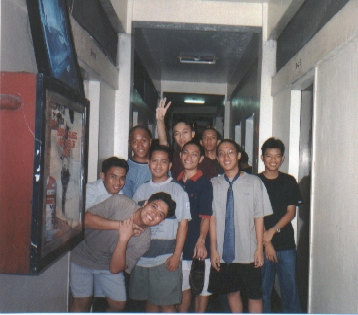
.gif) Some of the First Floor Boys of UP Diliman's freshmen dormitory, Kalayaan Residence Hall. The dormitory has been a witness to the friendship which have flourished between these young men .
Some of the First Floor Boys of UP Diliman's freshmen dormitory, Kalayaan Residence Hall. The dormitory has been a witness to the friendship which have flourished between these young men . .gif) The University of the Philippines, the first and premiere state institution of higher learning in the country, was founded on June 18, 1908 by an act of the First Philippine Legislature. Act No. 1870, otherwise known as the University Charter, specified the function of the University, which is to provide advanced instruction in literature, philosophy, the sciences, and arts, and to give professional and technical training.
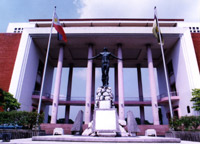
The University of the Philippines, the first and premiere state institution of higher learning in the country, was founded on June 18, 1908 by an act of the First Philippine Legislature. Act No. 1870, otherwise known as the University Charter, specified the function of the University, which is to provide advanced instruction in literature, philosophy, the sciences, and arts, and to give professional and technical training.
UP Diliman
The first institutions to be created were the School (now College) of Fine Arts and College of Agriculture in 1909. A year later, the transfer of the Philippine Medical School (now College of Medicine) increased the number of fields covered. This was upped by ten more during the first decade of the University's existence. By 1968, UP had 28 colleges in three campuses in addition to five regional colleges.
Major reorganizations were made after the President of the Republic decreed on November 20, 1972 a plan that would make the University a more efficient instrument of national development by maintaining its commitment to arts, letters, and the humanities as well as to the pursuit of truth and highest standards of academic excellence. The University was to preserve its institutional unity and academic integrity while allowing for decentralization of authority and autonomy of component units. With this, UP Los Baños, the agricultural center of Asia, was designated the first constituent member, effective January 1, 1973.
On January 24, 1979, the Health Services Center (now UP Manila) was established as another constituent member of the reorganized University. UP Visayas followed on May 31, 1979 as the national center for fisheries.
April 26, 1982 was the date of birth of UP Diliman as a constituent university. It being the seat of the UP Administration, the campus was not immediately constituted after 1972 although it was administered, along with the Manila units as a de facto university.
Today, the University of the Philippines System is composed of six constituent universities and one autonomous college (UP Diliman, UP Los Baños, UP Manila, UP Visayas, UP Open University (for distance education), UP Mindanao, and UP College Baguio) which have evolved into centers for arts and sciences, agricultural technology, health sciences, and fisheries. The research program of the University encourages a balance between pure research and "mission-oriented" projects which solve practical problems and generate useful technologies. And since a university is only as good as its faculty, appointments to the teaching staff are made strictly on the basis of merit, and the criteria for promotion include academic qualifications and potential, teaching ability, research productivity, and community service.
Thus, the university continues to be the center and source of highly trained "brainpower" in the country in numerous fields of specializations and intends to keep and upgrade its standards to maintain its commitment to excellence in higher education and service to the country.
UP Diliman is the UP System's flagship campus. It is the biggest in terms of the number of degree-granting academic units, student population, faculty complement and library resources.
The main campus occupies 493 hectares of prime land in Quezon City, less than 20 kilometers north of Manila. On campus are 25 degree-granting units, with extension programs in San Fernando, Pampanga and Olongapo City.
UP Diliman leads in pursuit of advanced studies in engineering, science and technology. It is a principal source of scientific and socio-economic researches in the social sciences, as well as important contributions in the creative arts and humanities.
Curently, UP Diliman offers academic programs in 222 major fields: 84 at the undergraduate, 138 at the graduate and 35 at the doctoral level.
The University has extensive alliances with international institutions of higher learning for joint academic programs, researches and student exchanges. The linkages involve universities in the United States, France, Germany, Finland, Australia, Spain, Vietnam, China, Japan, Korea and Libya.
These alliances provide the University with opportunities for curricular enhancement, faculty development, resource generation and sharing of expertise and programs.
The University likewise actively shares its diverse intellectual and creative resources through programs and activities addressing specific needs of all sectors of the Philippine society. Concern for and service to the Filipino is at the core of the University's extension agenda which is institutionalized in the Ugnayan ng Pahinungód, the University's volunteer program. These programs and activities include the conduct of short-term non-degree courses and trainings, refresher or review classes or workshops, seminars, conferences, continuing education programs, higher and technical skills training, exhibits, recitals, creative and consultancy works.
UP Diliman is headed by a Chancellor, and administered by the vice chancellors for Academic Affairs, Administration, Research and Development, Student Affairs and Community Affairs.
The Chancellor presides over the University Council, composed of faculty members with the ranks of assistant professor and up. The Council makes recommendations on matters of academic concerns to the Board of Regents, which is UP System's policy-making body.


*speech delivered at the Freshmen's Convocation, 14 June 2001Welcome to UP; welcome to the University of the Philippines. Congratulations for passing the UPCAT, the toughest admissions test in the country. Of the 64,848 who took the last UPCAT, you are one of the 3,747 who qualified for UP Diliman. Don't waste this opportunity. With a UP degree you will have an edge in finding jobs or in the private practice of your profession.
But an opportunity to succeed is no guarantee of success. A lot depends on what you make of it. The opportunity may slip out of your hands. I must therefore warn you at the outset that remaining in UP is as difficult as getting in.
Let me tell you the three easiest ways to be kicked out of UP. One is by academic delinquency or failing in many subjects. Another is by intellectual dishonesty such as cheating in exams or submitting plagiarized term papers. The third is by joining a mischievous fraternity and performing brutal initiations or engaging in frat rumbles.
If you do any of these, we will get rid of you. We will not coddle young crooks and budding criminals. After all, thousands of applicants for transfer from other schools are just too eager to take your place.
The moment you enter the portals of this institution, you will be treated as adults. We will not deal with you as little kids who may be forgiven for childish misbehavior. As adults you are presumed to be responsible for what you do, you should be intelligent enough to know the consequences of negligence, dishonesty and brutality.
Some politicians and media commentators have the impression that UP has become a subsidized school for the rich. This is half-truth. True, there are rich UP students… but do not overlook the vast majority who are middle class and many who are poor. This is one distinctive feature of UP as an academic community, its source of strength and dynamism: UP has a socially and economically mixed student body. No other university in the Philippines is as heterogeneous. It mirrors the class structure of the larger society. It remains an effective vehicle for social mobility.
You will soon discover that some of your classmates belong to the elite, but your other classmates may come from urban poor communities and destitute towns. Your professors don't care who is who. They are not awed by the rich; neither do they look down on the poor. No favors are given to those who pay a higher tuition because they belong to the upper income brackets.
UP is also ideologically heterogeneous. Divergent schools of thought are represented in its faculty. Hindi panay radikal at aktibista ang taga-UP. Marami ring konserbatibo at reaksyonaryo pa. Academic freedom sustains this ideological diversity. UP students are therefore exposed to different ways of looking at the world, to different ideas of what is right and wrong, to different concepts of justice.
UP is neither a seminary nor an indoctrination center. As a secular, non-sectarian institution, it does not promote a single line of thought, a single religious view, a single political ideology. Thus exposed to a staggering array of alternative philosophies, you will learn to think for yourselves, define your stand on a range of issues, and decide what you want to make of your life. All we hope for is that your choices be rational, based on solid knowledge and shaped by critical judgment. And whatever you become after graduation, we expect you to excel.
The university is a total learning community. The learning process occurs not only in the classrooms, but also in the public lecture halls, the libraries, the lobbies, the tambayans, the canteens, the dorms, etc. You will learn as much inside the classroom as outside. In informal discussions, you will develop your communication skills and sharpen your capacity for logical reasoning. Argumentation will drive you to read more than what your teachers require. Extracurricular activities form an integral part of university education. Do not regard them as a diversion, a waste of time. But do not get too involved in extracurricular activities at the expense of your studies.
To make the most of your undergraduate years in UP, I urge you to attend the many public forums where professors and guest lecturers pit their brains against each other. You should join wholesome student organizations, make friends with a variety of fellow students. Don't be a bookworm. Although grades are important, they are not everything you should aspire for.
The UP campus is a venue for forging bonds of friendship, the old school ties. Choose your friends well. Maraming lumagpak at hindi nakapagtapos dahil sa masasamang barkada. But the vast majority of UP students are decent and serious-minded people. After graduation you will need these friends. UP alumni tend to help and support each other.
UP is also a good place for finding a life-long partner. Take it from me, this is where my wife and I found each other.
You, incoming freshmen, are entering a fiercely competitive world, a harsher world than what my generation and earlier ones have known. The rapid development of technology will compel you, under threat of redundancy, to keep on learning new things, acquiring new skills… and unlearning old habits. Computer-based productivity tools are being introduced every so often and, in the process, the work environment is undergoing constant change.
The emergence of global capitalism has far-reaching implications on your career prospects. With the introduction of computers as a ubiquitous instrument of production, intellectual capital has become the most precious asset of a nation. The commodities that command the highest value in the global market are knowledge-based. Recognizing this, we are exerting all out efforts to provide you with the infrastructure for education in Information Technology.
Learn to use the computer and explore the Internet. But don't let these mechanical gadgets overwhelm you. Try to understand the science, the inner logic underlying the technology. And monitor the impact of technology on society and culture. Be alert to the possible environmental damage of certain types of technology and militantly oppose their reckless introduction.
In this epoch of globalization, we are bombarded with information and misinformation through satellite broadcasting, the print media and the Internet. More than ever, you need to sharpen your capacity for critical thinking to be able to distinguish truths from half-truths and brazen lies. Learn to detect the demagogue, the hidden persuaders, the manipulators of public opinion. Have the courage to take a stand on contemporary issues. While you must learn more about other countries, do not lose your sense of Filipino identity.
You have the good fortune of coming to UP in a period of transition. This year we shall reexamine our general education program. This consists of interdisciplinary courses that all of you must take before you specialize. This is where we nurture positive values, develop the capacity for critical thought and cultivate an appreciation for the inter-relatedness of the various spheres of knowledge.
The general education program is what makes UP distinctive. In UP we do not only train you to be good scientists, engineers, accountants, social analysts, etc. We want you to develop as well-rounded human beings who can form intelligent opinions on a wide range of issues.
Once again I welcome you to the University of the Philippines, the most vigorous and exhilarating intellectual community. Make the most of your stay on the campus. Don't waste your chance to become a UP alumnus. Study hard… but not too hard and become a nerd. Enjoy your student life in Diliman.

Recall the events that became part of your freshman living in the University. Trace back how we won the battle against the Reserved Officers Training Corps, the issues regarding the Revitalized General Education Program, the fraternity conflicts, the UAAP 64th Season and the expulsion of the Seranas.
Click here to access the official site of the PHILIPPINE COLLEGIAN

The story of UP Naming Mahal is as colorful as the history of the University.
In the younger years of the University, there was a need to give expression to the UP soul. The University sponsored a contest to select the lyrics for a song that would be capable of touching the heart and soul of every student and alumnus/alumna. As a result of the contest, the poem written by Teogenes Velez, a liberal arts student, was adjudged the best. Then another contest was sponsored to have the prize-winning poem set to music. The composition of Nicanor Abelardo, then a student in the Conservatory of Music, was chosen.
It is said that the composition was created on the spur of the moment. Nicanor Abelardo, together with his wife, had just arrived home from a town fiesta in Pampanga. Mrs. Abelardo reminded her husband of the musical competition which was to close at 12:00 noon. It was already 11. Abelardo finished the piece and presented it on time to win the prize.
The UP Naming Mahal that we know today was originally known as UP Beloved and was first sung before a UP audience in 1917. From then on the song has been part of the university activities and programs as one of the most eloquent expressions of the UP Spirit.
The Filipino version was put together from 7 translations received by a screening committee which found none of them, in full, suitable to the hymn's musical and literary accents. UP Naming Mahal is a composite of the best lines and words from the 7 translations with verses contributed by the members of the screening committee.
The original key of the UP Naming Mahal was B flat major, which is too high for the average vocal range. Prof. Hilarion Rubio of the Conservatory of Music suggested that it should be changed to the key of G major and should be sung in the original tempo of eighty quarter note in one minute.

1. Hit the track running and get your textbook early.
2. Always attend class.
3. Never go to class unprepared.
4. Start projects and papers early.
5. Never turn in projects/homework late or sloppily done.
6. Do as much optional homework and reading as you can.
7. Become a better reader.
8. Take worthwhile notes.
9. Get organized.
10. Do your study according to your biological clock.
11. Learn the skill of studying.
12. Learn the art of taking exams.
13. Do not cheat.
(How to Succeed in College Seminar
Pasig: Asia-Pacific Campus Challenge, 1997)

When things go wrong as they sometimes will
When the road you're trudging seems all uphill,
When the funds are low and the debts are high,
And you want to smile, but you have to sigh,
When care is pressing you down a bit--
Rest if you must, but don't you quit;
Life is queer with its twists and turns,
As every one of us sometimes learns,
And many a fellow turns about,
When he might have won had he stuck it out.
Don't give up though the pace seems slow--
You may succeed with another blow.
Often the goal is nearer than
It seems to a faint and faltering man;
Often the struggler has given up
When he might have captured the victor's cup;
And he learned too late when the night came down,
How close he was to the golden crown.
Success is failure turned turned inside out--
The silver tint of the clouds of doubt,
And you never can tell how close you are,
It may be near when it seems afar;
So stick to the fight when you're hardest hit,--,
It's when things seem worst that you musn't quit.
For comments, suggestions, and stories, please e-mail [email protected].

Being a UP student, you should be aware of the numbers of the University administrators, the library, and your respective colleges. We also have the directory of former Kalayaan Residence Hall occupants of the first floor Boy's Wing and some Bicolanos studying in UP Diliman.
