|
|
| |||||||||||||||||||||||||
 |
|
 | |||||||||||||||||||||||||
|
 | ||||||||||||||||||||||||||
 |
| ||||||||||||||||||||||||||
|
|
| |||||||||||||||||||||||||


|
|
Located at the church belfry, the ancient clock of Tayabas measures one meter and 42 centimeters in circumference. Its hour hand measures one half meter while the minute hand hand is 62 centimeters long. A 70-kilo heavy weight runs the hour hand while a 140-kilo heavy weight operates the whole clock. The heavy weights are suspended from a steel cable attached to the ancient church clock. The heavy weight strikes a giant bell to announce the time at intervals of every one and a half hour. Dr. Avelino A. Obispo, a businessman and civic leader of Tayabas, said the ancient church clock was erected in the St. Michael Archangel Basilica in 1911. The giant church clock came all the way from Europe, Dr. Obispo added. He said that during the Second World War, the clock was heavily damaged and for the next 30 years, it was abandoned and almost forgotten by the townspeople. In 1971, a group of civic spirited and concerned Tayabenses, led by Monsignor Gregorio Salvatus, Juan Rosales and Daniel Riola, spearheaded the repair and rehabilitation of the ancient church clock. The group hired the services and expertise of Agapito Zafranco, a clock repairer and inventor, who reassembled and repaired the damaged parts of the ancient clock. Zafranco was assisted by his three sons in the rehabilitation of the ancient timepiece. According to Obispo, the Tayabas church clock is one of the oldest of its kind in Asia. Tayabas' ancient church clock is one of the two major attractions of the town's minor basilica, one of the oldest Catholic churches in the Southern Tagalog region. The other attraction, which lures thousands of tourists and visitors to Tayabas, are the big, bronze bells located at the church belfry overlooking the whole town. From the church belfry, one can see in the distance Lucena City and even the island province of Marinduque. The giant bells, with Spanish lettering, date back to the 16th century. Numbering six, the giant timeworn bells are tied to a wooden platform on the church belfry. To reach the bells, one has to climb a crumbling stairway made of abode. The church tower is as tall as a six-story building. Up to now, residents of Tayabas, Quezon-once the cabezera (capital) of Quezon province-are puzzled as to how the big, bronze bells were brought to the church belfry. On the other hand, the Kalendariong Tagalog ni Don Honorio Lopez has been the country's oldest and most popular commercial calendar cum almanac. The Kalendaryo Lopez has survived super typhoons, earthquakes, and two World Wars. Now on its 100th year of publication, the calendar is printed simply on letterpress, an old hot-metal typesetting machine on a 5 by 7 inches format. The pocket-size almanac has been a useful and practical guide for millions of Filipino farmers, gardeners and fishermen for the past century now. Farmers from the days of General Emilio Aguinaldo, president of the first Philippine Republic, up to the present, use the Kalendaryo Lopez as their handy reference. Like the Bible, the almanac is an all-time best-seller, particularly during Christmas and the New Year, when farmers and fishermen turn their pages for planting schedules, high and low tides, horoscopes, and predictions. Incidentally, some of the Kalendaryo Lopez predictions on drug addiction, kidnappings, high prices of commodities and economic crisis have taken place in very alarming proportions. The almanac's latest innovations are two line ads printed on the right edge of its pages. The Kalendaryo Lopez (Dati's La Sonria) first saw print in 1900, published by the late Don Honorio Lopez, a trial lawyer, agrimensor, and publisher who served as technical assistant in Malacañang, and commanding general of the Legion de Veteranos de la Revolucion (1896 to 1898). He also served as a colonel in the Filipino-Spanish War (1899) and municipal councilor of Manila in 1916. Don Honorio Lopez was the father of former Manila Mayor Geminiano (Mel) Lopez and former Rep. Jaime Lopez. Know Your Government Officials
Office of the President The Members of the Cabinet »Executive Secretary: Alberto G. Romulo »Department of Agrarian Reform: Hernani A. Braganza »Department of Agriculture: Leonardo Q. Montemayor »Department of Budget and Management: Emilia T. Boncodin »Department of Education: Raul S. Roco »Department of Energy: Vicente S. Perez, Jr. »Department of Environment and Natural Resources: Heherson T. Alvarez »Department of Finance: Jose Isidro N. Camacho »Department of Foreign Affairs: Teofisto T. Guingona »Department of Health: Manuel M. Dayrit »Department of Interior and Local Government: Jose D. Lina, Jr. »Department of Justice: Hernando B. Perez »Department of Labor and Employment: Patricia A. Santo Tomas »Department of National Defense: Angelo T. Reyes »Department of Public Works and Highways: Simeon A. Datumanong »Department of Science and Technology: Estrella F. Alabastro »Department of Social Welfare and Development: Corazon Juliano N. Soliman »Department of Tourism: Richard J. Gordon »Department of Trade and Industry: Manuel A. Roxas III »Department of Transportation and Communications: Pantaleon D. Alvarez »National Economic and Development Authority: Dante B. Canlas »Office of the Press Secretary: Rigoberto Tiglao »Presidential Chief of Staff: Renato C. Corona
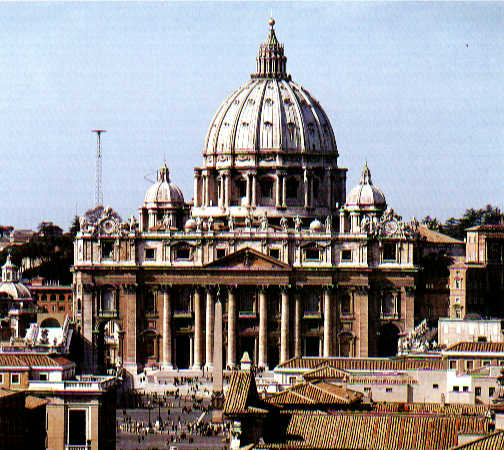
Citta del Vaticano: The Center of Catholicism Vatican City, in full STATE OF THE VATICAN CITY, Italian STATO DELLA CITTÀ DEL VATICANO, ecclesiastical state, seat of the Roman Catholic Church, and an enclave in Rome, situated on the west bank of the Tiber River. Its medieval and Renaissance walls form its boundaries except on the southeast at St. Peter's Square (Piazza San Pietro). Of the six entrances, only three--the Piazza, the Arco delle Campane (Arch of the Bells) in the facade of St. Peter's Basilica, and the entrance to the Vatican Museums in the north wall--are open to the public. Within the walls is a miniature nation. The most imposing building is St. Peter's Basilica, built during the 4th century and rebuilt during the 16th century. The city has its own telephone system, post office, and radio station, as well as an army of more than 100 Swiss Guards, its own banking system and coinage, stores, and a pharmacy. Almost all supplies--including food, water, electricity, and gas--must be imported. There is no income tax and no restriction on the import or export of funds. Banking organizations and operations and expenditures are veiled in secrecy. Vatican City's independent sovereignty was recognized by the then Fascist Italian government in the Lateran Treaty of 1929. Sovereignty is exercised by the pope upon his election as the head of the Roman Catholic Church. He has absolute executive, legislative, and judicial powers within the city. The pope appoints the members of the Vatican's governmental organs, which are separate from those of the Holy See. The Papal Commission for Vatican City exercises the papal powers of government; administrative powers are delegated to a governor, who is assisted by a central council. Cultural life has much declined since the Renaissance, when the popes were among Italy's foremost patrons of the arts. The Vatican Museums, the frescoes by Michelangelo in the Sistine Chapel, the frescoes by Pinturicchio in the Borgia Apartment, and Raphael's Stanze, or rooms, nevertheless attract critics, artists, and flocks of tourists from all over the world. The Vatican Library contains a priceless collection of manuscripts from the pre-Christian and Christian eras. The Vatican publishes its own influential daily newspaper, L'Osservatore Romano, and its press can print books or pamphlets in any language from old Ecclesiastical Georgian to Indian Tamil. Pop. (1978 est.) 729. (Encyclopædia Britannica CD 99 Multimedia Edition)
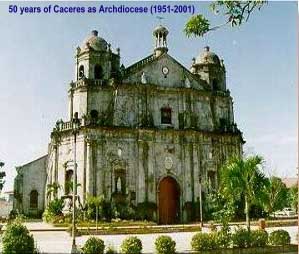
Ini An Kabikolan The Cathedral of Naga According to Dr. Domingo Abella, the actual work for the construction of the Naga Cathedral commenced in 1820, although Bishop De la Concepcion laid the cornerstone in 1816, in the first year of his episcopal rule. However, the plaque installed near the front door of the church by the Philippine Historical Committee in 1950 declares that the construction was begun in 1808. We have to believe Dr. Abella. His authoritative monograph, Bikol Annals (Volume 1, The See of Nueva Caceres), is based on unquestionable primary sources, including official Vatican documents, which established definitely that the episcopate of the said bishop began in 1816. In 1808, Bishop De la Concepcion was still the parish priest of Dilao (Paco, Manila) whose present parish church he also built. Earlier, he constructed the parish church of Binangonan de Bay, which still stands today. Bishop De la Concepcion, however, did not live to finish the cathedral. He died in 1829, after nine years of continuous work on his dream of a consolidated religious center in the city of Nueva Caceres (now Naga), which included not only the cathedral but also the present minor seminary and the old episcopal palace which was destroyed by American planes in the 1945 liberation campaign. The great builder's successor, Bishop Juan Antonio de Lillo, OFM, who was more of a contemplative than an administrator, did not add a single stone to the cathedral in his 9 years as episcopal head. It was a mere diocesan administrator, Msgr. Tomas Ladron de Guevara, who was sent to manage the affairs of the diocese after the death of Bishop Lillo in 1840, who completed and inaugurated the cathedral on 27 April 1843. It appears, however, that Bishop De la Concepcion died when the cathedral was almost finished, because it took Msgr. Guevara only about a year to complete the project. It must be noted that the first cathedral was located in the downtown area now occupied by the Naga City Public Market. What served as the seminary and episcopal residence were along Padian Street, now Calle Caceres ("Padian" was interpreted by Dr. Abella to mean "where priests are made"). In 1816, the old cathedral was already in ruins due to the earthquake of 1811, and the other buildings were described as "ramshackle affairs". This and the fact that Bishop De la Conception considered the old site as "swampy" caused him to locate the religious center at its present site. The prolongation of what is now known as General Luna Street on a straight line leads directly to the front door of the cathedral. Obviously, it was intended so, while the old Calle Real (now, Elias Angeles St.) was to pass between the cathedral and the episcopal palace. However, private property rights must have intervened, so that General Luna Street could not be extended along a straight line towards the cathedral. Barely 13 years after its inauguration, it was seriously damaged by the typhoon of October 1856. The massive repair job was undertaken by another builder-bishop, Msgr. Francisco Gainza, OP, the third of the four great Dominicans to head the See of Caceres in the Oriental Indies. The Cathedral was also seriously damaged by the earthquake of 1887, and was repaired by public works funds under the direction of the last Spanish Bishop, Msgr. Arsenio Campo y Monasterio, OSA. The repairs were completed in 1890. It was this bishop who endowed the cathedral with its legendary organ, now said to be beyond repair. To complement the organ, Bishop Campo built a wooden choir loft, now demolished. In condemning the three Bicol martyr-priests-Fathers Gabriel Prieto, Severino Diaz, and Inocencio Herrera-in 1896, it was claimed by the Spanish authorities that guns were found hidden within the pipes of the organ. Father Herrera was primarily blamed, because he was the chaplain of the choir. The first great renovation work in the past century was done during the incumbency of Bishop Francisco S. Reyes (1925-1937), the first and only Nagueño to become Bishop of Caceres (he was born in Naga City on 30 January 1876 and grew up on the same city). The interior of the church was painted in a style similar to that of the present renovation. It was most probably during the time of Bishop Reyes that the only significant face lifting of the cathedral's façade was done. It included the installation of a clock, now said to be defying repair. In the original De la Concepcion design (shown in the frontispiece of the Bikol Annals) the apex of the façade was occupied by one of three stone figures, two of which are still in their original places in the upper portion of the façade. The said third stone statue was removed and deposited on the ground near the southwest corner of the convent. These statues represented the three cardinal virtues, and they were known then to the people of Naga as Sta. Fe, Sta. Esperanza and Sta. Caridad. It was Sta. Fe which was removed and replaced by the small belfry housing the bell for the clock. For architectural reasons, the said belfry was replaced by a taller one (but without a bell) in the latest renovation works. (Luis General) POP QUIZ Answer the following questions.. 1. What do you call the procession of the image of Our Lady of Peñafrancia from the Peñafrancia Basilica Minore to the Naga Cathedral? 2. Who was the first bishop of the Church of Nueva Caceres? Tour Guide is a division of Centro Rojo Infohub (CRIH). It features different tourist attractions in the Bicol Region, the Philippines, the whole world. It also gives some historical account on some famous landmarks. Certified Centro Rojo Amazing Info. Copyright © Centro Rojo Information Hub. All rights reserved. |
|
| |||||||||||||||||||||||||||||||||||||||||||||||||||||||||||||||||||||||||||||||||||||||||||||||||||||||||||||
|
|
|
|||||||||||||||||||||||||||||||||||||||||||||||||||||||||||||||||||||||||||||||||||||||||||||||||||||||||||||||