![[logo]](toplogo1.gif)


|
|
| ||||||||
Solutions
The following solutions are for questions in the sequence as given in Set – B of the JEE Screening Paper.
 (As
(As  = 0)
= 0)  ;
; 
2. (C); Magnetic
moment ‘M’ = (qw
/2p )(p
r2)
angular momentum ‘L’ = mw r2
Þ M/L = q/2m
3. (D); n fundamental = (1/2L)(T/m )1/2
m 1 = p r (2r)2 , m 2 = p r r2 ; L1
= L, L2 = 2L
n 1/n 2 = (L2/L1)
(m 2/m 1)1/2 = 1
4. None of the given choices is correct. The correct dimensional formula for (1/2)e 0E2 which is simply energy density (i.e. energy per unit volume ) is ML-1T-2.
5. (B)’
vsound = (g
RT/M)1/2
As g (=cP/cv)
and T are same for both the gases, required ratio
equals (m2/m1)1/2.
6. (C); For an ideal gas in an isobaric process (D V/VD T) = 1/T, hence d = 1/T.
7. (A); During phase changes, temperature remains constant otherwise it increases linearly.
8. (A);
While falling down v = -(2gh)1/2. Just
before impact v1 = -(2gd)1/2.
Just after impact v2 = + {(2g(d/2)}1/2
; afterwards, v = 
9. (D); f1
= f (V/(V -  )), f2 = f (V/(V
-
)), f2 = f (V/(V
-  ))
))
Þ f1/f2
= (V - )/(V - ) = 323/306 = 19/18
12. (C); toppling
begins when FL = Mg(L/2)
Þ L = Mg/2
13. (C); R¢ = 2R [As R µ mq4 ; where m and q are
mass and charge of electron respectively.
1/l = R¢ [ ], Here nf = 2
; ni = 3, as maximum wavelength
corresponds to minimum energy of transition.
], Here nf = 2
; ni = 3, as maximum wavelength
corresponds to minimum energy of transition.
15. (B);  = E(2p r) = e induced
= (p a2)(dB/dt)
= E(2p r) = e induced
= (p a2)(dB/dt)
17. (B); Every emergent ray is parallel to corresponding incident ray.
19. (B); T = Wien’s constant/l min
21. (D); i2(t) B(t)
µ i2 (t)i1(t)
µ (1–e–t/t )e–t/t
At t = 0, i1(t).i2 = 0
Also i1(t).i2 (t) ® 0 as t ® ¥
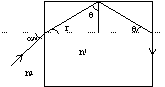
r + q c =p /2 . . . .(ii) where critical angle q c = sin- 1(n2/n1); Þ a m = sin- 1((n1/n2)cosq c) = sin- 1[(n1/n2 cos(sin- 1(n2/n1))] |
 |
 | = g cos q
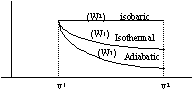
Þ W2 > W1 > W3. |
 |
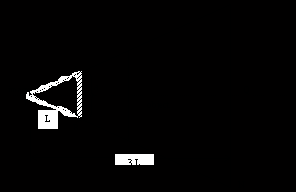
MN/AB = IQ/IP Þ MN = (3L/L)(d) = 3d |
 |
 . . .(i)
 .
. .(ii)
.
. .(ii)
27. (C); Object lies slightly beyond the focus of the objective. Therefore intermediate image is real, inverted & magnified.
28. (D); l min = 12400/V = 12400/(80 ´ 1000) » 0.155 A0 Þ continuous X-ray having wave length l ³ 0.155 A0 will be emitted. Also energy of the incident electron is sufficient to knock out an electron from K-shell. Hence, characteristic X-rays will also be emitted.
29. (C);
Since magnetic force  = q(
= q( )
)
for +ve charge  q = +q
for –ve charge  q = -q
therefore both will be accelerated along –y
axis.
30. (B); Qq/4p e 0a + Qq/4p e 0Ö 2a + q2/4p e 0a = 0
Þ a = -2q/(2+ Ö 2).
31. (C); P
= F. v
since F = r Av2
P µ v3.
32. (D); Ixx’
= (3/2)mR2 since m = r L & R = L/2p
IXX¢ = 3r L3/8p 2
33. (B); Since no net torque is acting along the axis of rotation & no dissipative force is present, hence angular momentum & energy will be conserved.
& v is velocity of efflux. Þ (L2)(2gy)1/2 = (p R2)(2g(4y))1/2 Þ R = L/(2p )1/2 |
 |
 = 0. As we come close to wires
magnitude of B increases. The direction of
magnetic field on opposite sides of a wire will
be opposite.
= 0. As we come close to wires
magnitude of B increases. The direction of
magnetic field on opposite sides of a wire will
be opposite.36. (A); Undergoes dehydration easily as the product obtained is conjugated and is more stable.
37. (B); D H =  (reactant) =(
–110.5 – 241.08) – (–393.5) = 41.2 kJmol–1-
(reactant) =(
–110.5 – 241.08) – (–393.5) = 41.2 kJmol–1-
38. (A); PhCH=CHCH3 will exhibit geometrical isomerism.
39. (D); Kc=  =
=  , (R in L.atm.K–1
mole–1).
, (R in L.atm.K–1
mole–1).
40. (C); C6H5–COOH + SOCl2 ¾ ¾ ® C6H5COCl + SO2 + HCl
 =
0.44 – 0.33 = 0.11V is positive, hence
reaction is spontaneous.
=
0.44 – 0.33 = 0.11V is positive, hence
reaction is spontaneous. 42. (B); Effective nuclear
charge decreases from F– to N3–
, hence the radii follows the
order:
F– < O2– < N3–.
43. (A); px orbital being dumbell shaped, number of nodal planes = 1
45. (C); –CH3 is the best nucleophile because carbon has the least electronegativity among the among the given options.
46. (C); 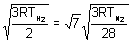 Þ T2
= 2T1
Þ T2
= 2T1
48. (D); C + O2 ¾ ¾ ® CO2, CO2 + C ¾ ¾ ® 2CO, The CO so produced reduces Fe2O3 to Fe via Fe3O4. and FeO.
49. (D);  \ Cr is
in +6 oxidation state.
\ Cr is
in +6 oxidation state.
50. (B); (PV)Observed / (PV)Ideal < 1 Þ Vobs < Videal, Vobs < 22.4 litre.
51. (D); Aliphatic amines are more basic than aromatic amines.
52. (D); At initial stage concentration of each product will increase and hence Q will increase.
53. (D); As unit of k is
sec–1 , reaction is of first order r = K[N2O5]
\ [N2O5] =  = 0.8
= 0.8
55. (C); Mass of 1L water
vapour = 0.6 g , V =  = 0.6 cm3.
| 57. | (C); | 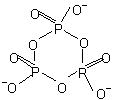 |
Number of P–O–P bonds = 3 in trimetaphosphate which is the most stable one among all the cyclic metaphosphates. |
59. (D); Rate of reaction will be R – I > R – Br > R – Cl > R – F. As I– is the best leaving group among halide ions.
60. (D); Structure of SF4 is T.B.P. with one lone pair , while CF4 is tetrahedral with no lone pair and XeF4 is octahedral with 2 lone pairs and is square planar.
61. (B); N is sp, sp2
and sp3 hybridised in  and
and  , respectively.
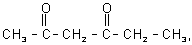 –CH2– group is flanked on
both sides by electron - withdrawing groups and
hence is most acidic.
–CH2– group is flanked on
both sides by electron - withdrawing groups and
hence is most acidic.63. (A); Non-metallic oxides are acidic and acidic character decreases with decreasing non metallic character.
64. (C); NH3 does not react with CaO
65. (A); S, Se, Te cannot undergo hydrogen bond formation because of their larger size and lower electronegativity values.
66. (C); Assertion is correct but reasoning is incorrect because the energy of 2s orbital is less than 2p orbital.
67. (C); Assertion is correct but reasoning is incorrect because 1-butene reacts with HBr in presence of peroxide to form n – butyl bromide via secondary free radical.
68. (B); Q = 0 since W = PD V = 0 ´ D V = 0 (D E = 0 in an isothermal process).
69. (A); c µ  , mc µ , frequency of
collision µ c,where c = rms velocity
, mc µ , frequency of
collision µ c,where c = rms velocity
 , is stabilized, hence its
intermediate carbocation is more stable than the
one in benzene.
, is stabilized, hence its
intermediate carbocation is more stable than the
one in benzene.71. (C); f(q ) = sinq ´ 2 sin2q cosq = sin22q ³ 0 " q Î R
72. (B); The given normal is y = -x + k
Now normal to the parabola y2 =12x of slope -1 is
y = –x + 6 +3 ( y = mx –2am – am3)
Þ y = –x + 9. Thus k = 9.
= n+1Cr + n+1Cr-1 = n+2Cr .
74. (B); Given a < b and c < 0 < b
Since a + b = –b and a b = c
a + b < 0 and a b < 0 i.e. a and b are of opposite signs.
Þ As a < b Þ a < 0 < b and |a | > b ( since a + b < 0 ).
| Alternatively:
Let f(x) = x2 + bx +c Þ f(0)
= c < 0 Þ b < |a |. |
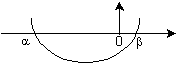 |
75. (C); For the given f :R ® R
If f is onto, |f| will be into.
If f is one-one, |f| can be many-one.
If f is differentiable |f| can be non differentiable.
But if f is continuous, then |f| is also continuous.
76. (D); 2x + 2y =2 Þ 2y = 2 – 2x Þ y = log2(2 –2x)
y will be real if 2 – 2x > 0 Þ 2x < 2
Þ – ¥ < x < 1.
Þ 1 + yy² + (y¢ )2 = 0 .
78. (A); We
have 
Þ 1 ³ M1/2 Þ M £ 1Þ 0 < M £ 1.
79. (D);
For non-trivial solutions 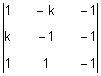 =0
=0
Þ 1(2) + k(-k+1) –1( k+1) =0 Þ k2 –1= 0 Þ k = ± 1.
80. (C); RQ = 5 , OR = OQ = 5 (O
being the origin)
, OR = OQ = 5 (O
being the origin)
Þ Ð ROQ =  Þ Ð RPQ =
81. (B); 2ac sin(p /2–B)
= 2ac 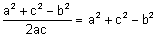 .
.
82. (C);  =
=  .
.
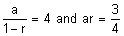
Þ  Þ 16 r2 – 16r +3 = 0
Þ (4r –1)(4r –3) = 0 Þ r = 1/4, 3/4 .
84. (B); g(2) = 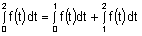
Þ 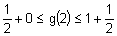 Þ 0 £ g(2) < 2 .
85. (A); 2(r + R) = 2(s
–c) tan +
c = 2s –2c + c = 2s – c =a + b.
+
c = 2s –2c + c = 2s – c =a + b.

We have to fill nine places so that odd digits occupy the even places.
Þ Total number of different
numbers =  .
.
87. (A); arg(-z) – arg(z)
= arg = arg(-1)
= p
= arg(-1)
= p
88. (D); S º (13/2,
1). Slope of line PS =  .
.
 i.e.,
2x + 9y + 7= 0.
i.e.,
2x + 9y + 7= 0. 89. (B); Let O be the foot of the tower of height h and a be the angle of elevation
Þ OA = h cota = OB = OC Þ O is the circumcentre.
90. (C); 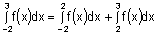 =
= 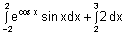 = 0 +2 = 2.
 ).
).92. (D); The
statement ‘S’ is true as their
derivatives cosx and –sinx respectively are
< 0 " x Î
(p /2, p
) and the statement ‘R’ is false as
from the sign of df/dx, sign of d2f/dx2
can not be checked.
93. (C); f(x)
= 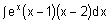
f¢ (x) = ex(x –1)(x –2) Þ f¢ (x) < 0 Þ 1 < x < 2
So f is decreasing in (1, 2).
94. (A); Using 2g1g2 + 2f1f2 = c1 + c2
we get 0 + 2.k.k = 6 + k Þ 2k2 –k – 6 = 0
Þ (2k + 3)( k –2) = 0 Þ k =2 , –3/2 .
95. (B);We have  Þ
Þ 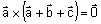 Þ
Þ 
Also, 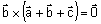 Þ
Þ  Þ
Þ  .
.
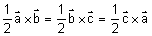 .
.96. (D); slope of the normal at (3, 4) is tan(3p /4) = -1
Þ slope of the tangent at (3, 4) is 1 Þ f¢ (3) =1.
97. (A); 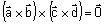 Þ
Þ  are collinear.
 and
and  .
. Thus the angle between the planes is zero.
98. (A); f(0) =1, f(0– ) < 1 and f(0+ ) < 1
Þ f has local maximum at x = 0.
 are
coplanar
are
coplanar Þ their linear combinations will also be coplanar
Þ  = 0.
= 0.
| 100.
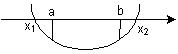
(D); Let f(x) = (x –a)(x –b) –1 Þ f(a) = –1 < 0 and f(b) = –1 < 0 Þ x1 Î ( – ¥ , a) and x2 Î ( b , ¥ ) . |
 |
101. (A); |zi|2
= 1 Þ  , i = 1, 2, 3.
Þ |z1 + z2 +z3| =  =
= 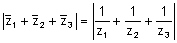 =1.
=1.
102. (C); Let a , a 2 be the roots
a + a 2 = – , a 3
=1. Hence a =1, w or w 2.
, a 3
=1. Hence a =1, w or w 2.
But a ¹ 1 as
p > 0 Þ a = w or w 2 Þ  Þ p =3.
103. (C); y2 = k . Directrix: x
–
. Directrix: x
– 
Comparing with x –1 = 0, we
get  Þ 32
– k2 = 4k
Þ 32
– k2 = 4k
Þ k2 + 4k –32 = 0 Þ ( k+ 8)( k –4) = 0 Þ k =4, –8 .
104. (B); Let f(x) = ex –1 –x
f¢ (x) = ex –1 > 0 " x Î (0, 1)
g(x) = loge(1+x) – x
g¢ (x) =  =
=  < 0
< 0
so g(x) is decreasing Þ loge(1+x) < x.
105. (B); 
= – =
=  =
=  .
.