![[logo]](toplogo1.gif)


|
|
| ||||||||

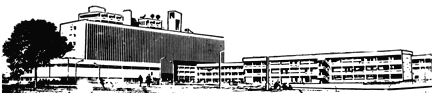
I I T - D E L H I

Indian Institute of Technology Delhi is one of the six Institutes of Technology created as centres of excellence for higher training, research and development in science, engineering and technology in India, the others being at Kanpur, Kharagpur, Madras Bombay and Guwahati. Established as College of Engineering in 1961, the Institute was later declared an Institution of National Importance under the "Institutes of Technology (Amendment) Act, 1963" and was renamed "Indian Institute of Technology Delhi". It was then accorded the status of a deemed university with powers to decide its own academic policy, to conduct its own examinations, and to award its own degrees.
HRH Prince Philip, the Duke of Edinburgh, laid the foundation stone of the Institute on January 27, 1959. The Institute was inaugurated by Prof.Humayun Kabir, the then Union Minister for Scientific Research and Cultural Affairs on August 21, 1961. The Institute buildings were formally opened by Dr.Zakir Hussain, the then President of India, on March 2, 1968.
I I T - B O M B A Y
IIT Bombay was established with the co-operation and participation of the UNESCO, utilizing the contribution of the Govt. of USSR. The Institute received substantial assistance in the form of equipment and expert services from USSR through the UNESCO from 1956 to 1973. The Institute received several experts (59) and technicians (14) from several reputed institutions in the USSR. The UNESCO also offered a number of fellowships (27) for training of Indian faculty members in the USSR.
Under the bilateral agreement of 1965, the USSR Govt. provided additional assistance to supplement the Aid Program already received by the Institute through UNESCO.
Objectives and Goals : The Indian Institute of Technology, Bombay seeks to establish traditions which will foster creativity and growth of excellence.
The institute has the following broad objectives :
The Institute cherishes the hope that its graduates will be the leaders of tomorrow. Their education is patterned with this in view. Thus in the engineering curriculum, besides the professional courses, there is a strong emphasis on acquiring a thorough grounding in the basic sciences of mathematics, physics and chemistry and a reasonable knowledge in subjects like economics, english, philosophy and social sciences belonging to the Humanities and Social Science. The emphasis on the basic sciences removes to some extent the fear of rapid obsolescence, while studies in the Humanities help the students to interact more positively with the society in which he lives. Besides making available facilities for higher education, traning and research in various fields of engineering and technology, the Institute contributes to the industrial development and economic growth of the country by preparing a cadre of engineers and scientists, who provide both man power and support R&D work for industries.
I I T - K A N P U R
The Indian Institute of Technology, Kanpur is one of the six premier institutions established by the Government of India to provide engineering education, to promote research of the highest international standard, and to provide leadership in technological innovation for industrial growth of the country. Starting with 100 students, a small faculty and borrowed buildings in 1959, the Institute now has its own sprawling residential campus, about 1250 undergraduate and 850 post-graduate students, 325 faculty, and more than 1500 supporting staff.
From its very inception, IIT Kanpur has been striving to develop itself into an institution of excellence in education and research in consonance with the contemporary and future needs of India. In meeting this challenge, the Institute has always been making special efforts to recruit talented faculty on a world-wide basis and to admit brilliant students from all over the country by a careful selection process. Continuous efforts are being made to provide the faculty with well-equipped facilities to enable them to participate in national endeavours in Science and Technology in a major way. In addition to offering formal under-graduate and post-graduate degree programs, the Institute has been involved in Continuing Education and Research & Development in areas valueable to both the industry and the government.
More than 12,000 students have graduated from IITK. Now they work in India and abroad as engineers, researchers, academicians, consultants, and industrial managers. In a span of 35 years, the Institute has attained recognition as a major centre of learning in engineering, science and several inter-disciplinary areas.
I I T - K H A R A G P U R
To cater to the need of trained manpower for higher learning in science and technology in the country, the Indian Institute of Technology at Kharagpur, the first chain of six IIT's, was established in 1950. The idyllic, sylvan setting at Hijli was chosen to provide a cordon sanitaire to the serious learners for uninterrupted pursuit of studies. There was also an element of poetic justice in choosing of yesteryears as the coign for opening up new vistas to the future.
From a modest start in the dilapidated Hijli jail building, IIT Kharagpur has been engaged in a virtually continuos process of development. The handsome main building with its majestic tower was inaugurated in 1956 and Pundit Jawarhal Nehru in the first convocation address in the same year said :
"Here in the place of that Hijli detention camp stands this fine monument of India, representing India's urges, India's future in the making. This picture seems to me symbolic of changes that are coming to India. Today, IIT Kharagpur has come a long way to its present position of preeminence with eighteen academic departments, eight multidisciplinary centers, a School of Management, a School of Telecommunications and several sophisticated central facilities.
It is the largest and most diversified among all the IITs. In a study sponsored by the Department of Science and Technology, Government of India, it has the highest relative employment productivity index among the IITs and is the top supplier of fresh engineers / technologists to the public and private sector industries. It also ranked first among the IITs in the production of science and engineering Ph.D.'s. IIT Kharagpur strives to produce scientists and technologists of the highest caliber to help the nation become self-reliant in its technological needs and to provide leadership in the field of technical education and research.
Some of the distinctive features of the IIT programmes are science based engineering education, emphasis on complete education, continuous internal evaluation and flexibility for experimentation, upgradation and innovation in curriculum design. Over the last four decades of its existence, IIT Kharagpur has redefined its aims, broadened its objectives, and introduced major changes in its programmes and priorities. The syllabi and the curricula are constantly updated and modified keeping in pace with technological developments. It is no longer considered enough just to train first-rate engineering graduates with the help of a competent faculty and staff. Consolidation and diversification of academic effort to relate the entire educational endeavor to the larger context of the national development process, constitute the focus of its dynamic educational philosophy.
I I T - MADRAS
The Indian Institute of Technology, Madras, is among the foremost of Institutes of national importance in higher technological education and in basic and applied research. The institute, with a self-contained campus of nearly 360 faculty, 4000 students, 1250 administrative and supporting staff, is located in a beautiful, wooded land of about 250 hectares in South Madras. It has been growing from strength to strength ever since it obtained its charter from the Indian Parliament in 1961, and has established itself as a premier centre for teaching, research and industrial consultancy in the country.
The activities of the institute encompass several Departments and advanced research centres, in various disciplines of engineering and sciences with nearly 100 laboratories organised on a unique pattern of functioning. A faculty of international repute, a brilliant student community, excellent technical and supporting staff and an effective administration have all contributed to the pre-eminent status of this institute. Academics The institute has 12 departments, which offer programmes of study in engineering and pure sciences, and 15 centres which conduct specialized research in state-of-the-art laboratories The institute also has a placement cell which arranges for companies to recruit students of all programmes in their final year. Co-curricular activities (NCC, NSO and NSS) form a compulsory part of the B.Tech programme. Extramural lectures are an integral part of the academic programme and are aimed at exposing the students to eminent personalities.
| About myself | Feedback | Copyright © 1999, Rohin Saluja This site is best viewed by Internet Explorer 4.0 and above with a resolution of 640 X 480. |
