The
physical topology of a network refers to the configuration of cables, The
logical topology
of a network refers to the architecture, that is
computers, and other peripherals.
the way which the network appears to the devices that use
it.
Types of Network Topology
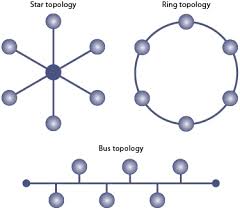
There are 3 types of network topology which is bus, ring, and star topology.
Bus Network Topology
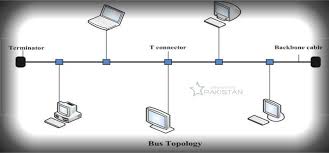
A bus network consists of a single central cable
(backbone/trunk), to which all computers and other devices connect
(node).
- The bus in a bus network transmit data, instructions, and information as a series of signal.
- Those signals are sent as electrical pulses that travel along the length of the cable in both directions.
- Each devices is connected to the single bus cable through T-Connector.
- A terminator is required at each end of the
bus cable to prevent the signal from bouncing back and forth on the bus
cable.
- When a sending device transmits data, the address of the receiving device is included with the transmission.
if the device address does not match the
intended address for the data, the device ignores the data.
If the data does match the device address, the data
is accepted. All devices receive the data but only the
receiving device accept them.
Ring Network Topology
On a ring network, a cable forms a closed loop (ring) with all computers and devices arranged along the ring.
- Data transmitted on a ring network travels from device to device
around the entire ring, in one direction (clockwise or counterclockwise)
- Token passing is one method for sending data around a ring
- Each device takes a turn sending and receiving information through the use of a token.
- The token along with any data is sent from the first device to
the second device which extracts the data addressed to it and adds any
data it wishes to send.
Then second device passes the token and data to the third device, etc.
until it comes back around tothe first device again. Only the device
with the token is allowed to send data . All other devices must wait
for the token to come to them.

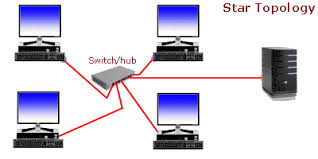
Star Network Topology
All the computers and other devices on the network connect to a central
device, thus forming a star. Two types of devices that provide a common
central connection point to all the other devices on the network are a
hub and a switch. Hub and switch are device that provides a common
central connection point for other devices on a network.
All data that transfers from one device to another passes through the hub or switch.