

|
CATEGORIES |
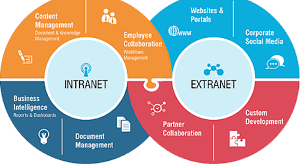
INTRANET |
EXTRANET |
|
DEFINITION |
A
network that belongs to an enterprise and is a accessible only by that
enterprise’s employees or authorized users. |
A
private network that more than one organizations that use internet
technologies to allow suppliers, customers and business partner limited
access to their network. |
|
TYPE
OF USERS |
Authorized
employee ONLY. |
Authorized
group from collaborating companies. |
|
USAGE |
Provide
information for organization employees. (Telephone directories. Employee
information, E-mail) |
Provide
information to suppliers, customers and business partner. (Check sale stock) |
|
SECURITY |
Higher
– security control are higher. |
High
– Security control are high. |
|
TYPE
OF ACCESS |
Private
and restricted. |
Private
and outside authorized partners. |
|
INFORMATION |
Specific,
corporate and proprietary. |
Shared
in authorized collaborating groups. |
|
Various/Types of Internet
Connection |
Transmission
Media Type of physical system used to carry a communication
signal from one system to another. |
Communication
Device Hardware component that enables a computer to send and
receive data, instructions to and from one or more computers. |
Internet
Service Provider (ISP) A business that provides individuals and organizations
access to the Internet free or for a fee. |
Data
Transfer Rate The speed at which data can be transmitted between
devices. |
|
High-Speed
Broadband Connection |
||||
|
Cable
Internet Service (Cable) Provides high-speed Internet access through the cable
television network via a cable modem. |
Physical: Coaxial Cable Wireless: Communication Satellite (MEASAT Satellite) |
Cable Modem Dish-Shaped Antenna: (Satellite Dish) |
Astro: Astro TV, Astro Beyond, IPTV |
128 Kbps to 52 Mbps |
|
Digital
Subscriber Line (DSL) Provides high-speed Internet connections using regular
copper telephone lines. |
Physical: Unpaired Twisted Pair Cable Wireless: Broadcast Radio (Wi-Fi) |
Network Interface Card (NIC) Wireless Adapter Card Wireless Access Point |
TMNet: Streamyx |
128 Kbps to 8.45 Mbps |
|
Cellular
Radio Network Offers high-speed Internet connections to devices with
built-in compatible technology or computers with wireless modems. |
Cellular Radio: High-frequency radio waves (2G, 3G &
4G) |
Wireless Modem |
Celcom, Maxis, Yes, P1 |
2G: 9.6 Kbps to 19.2 Kbps 3G: 144 Kbps to 2.4 Mbps 4G: Up to 15 Mbps |
|
Fibre To The
Premises (FTTP) Uses fibre-optic cable to provide high-speed Internet
access to home and business users. |
Physical: Fibre-Optic Cable |
Cable Modem (BTU: Broadband Termination Unit) Wireless Access Point: (Residential Gateway: RG) |
TM Unifi |
5 Mbps to 100 Mbps |
|
Wi-Fi (Wireless
Fidelity) Network uses radio signals to provide high-speed Internet
connections to compatible or properly equipped wireless computers and
devices. |
Wireless: Broadcast Radio (Wi-Fi) |
Wireless Adapter Card Wireless Access Point |
TMNet Hotspots, P1, Yes |
802.11: Series of Standards 802.11: 1 to 2 Mbps 802.11a: Up to 54 Mbps 802.11b: Up to 11 Mbps 802.11g: 54 Mbps & higher 802.11n: 108 Mbps & higher |
|
Fixed
Wireless Provides high-speed Internet connections using a
dish-shaped antenna on your house or business to communicate with a tower
location via radio signals. |
Radio Signals |
Dish Shaped Antenna : (Satellite Dish) Tower Location |
|
256 Kbps to 10 Mbps |
|
Satellite
Internet Service Provides high-speed Internet connections via satellite to
a satellite dish that communicates with a satellite modem. |
Satellite |
Satellite Modem Satellite Dish |
|
1 Gbps |
|
Low-Speed
Internet Connection |
||||
|
Dial-Up Connection |
Physical: Unpaired Twisted Pair Cable |
Telephone (Dial-Up) Modem |
Telekom Malaysia |
Limited to 56 Kbps |


-
An internet service providers are
categorized as regional or national ISPs.
-
A regional ISP usually provides
Internet Access to a specific geographical area.
-
A national ISP is a business that
provides Internet Access in cities and towns nationwide.
-
Other than Internet Connection,
ISPs may also provide related services like web site hosting & development,
e-mail hosting, domain name, registration etc.
Responsibilities of an ISP.