Guenevere: Queen of the Britons
By: Jennifer Freely
Guinevere, Guenevere, or Gwenhwyfar is the queen of the legendary King Arthur and lover of his champion, sir Lancelot. However, this barely touches upon her, the woman or the myth. The truth is that the figure of Guenevere is widely known both with and without her association to either her husband or her lover. There have been many different representations of her written throughout the centuries, and she continues to be a muse to the poets even today. She is also the subject of much debate about her role in the fall of Camelot and the Knights of the Round Table.
In Lanval, Guenevere is a self- important petulant queen who is only interested in her own vanity. She is seen also as a promiscuous adulteress who makes an inappropriate offer to Lanval. When Lanval refuses her, she insults him by implying that he is gay, then accuses sir Lanval to Arthur. She tells Arthur that the situation was reversed and it was he who made the proposition to her, and consequently she causes a good knight to be put on trial for his life.
In Sir Gawain and the Green Knight, she is barely seen other than to as gay and very beautiful:
Fair queen, without a flaw,
She glanced with eyes of grey.
A seemlier that once he saw,
In truth, no man could say. (lines 81- 84)
However, in the end of the story, it is discovered that the creation of the Green Knight, sir Bercilak de Hautdesert, has been created by Morgan Le Fay to scare Guenevere to death.
Hailed as the most romantic and tragic love triangle in history is that of King Arthur, sir Lancelot, and Queen Guenevere. Following Andreas Capellanus� rules of courtly love, Guenevere may be loved by both Arthur and Lancelot. However, she can only love one of them, and her heart goes to Lancelot, her knight. Arthur is often seen as being so busy at being King of the Britons that he forgets to be a husband to his wife. Lancelot, on the other hand, is a knight devoted to her and a follower of the courtly art of love.
In Morte Darthur, Guenevere feels herself torn between her duty and warm affection for Arthur and her passionate love for Lancelot. Guenevere feels guilty about her affair, was discovered and believes that their adulterous love has been the cause of the knights� death. After Lancelot and Guenevere they are discovered, Guenevere leaves Camelot and becomes the Mother Superior at the convent at Amesbury. After the Last Battle, when the knights of the Round Table and presumably Arthur are dead, and the Table fallen, she gives her speech about the blame being hers and sir Lancelot�s.
�Through this same man and me hath all this war be wrought, and the death of the most noblest knights of the world; for through our love that we have loved together is my most noble lord slain. Therefore, sir Lancelot, wit thou well I am set in such a plight to get my soul heal. And yet I trust, through God�s grace and through His Passion of His wounds wide, that after my death I may have a sight of the blessed face of Christ Jesu, and on Doomsday to sit on His right side; for as sinful as ever I was, now are saints in heaven. And therefore, sir Lancelot, I require thee and beseech thee heartily, for all the love that ever was betwixt us, that thou never see me no more in the visage. And I command thee, on God�s behalf, that thou forsake my company. And to thy kingdom look thou turn again, and keep well thy realm from war and wrack, for as well as I have loved thee heretofore mine heart will not serve now to see thee; for through thee and me is the flower of kings and knights destroyed. And therefore go thou to thy realm, and there take thee a wife, and live with her with joy and bliss. And I pray thee heartily to pray for me to the Everlasting Lord that I may amend my mis- living.� (pg. 151 & 152)
Feeling there is no other way to save her soul is to give Lancelot up and give herself over to God, which she does with great sadness.
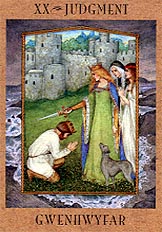
Guenevere is also a figure of truth, wisdom, and fair judgment. In a Welsh myth, her name is spelt Gwenhwyfar as in the book The Mists of Avalon. She is a goddess and first lady among the isles and the ocean. Her judgment and wisdom are beyond reproach and a prophecy declares �that no one man could rule Wales without her by his side.� This leads to many attempts by men to woo her and even to abduct the goddess queen, with the notion that that will make them king. However, Gwenhwyfar�s duty in this myth is to judgment, not romantic love, so she awaits the once and future king of Britain.
No matter how her name is said or spelt her beauty is the same, in that no one can her. Tennyson wrote about Guinevere as being beyond any other in soul or spirit. She is a literary icon; the Arthur legends simply would exist without her presence. Guenevere has been portrayed as everything from a pure goddess to a sultry temptress. She is an embodiment of the many faces of women, giving them a good deal of passion and depth.
Work Cited
Malory, Sir Thomas. Morte Darthur, in The Norton Anthology of English Literature,
7th Ed. New York: W. W. Norton & Company Inc., 2000, pp. 421- 439.
Sir Gawain and The Green Knight, in The Norton Anthology of English Literature,
7th Ed. New York: W. W. Norton & Company Inc., 2000, pg. 160.
Waldherr, Kris. The Goddess Tarot. Stanford:
U.S. Games Systems, Inc., 1999, pgs. 57 and 58.