Emotional Development
|
It may difficult for a person emotionally unstable to build good interpersonal relationships. The normal emotional development of the child is therefore essential for him/her attaining later in life the capacity of building strong interpersonal relationships and a good functional behavior. Many psychologists have studied the emotional develoment of the child. We will see a brief summary of the work of three of the most proeminent of them. To finish, I will broaden the view to include more about the social aspect of human functionality, narticularly with Maslow Emotional Development of the Child in the Eyes of AssagioliIt was Assagioli who, having been in the footsteps of Sigmund Freud, saw that the child, as a baby, lives, first, a period of primary narcissism, then develops a secondary narcissism, to end, while becoming an adult, in a period of tertiary narcissism with the choice of his/her beloved partner Then, said Assagioli, this adult knows normally a balanced affective relationship with others that leads to mutual gratification; this can lead further to true altruism, i.e., to unconditional love and concern for others. It is a simple view of the emotional development of the human being but it is full of lessons. We have gone partially through it in the preceding chapter, and it will not be reviewed here. Emotional Development of the Child According to EriksonThe emotional development of a human being is more elaborate in the theory of Erikson. According to the later, the emotional growth of the human being goes through eight psychosocial and conflictual phases that can interlace, and sexuality plays a minor role in this development (let us not he obsessed by sex!) How well or bad has been the solution of each of these conflicts will determine how the person will bloom socially.
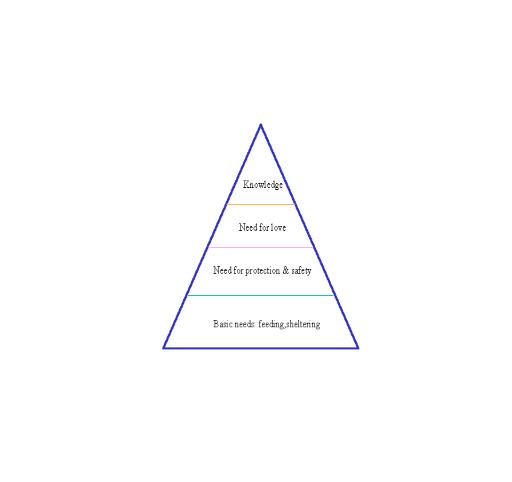
Freud's Psychosexual Stages of the Emotional Development of the ChildThe analysis of Sigmund Freud is mostly based on sexuality (this cannot be ignored); therefore, the stages of the emotional development of the child are qualified as pychosexual. The first stage is the ORAL STAGE. During this stage the zone of maximal sensual stimulation is the mouth and the lips, and this helps the newborn to nourrish himself. So it's "nature." Since the nipple of the mother is also for her an erogenous (sensual) zone, she enjoys breast-feeding her child (it is also nature). Thus, the mother and her child are linked in some psychosexual (sensual) pleasure, which if, for any reason, is disturbed can lead to an emotionally unstable child and somewhat to a dependent person or to a complaining or recriminatory one. The second stage is the ANAL STAGE that goes from 2 to 4 years, when baby is at the kindergarten. Having been weaned of his/her mother's breast,the child has no more his/her lips being stimulated by the nipple of his/her mother; this ends the maximal oral pleasure he/she has had while feeding him-/herself and the oral stage. However, he/she does still have some great pleasure in defecating, in voiding his/hex bowel- (it's again Nature), till he/she is forced to control himself to be accepted by the society. If ever, he has been badly forced to do so or, at the opposite end, has been left "unleashed" (a rarer event), at this period, he/she can develop either into a sadic person (liking to hurt people mentally or physically}, a masochist one (liking to be tortured) a sado-masochist one (having both wishes) or a disordered person (either in his/her behavior or in any act in his/ her life) such are an alcoholic, a drug addict and/or a (social) bum. The third phase of the emotional developement of the child is the PHALLIC STAGE that goes from 5,6 or 7 to12, 13 or 14 years. Having lost both the early and maximal oral pleasure in feeding him-/herself and the early and maximal anal pleasure in defecating him-/herself, the child still have his/her external sexual parts (penis and vagina primordially, and then later the breast) that are very pleasurable and as they grow in size, they become more and more sensitive and pleasurable. Because he/she has no sexual act (coit), it is only the protuding part of those sexual organs - the glans (tip) of the penis for the boy and the vaginal lips and the clitoris for the girl- that are accidentally or voluntarily stimulated by their caregivers. Therefore, this stage is called the phallic stage to distinguish it from the next one. If ever, for any reason, the child is abused - materializing thus the Oedipal myth - or has been made afraid or complexed about these parts - nourishing thus the complex of castration - or if he cannot get a true and balanced parental love (particularly from the mother), then he is likely to be stopped at this stage of his psychosexual development. He/She will thus be stunted emotionally and will be less likely to succeed in the familial or social life than his/her normal peers. The fourth phase of the psychosexual development of the child is the GENITAL STAGE that goes from adolescence to death. Normally, the society allows and encourages an adult to have sexual relationship with another adult of the opposite sex. Because, during the sexual act, the penis of the man penetrates the vagina of the woman and because this could lead to the birth of a child, this stage is called the genital stage (from the latin, "genitus" (past of "gignere"): to beget). Normally, this stage is less likely to be disturbed than the others, and it is also less likely to lead to a significant psychosexual stunted growth than the precedent ones. Nevertheless, any disturbance of this stage can prevent a normal family life and a normal sexual relationship particularly between partners of opposite sex but not necessarily a normal psychoaffective life, and the individual may be well balanced emotionally. As you can see it, for Freud the success of somebody in society, his functionality, is mostly related to his affective or sexual life and less to his intelligence or to any other thing; however (remember that) , man is only an animal and, perhaps, it is why sex prevails in his development. It is, at last and again, the way of "Nature!" Hierarchy of our Social Needs in Maslow's EyesWhile the authors that we have seen, since then, have considered only or mostly the individual and emotional growth of men, a growth that is fairly parallel to but not dependent of their physical growth, Maslow considered mostly the growth of their social needs; this growth has no specific chronolgy and there is no time-table for it. It happens mostly when our lower or primordial needs are satisfied. It might seem, at the first view,that this has nothing to do with a people developing good interpersonal relationship, but indeed it has, as we are going to see it. At first, our primordial needs must be satisfied; those needs are for feeding, clothing and sheltering ourselves; They are material needs and thus are mostly primordial; they must then be fulfilled before the individual can move to a higher level. We cannot live withouth food. Similarly it will be hard, these days, for anyone of us to live withouth clothes and withouth shelters. Man, since his apparition on Earth, has always looked for these needs which are basic to him and are much linked to the other two next levels of his social needs. Indeed, man needs also and urgently protection and safety in the environment and from the community he lives in and, thus, the need for God or for the gods who protect the community and the need for justice is justified. It is why he lives in groups and it is also why his community has also a police force or an army. Those needs are also vital to him, even if they are somewhat less crucial than the first ones, and they are so since he was a baby, needing the protection and the caring of his parents to survive in a world which he is not yet prepared to master or even to deal with. The next other level of human needs is the needs for friendship, for loving, for belonging or for sharing and, thus, the need for a village or for a nation and the need for laws that rule efficiently the community. Man is mostly a social animal; he is nevertheless not the only one; birds and bees are also very social animals and most mammals and fishes are. Those needs are particularly necessary for the protection or the conservation of the species while the basic needs were for that of the individuals. Those needs even it they are less vital to man than the first two groups are really thus important to him. To express such a relationship between the diverse needs, it is usual to build a pyramid, the Maslow's pyramid inside of which are placed the needs in their hierarchical order, from the basic ones at the basis of the pyramid to the less crucial ones at its tip. Baby will surely be sick and very sick withouth the love of his mother even if the other and basic needs (food and safety, for example) are filled. Many dysfunctional behaviors can also be explained by a lack or a perversion of these needs of the third level; they can also explain, as well as the others seen with the other authors, the genesis of the mental illnesses or of any dysfunctional behavior in our society. The last level is the intellectual needs. These needs are not specific to the human race, at least in their lower forms, since many are less or more evident in some other animals These are:
--------------------------- * A big obstacle to good interpersonal relationships often comes from too much self-disclosure that blocks our understanding of our interlocutor; |