Brief Notions of Epidemiology:


A lot of people don't have an idea of what is epidemiology and of its importance in their life. It is why I have found good to add to this text those lines that follow. Epidemiology is an important part iof the social evolution of the humanity.


  1. Definition of the Epidemiology:

  2. Presently, Epidemiology is not the science which studies , only, the distribution and propagation of the infectious diseases ; it is also the science that surveys thoe illnesses that are non infectious but which constitute major public health problems, in a given geographical zone. According to the Online Principles of Epidemiology , a Computer-Based Tutorial Program, by Howard Strasberg, this science "is the study of the distribution and determinants of disease in human populations. It involves assessing the frequencies and types of disease in various groups of people and the factors which influence their distribution."

    My new definition of the epidemilogy will be, therefore, the following one:

    The epidemiology is this science whose domain is:
    1. the study of the repartition of the major health's problems in the area
    2. the survey of risk factors (those determinants) that increases the probability of the developpement of one or several of these major problemes of health (public health's problems) , in a population
    3. the survey of policies to be adopted at a global level by the political institutions in order to limit these factors of risk and to prevent the development of these major public health problems. As professor Howard Strasberg points it, "Population medicine differs from clinical medicine in that while clinical medicine deals with the medical care of individuals, population medicine focuses on the community. However, the information gained in population studies can then help guide physicians to the proper diagnosis, treatment and prevention of disease in individual patients."

    My new definition of the epidemiology, although very large, is not a complete one, because what is a major public health's problem remains to be defined. Indeed, a regional problem of health can constitute a problem of major concern as well to the point of view of the potential lethality of the illness than to that of the socioeconomic burden it brings. The medico-sanitary politics, to be adopted by the concerned organisms, will vary, therefore, accordingly to this lethal or invalidating potentiality of the illness and accordingly to the regional resources.


  3. What is an endemic, what is an epidemic and what is a pandemic ?

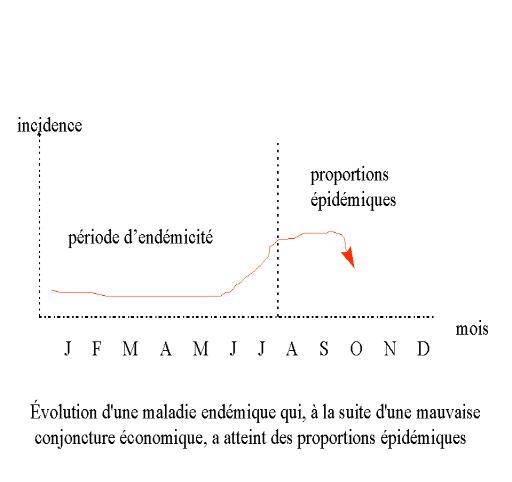
  4. An illness is endemic, in a geographical region, when it demonstrates itself there, with incidences more or less equal, but statistically significant, during a period equivalent to one year (fig. l)

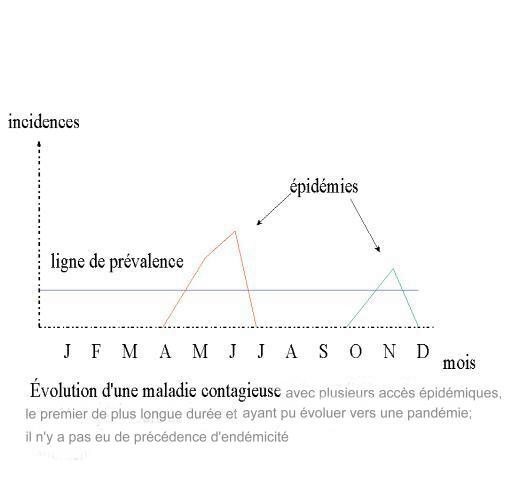
    An illness reaches some epidemic proportions when:
    1. having been endemic in a region, its incidence straightens itself suddenly, to reach values that are located outside of the field.of predictable values
    2. having not been endemic in a region, it appears brutally with a substantial incidence (fig. 2)

    An illness is pandemic when, after having reached epidemic proportions, it spreads over more than one continent or widely different ecological areas.


  5. . Notions of incidence and of prevalence:
    • The incidence of an illness in a given geographical region is the proportion of new cases of this illness to the total population of this region, during a definite periode, often less than one year.
    • The prevalence of an illness, in a given geographical region, is the total proportion of cases to the (total) population during a given period - one year or more - of collection of the data, by the study of the cohorts*.


  6. Notions of eradication and control:

  7. When, by the processes of immunization, chimiotherapy and sanitation (purification of swamps and other dead water basins, by ex.), the prevalence of an illness in an given environment , has become statistically negligible amd its propagation to adjacent area, i.e., its incidence in a period of several years, has become statistically non signififcant one says that this illness has been eradicated from the area.

    The ultimate goal of the Epidemiology is the eradication of diseases. When this goal is not reached, for an illness , but that its prevalence has been maintained at a reasonable rate, one uses the term of control.


---------------------

* The cohort is a group of people, about the same age, often living in the same geographical zone, that are followed from a beginning period to an end period (most often years) for the occurence of a particular disease.

Hosted by www.Geocities.ws

1