

I search for information on how best to terraform Mars for human and animal habitation. I'm extremely concerned about endangered wildlife and hope to find a safe home for them on Mars, since I have some lack of faith that mankind will stop cutting down the rainforests and polluting the atmosphere of the Earth.
Though it may take some decades and perhaps centuries to terraform Mars - depending on how dedicated we are to warming the planet and thickening the atmosphere - it is possible. Mars has water, and mineral resources we can use to support ourselves while we begin the work.
Sulfur can be filtered out of air taken from Venus, and we can use this to thicken the Martian atmosphere. Nitrogen and Carbon dioxide form Venus' highest concentrated gases, and Nitrogen can also be taken from the Saturnian moon Titan. Asteroid and comet material can also be used to thicken the atmosphere.
Powerful solar mirrors orbiting Mars will heat the surface, while factories producing greenhouse gases (which are undesirable here on Earth) can be beneficial in warming the climate on Mars. Initial bases may be near the northern pole on Mars, since the ice there is mostly water (while the ice at the southern pole is frozen carbon dioxide). This area will eventually be the "Boreal Ocean."
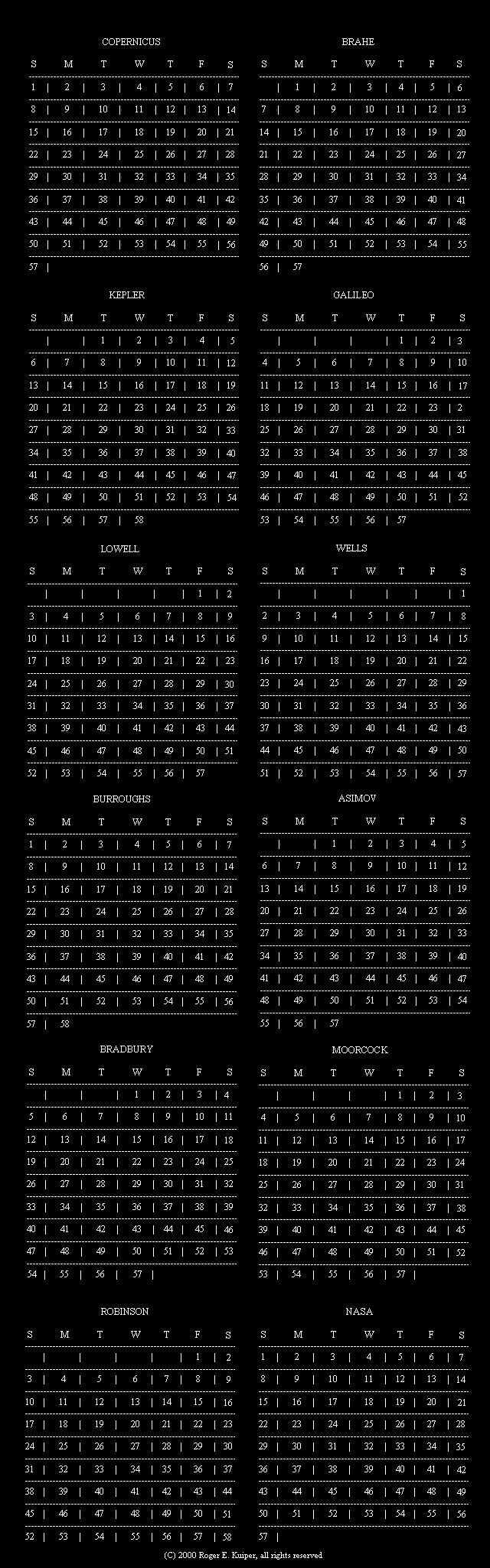
In order to have an exact 24 hour day on Mars (which revolves in 24 hours and 37 minutes), an hour would have to be 61.54166666667 minutes long. In other words, each second of a Martian minute would have to be 1.0256944444 Earth seconds long. This extension of a second would actually be hardly noticeable to Humans. If scientists prefer the current second to be used on Mars, each minute wuld have 60 seconds and each hour would have 60 minutes, and an adjustment period at midnight would be 37 minutes long, and we'll call it "Ares Tribute." Mars orbits the Sun in 1 year and about 10 and 1/2 months Earth time. To have a 12 month calendar, Mars would have to have 57 days per month, with an extra day every four months. The Martian year will start in midwinter of the northern hemisphere, as it does in the northern hemisphere on Earth. The months are Copernicus, 57 days; Brahe, 57 days; Kepler, 58 days; Gilileo, 57 days; Lowell, 57 days; Wells, 57 days; Burroughs, 58 days; Asimov, 57 days, Bradbury, 57 days; Moorcock, 57 days; Robinson, 58 days; and NASA, 57 days. Each month is slightly more than 8 weeks in length. Someone ten years old on Mars is almost 19 years old on Earth. Someone 15 years old on Mars is 28 years old on Earth.