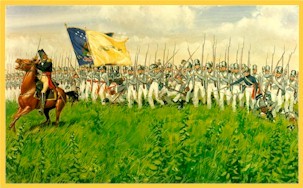
The United States military in the past used to rely on private citizens to be able to rise up, with arms, in the case of hostilities in their regions. This maintained the ability for a sufficient force to be called upon in the case of an emergency, such as invasion by a foriegn power. In the early decades of the nation the federal government's primary role was to supply a means for defense of property and the interest of its citizens. In order to help with the cost of supporting a large military, the government sought the help of its citizens. This help was given in the form of militias.
The men in each town, county, or region would belong the local militia. These groups were a mix between the Elks Lodge and the National Guard. In drastic contrast to the military today the men elected their superiors, this was great for moral but was not very efficient in selecting quality commanders, like school elections it usually turned into just a popularity contest. The richest man or men would usually be elected the officers of the militia. The non-commisioned officers, sergeants and corporals, were also elected these positions would usually be filled with tradesman, shop owners, and the skilled tradesman of the area. The privates would be the non-skilled workers or small local farmers, the bulk of the population.
In order for professional military commanders to determine their regular army forces from those units that were local militia, and not as effective, a color code system was agreed upon. The nation after sometime unofficially agreed that blue should be the color of the regular army uniform and gray the color of the militia. This was never really set in stone. Since the units were volunteer citizen soldiers they would vote on the style and color of the uniform that they would wear, sometimes they did not follow these guidelines. Many of these uniforms were very fancy and elaborate, it all depended upon the resources of the militia members. The primary considerations of these organizations was not functionality but how they looked in a parade. Most of the time these uniforms resembled peacocks in their full glory.
During the Civil War the confusion of no set uniform policy was terribly realized at the First Battle of Manasses. The regular army was not a substantial force at the beginning of the war. Most of its professional regiments were stationed in the frontier and used as a police force rather than a military organization. So when the war broke out in 1861 the cry rose for volunteer regiments to join the army. These volunteers on both sides were the local militias that marched to war in the uniforms that they had elected upon. So on both sides the forces were a wide variety of colors, mostly gray and blue. The confusion came when you try to figure out, in the fog of war, who was friendly and who was the enemy. The flags flown by each regiment did not help due to the fact that no standard was set on which flags or style to use. In many cases friendly units devastated one another before the mix up was worked out.