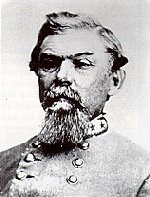
Report of Maj. Gen. William J. Hardee, C. S. Army, commanding Left Wing.
Headquarters Hardee's Corps,
Shelbyville, Tenn., December 1, 1862
Major: I have the honor to transmit the following report of the operations of my command on October 8 last against the forces of the
United States in the battle of Perryville:
For several days before the engagement the enemy had advanced strong columns from Bardstown in the direction of Perryvilie and
Danville. My troops occupied the village of Perryville, and on October 6 and 7 some skirmishing occured between my cavalry under Colonel
Wheeler and the advanced forces of the Federal army, which were brilliantly managed by that brave and able officer.
On the 7th I informed General Bragg, who was at Harrodsburg, that the enemy was moving in heavy force against my position. With the
view of inflicting a decisive defeat, or at least of pressing him back from any farther advance against our line of communications in the
direction of Danville and Cumberland Gap, I urged the concentration of our whole army at Perryville.
On the evening of the 7th, my wing of the army having been re-enforced by the division of Cheatham and orders having been issued to
engage the enemy on the following morning, I again earnestly urged upon General Bragg the necessity of massing his forces on that
important point. That night Major-General Polk arrived and assumed command.
The country near Perryville is boldly undulating and varied with farm-houses, corn fields, and plantations, bordered by native forests. A
creek called Chaplin Fork flows northwardly through the village and unites 4 or 5 miles beyond it with another little stream called Doctor�s
Fork. The space between the two from east to west is about 1 1/2 miles. A good road running a little south of east from Mackville to Perryville
crosses this stream, and a turnpike from Springfield running nearly east and west passes through Perryville to Danville. Another fine
macadamized highway traverses the village from the south in a northwardly direction toward Harrodsburg and Lexington and another
southwardly in the direction of Lebanon. The position at Perryville is strong, and offered many tactical and strategical advantages. The
key of the enemy�s position was at a point where the Mackville road crosses Doctor�s Fork, about 1~ miles from the village, near a barn and
white farm-house on the hill west of the creek. The autumnal drought left the streams almost dry, only pools of water being found here and
there along their channels.
The forces under my command were two divisions, constituting the left wing of the army, commanded respectively by Major-General
Buckner and Brig. Gen. J. Patton Anderson. Each consisted of four brigades, with a battery attached to each brigade. Thinned by battle and
reduced by long and arduous service, my effective force did not exceed 10,000 men. No means exist for ascertaining accurately the strength
of the Federal forces, but from information derived from prisoners captured from five of their divisions it is believed that the enemy
displayed not less than 35,000 men, under the command of Major-Generals McCook, Rousseau, Jackson, and other generals.
My line of battle was originally established between the Harrodsburg turnpike and Chaplin�s, its general direction being nearly north and
south, with the left resting near the village and the right extending down the stream. The line was subsequently advanced about noon, by
order of General Bragg, who arrived about 10 o�clock in the morning, westwardly, so as to take position on the space between the two streams
on the west of the town, extending across the Mackville road, with its left toward the Springfield turnpike. An interval between the left
and the Springfield road was swept and protected by a tine battery of 12-pounders, under Captain Seinple, posted on the Seminary Hill, near
the eastern side of the village. Brigadier-General Anderson, with two brigades, under command of Brigadier-General Adams and Colonel
Powell, covered the extreme left on the Springfield road to protect our communications with Danville and Harrodsburg. The enemy occupied
the western or left bank of Doctor�s Fork, extending across both sides of the Mackville road and across the Springfield road.. The left of the
enemy north of the Mackville road was thrown back in a northwesterly direction, forming an obtuse angle deflected about 3O [degrees] along broken
heights from their center and right, the angle being near the point where the Maekville road crosses Doctor�s Fork. About 1 o�clock in the afternoon
General Cheatham�s division crossed Doctor�s Fork on our extreme right and engaged the enemy�s left on the heights with
great vigor. Immediately I ordered General Buckner to advance his division and attack the salient angle of the enemy�s line where the
Mackville road crosses Doctor�s Fork. The position was a strong one. The enemy was posted behind a natural parapet afforded by the character
of the ground and some stone fences, which were enfiladed by their batteries on their right and swept by another strong battery posted in
their rear.
The brigade of Brigadier-General Johnson gallantly led the advance, with Brigadier-General Cleburne�s as a support, while the brigade of
General St. John R. Liddell was held as a reserve. The brigades of John C. Brown and Jones, of Anderson�s, and [S. A. M.] Wood, of
Buckner�s division, had been detached to occupy the interval between the right of Buckner and the left of Cheatham, and the two remaining
brigades of Anderson�s division, under command of General [D. W.] Adams and Col. [Sam.] Powell, [Twenty-ninth Tennessee], covered the
extreme left of our line. By this time, Cheatham being hotly engaged, the brigades of Johnson and Cleburne attacked the angle of the
enenmy's line with great impetuosity near the burnt barn while those of Wood, Brown, and Jones dashed against their line more to the right,
on the left of Cheatham. Simultaneously the brigades of Adams and Powell, on the left of Cleburne and Johnson, assailed the enemy in front,
while Adams�, diverging to the right, united with Buckner�s left. The whole force thus united then advanoed, aided by a crushing fire from
the artillery, which partially enfiladed their lines. This combined attack was irresistible, and drove the enemy in wild disorder from the position
nearly a mile to the rear. Cheatham and Wood captured the enemy�s battery in front of Wood, and among the pieces and amid the dead and
dying was found the body of General James S. Jackson, who commanded a division of the enemy at that point.
As evening closed in I ordered forward Liddell�s brigade to re-enforce Cheatham. Arriving near twilight, it was difficult in the melee to
distinguish friend from foe. Major.General Polk first discovered the enemy, in whose ranks he found himself by chance, and escaped by his
coolness and address. Returning rapidly he gave Liddell the order to fire, and a deadly volley was poured in that completed the rout. By
this brigade; so gallantly led and directed by General Liddell, arms, prisoners, and colors were captured, together with the papers and
baggage of Major-General McCook. Night closing in our camp-fires were lighted upon the ground so obstinately contested by the enemy, so
bravely won by the valor of our troops.
The loss sustained in the battle was severe�242 killed and 1,504 wounded from my command�attest the severity of the conflict.
Brigadier-General Cleburne, who led his brigade with his usual courage and judgment, was wounded, but remained in command until the close of
the day. Brigadier-General Wood was severely wounded in the head by the fragment of a shell; his quartermaster, commissary, and assistant
adjutant-general were killed, and the three colonels next in rank, on whom the command successively devolved, were wounded.
Brigadier-General Brown was severely wounded while rendering efficient service on the right with his command. Many other valuable officers were
killed or wounded in the battle.
To Major-General Buckner I am indebted for the skillful management of his troops, the judicious use of his artillery, and for the opportune
services of himself and the veteran division under his command.
To Brigadier-General Anderson the defense of the extreme left in the direction of Danville was intrusted. His operations were not under my
immediate supervision. Two of his brigades were detached and advanced boldly, but one brigade was compelled by greatly superior
numbers to resume its original ground, from which, under the cool direction of General Anderson, it subsequently withdrew in good order. Both
brigades were gallantly conducted by General Adams and Colonel Powell, the latter having suffered severely in the unequal contest.
To my staff I am under obligations for promptitude displayed by them in the execution of my orders and for the intelligence and zeal shown
in the discharge of their respective duties. I refer to the reports of division and brigade commanders for details of the operations of their
commands.
To the officers and men I tender my thanks for the daring courage and fine discipline exhibited by them on the field of Perryville. When
advancing none shrank nor lingered in the attack; when engaged no Southern standard was abandoned. Our path was marked by the crushed
lines and disorderly battalions of the enemy. Our troops displayed higher qualities than mere discipline can confer. The fervor of freemen and
the enthusiasm of patriots animated their valor. Whenever they advanced the enemy recoiled before the shock; when they retired he dare
not venture to pursue.
Very respectfully, your obedient servant,
W. J. Hardee,
Lieutenant-General.
Maj. George Williamson., Chief of Staff
Back