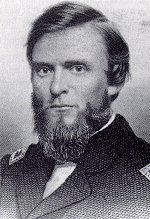
Report of Brig. Gen. Joshua W. Sill, U. S. Army, commanding Second Division, First Corps, Army of the Ohio, including skirmish, October 8, at Lawrenceburg
Three miles northeast of Chaplintown
October 9, 1862General: Left Frankfort 1 a.m. yesterday. By arriving at Lawrenceburg the rebel cavalry appeared in front and a smart skirmish ensued, owing to an imprudent advance of Jacob's cavalry. The leading company lost 3 killed, 12 wounded, 13 missing. Several of the enemy killed and wounded I doubt not.
Our march from Lawrenceburg was closely watched by the enemy's cavalry, and at daybreak of to-day they appeared in force and attempted to drive in the pickets. They exhibited three regiments of infantry and one of cavalry. Our pickets were re-enforced and a sharp firing was kept up for three or four hours. On our side the Thirty-second Indiana, First Ohio, Fifteenth and Nineteenth Regulars were engaged, and a section of Guenther's battery. Their loss respectively was Thirty-second Indiana, 1 killed; First Ohio, 3 killed and 8 wounded; Sixteenth [?] Regiment, 1 killed (The Fifteenth suffered 1 man killed and 2 wounded). The enemy must have suffered very severly. Many of their men were seen to fall
I presume they picked up some of our stragglers, and I fear they have captured a train of sixteen wagons sent after me unadvisedly, and which contained articles for the Fifth Brigade. I know nothing of General Dumont's column, but I suppose he has moved on Frankfort.
Respectfully, your obedient servant,
J. W. Sill
Brigadier-General, Commanding
General Buell.
Will move to Willsburg to-morrow via Chaplintown.
Report of Col. Edwin A. Parrott, First Ohio Infantry.
Hdqrs. First Regt. Ohio Volunteer Infantry
In Camp, October 9, 1862Captain: I have the honor to submit the following report of the skirmish had with the enemy this morning by the troops under my command at Dog Walk:
As my regiment left camp the general commanding appraised me that rear was threatened by the enemy and ordered me to march back on the road until I overtook the Nineteenth U. S. Infantry, previously sent out. About a half a mile from camp I came up with our troops on the road to Lawrenceburg. Major King, Fifteenth U. S. Infantry, had his battalion drawn up in an open field, where he commanded the road; Major Carpenter, Nineteenth U. S. Infantry, was to his left and in the road, which at that point makes an abrupt turn. Being the ranking officer present, I posted the First Ohio behind the crest of a ridge in the skirt of the woods to the rear of the open ground and ordered the battalions of regulars to fall back across the field and form on the same line and to the right of the First Ohio. In the mean time Lieutenant Guenther had come up with a section of Battery H, Fifth U. S. Artillery.
Just as our line was formed the enemy appeared, marching by the flank up the hill in front of where I had found Major King's command. Lieutenant Guenther, having got one of his pieces in position, opened with such effect as to check the progress of the enemy and cause him to fall back under cover of the hill. From this position the enemy advanced a strong line of skirmishers. To oppose these I deployed forward a company from each battalion of the regulars; Company C, Captain Thruston, and part of Company B, Lieutenant Kuhlmann, First Ohio. The skirmishersbecame engaged at once and very warmly.
Major Drake at this time reported to me with the Forty-ninth Ohio Volunteers, and was sent to a position on the right and deflected at nearly a right angle to Major King, and was ordered to cover his front and right flank with skirmishers. I have no report from him, but believe there was no firing on his part of the line.
The guns of Lieutenant Guenther commanded the road in front of our center so as to check any advance along it, and the enemy's main attack was directed against our left.
The skirmish line in front of the First Ohio was strongly attacked and at one time driven a short distance from the hill on which it was posted, but being re-enforced, rallied and in turn drove the enemy back. For nearly four hours the firing here was strong and steady, and when the enemy had been driven from here he appears to have fallen back altogether and to have given up the attack, as the firing was not resumed until our troops had again taken up the march toward Mackville.
The section of Lieutenant Guenther's battery was handled with the usual vigor and skill of that accomplished officer, and was effective in checking the advance of the enemy and in driving him from a dwelling-house, under cover of which he was making the most severe fire on our line of skirmishers.
I must particularly commend Captain Thruston and Lieutenant Kuhlmann, of the First Ohio, who bore the brunt of the enemy's attack.
The firing began a little after 8 a.m. and the enemy was finally repulsed about 1 p.m. I did not attempt to do more than hold our position and keep the enemy at bay, because I had been ordered to act strictly on the defensive.
The attacking force, I have learned from citizens and others who saw the enemy marching up, was about 2,500 to 3,000 strong, mixed infantry and cavalry, with two howitzers, which latter were not used on us. Eleven of his dead and 2 mortally wounded were found on the field, but many other bodies were seen to be carried off by him. We got from him three Springfield muskets and one Harper's Ferry rifle.
I am, your obedient servant,
Ed. A. Parrott,
Colonel First Regiment Ohio Volunteer Infantry